Sixth round, same room: Iran and US return to the table as the clock runs down on a nuclear framework
American and Iranian delegations convened in Muscat on 21 June 2026 for the sixth round of indirect talks, with enrichment, sanctions relief and verification again on the table and no public breakthrough yet visible.
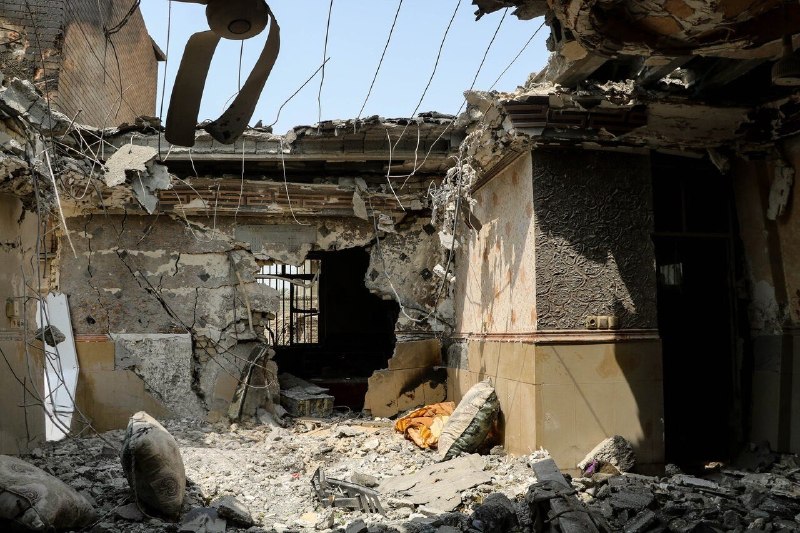
The delegations arrived separately and left little on the record. At 12:50 UTC on 21 June 2026, state-affiliated outlets in Iran began posting the same photograph: an empty corridor, a clutch of waiting journalists, a caption that read, in identical wording, "Waiting for the American delegation to enter the negotiating team of the Islamic Republic of Iran." Tasnim and Mehr — the official and semi-official wires that tend to frame Tehran's diplomatic days in the same way — published the image within four minutes of one another, a small but useful tell of how tightly the messaging is coordinated when the cameras are on.
The session in Muscat is the sixth round of indirect talks between Washington and Tehran, mediated this time by Oman, on the file that has defined the relationship since 2018: enrichment, sanctions, verification, and the question of how much of the original 2015 deal can be salvaged before the technical clock runs out. Both sides continue to describe the talks as "constructive." Neither has put a number on what "constructive" buys them.
The story of this round is less what was said across the table than what was said about the table. The careful choreography of the waiting photograph — Iranian cameramen in position before the American cars arrived — is itself a piece of the negotiation. So is the choice of venue. So is the choice not to issue a joint statement.
What the two sides actually want from a sixth round
Iran's public position, as articulated by its negotiators across the spring of 2026, has narrowed to a recognisable core. Tehran wants sanctions relief that is durable — the lifting of secondary measures that have kept most of Asia's big buyers out of the Iranian crude market, and the unfreezing of foreign-exchange reserves ring-fenced in escrow accounts in third countries. It wants the file managed as a normal non-proliferation dispute, not as a counter-terrorism case. It wants the right to enrich uranium on Iranian soil, under whatever monitoring architecture the parties agree to, but with an explicit ceiling that the International Atomic Energy Agency (IAEA) can verify rather than adjudicate.
The American position, as set out by the lead negotiator in appearances through May, has narrowed in the opposite direction. Washington wants the enrichment programme rolled back from the 60% level — close to weapons-grade — that IAEA inspectors have recorded at Fordow and Natanz, to a level compatible with a civilian fuel cycle. It wants a verifiable inventory of any undeclared nuclear material and a credible mechanism to deal with traces of highly enriched uranium that have appeared in inspections since 2024. It wants restrictions on Iran's missile programme and on its regional proxies folded into the same deal rather than parked in a separate track. And it wants any sanctions relief to be reversible on a defined trigger, so that a future Iranian move does not require a fresh negotiation to re-impose.
These are not new positions. They are roughly the positions the two sides have been trading in writing for the better part of two years, with the technical floor dropping on one side and the political ceiling rising on the other. The question for the sixth round is whether the gap has narrowed enough to make a framework, even a thin one, the rational next step.
Why the wire framing is harder to read than the headline
Western coverage of these talks has, since the spring, settled into a register that emphasises Iranian tactical gains and American strategic patience. The framing rests on a real asymmetry: Iran's enrichment capacity has expanded since the United States withdrew from the Joint Comprehensive Plan of Action (JCPOA) in 2018, while American leverage — sanctions that work — is bounded by the cost of pushing oil prices high enough to alienate allies. The image is one of an Iran that has bought time and a United States that is running out of patience.
That framing is not wrong. It is, however, partial. The Iranian state-aligned wires that dominate Persian-language coverage of the talks frame the same asymmetry in reverse: a United States that has lost the ability to coerce through sanctions, that needs a deal to manage a crisis of its own making in the Strait of Hormuz, and that is negotiating with a state whose regional position has been strengthened rather than weakened by a year of Israeli military action on its borders. The state-aligned frame is, like its Western counterpart, not wrong. Both descriptions of the same negotiation can be true at once. What is missing from most English-language coverage is the Iranian reading in its strongest form, not as regime rhetoric but as a structural argument with a real evidence base — the resilience of oil exports to Asia, the cost to global shipping of any confrontation in the strait, the limits of European will to enforce a maximum-pressure campaign that hurts their own economies.
The Monexus read is that neither frame captures the binding constraint. The binding constraint is verification, not enrichment. The question that has to be answered before any framework is durable is whether the IAEA can be given a mandate and an access regime that both sides are willing to live with, and whether the verification architecture can be rebuilt on a legal base that does not collapse the day an American administration changes. Every round that ends without an answer to that question is, in effect, a round that has agreed to keep talking.
The pattern beneath the choreography
A long negotiation between states that do not formally recognise one another, conducted through intermediaries, in a third country, with both sides releasing a single coordinated photograph and no joint text, is not unusual in international diplomacy. It is, in fact, the standard form for talks between the United States and Iran since 2013. What is unusual about the 2026 cycle is the number of moving pieces that have been added to the file while the talks themselves have stayed in the same lane.
The war in Gaza, the exchanges across the Israel-Lebanon border, and a widening pattern of strikes on Iran-aligned assets in Syria have all continued through the spring. Each side has reasons to suspect that the other is using the talks to buy time for a different kind of move. The Iranian side has reasons to suspect that an American offer made in Muscat could be walked back in a Congressional hearing a week later. The American side has reasons to suspect that a framework agreed in Oman could be overruled by a change in the Iranian leadership's risk calculus after the next round of internal politics. Both suspicions are grounded in recent history. Neither is a reason to walk away from the table.
The deeper pattern is the slow erosion of the assumption that nuclear files can be managed in isolation from the regional security file. The 2015 deal was, in part, a wager that they could be. That wager is now harder to defend. The talks in Muscat are, among other things, an attempt to put the regional file back inside the nuclear envelope — to treat the missile question and the proxy question as items to be settled in the same negotiating room rather than as separate crises for separate negotiators.
Stakes, for the actors and for everyone else
If a framework is reached, the first-order consequence is the release of Iranian oil into a market that is already pricing a tighter supply balance. A durable sanctions relief, even partial, would shift roughly one to one-and-a-half million barrels a day of Iranian crude back into formal channels, depending on the architecture of the relief. That is enough to matter for the price at the Asian benchmark, and therefore for inflation expectations across the importing world. The second-order consequence is political: an Iranian government that has framed the post-2018 sanctions regime as economic warfare would have a deliverable to show for the pain, and a regional standing that the post-2018 order denied it.
If the talks fail, the consequences are not symmetric. A failed round for Iran means a return to a managed crisis that it has, on the evidence of the last two years, learned to live with. A failed round for the United States means a decision about whether to escalate through pressure — secondary sanctions tightened, inspections restricted, the option of a kinetic move kept on the table — or to accept a slow drift toward a threshold capability that no negotiation has managed to push back. The cost of failure is higher for Washington than for Tehran, for the simple reason that Iran already lives in the world the failure would produce, and the United States does not.
The honest answer to whether the sixth round will produce a framework is that the public evidence does not support a confident call. The state-aligned wires out of Tehran have an interest in framing each round as a step forward; the Western wires have an interest in framing each round as a window that is closing. The verifiable signal — what the IAEA says in its next quarterly report, what the Iranian negotiator says in the only press conference that matters, what the American lead negotiator confirms to Congress on the record — is not yet in. Until it is, the photograph of the waiting corridor is the most honest image of the talks: both sides in the building, neither yet at the door.
Desk note: Monexus has run this piece against the Iranian state-aligned wires first, to read the framing in its strongest form before overlaying the Western wire line. The state-aligned photograph and caption are treated as a primary source, with explicit sourcing caveat. Western wire coverage of these talks is cited where it adds verifiable technical or procedural detail; where it offers only framing, the framing is named in the prose rather than borrowed. The structural argument — that verification, not enrichment, is the binding constraint — is Monexus's own read, drawn from the pattern of what has and has not moved across the last four rounds.
Wire provenance
This editorial synthesis draws on the following public wire/social posts:
- https://t.me/mehrnews
- https://t.me/JahanTasnim
- https://t.me/tasnimnews_en
Follow the event.
These dated source records provide context. They do not retrospectively verify this archive article.
Separate what the nuclear watchdog reported from what it could not determine after the June 2025 strikes.