Britain's revolving door hits seven: Starmer's exit and the case for stability
Keir Starmer's resignation sets Britain on course for a seventh prime minister in a decade — a record that should embarrass the political class more than it does.
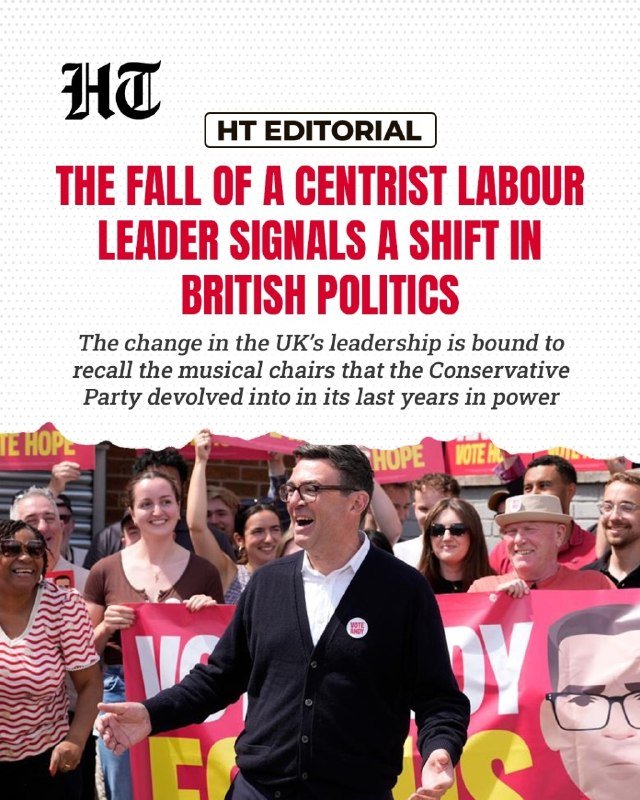
Keir Starmer walked out of 10 Downing Street on the morning of 22 June 2026 and did what an increasing number of his predecessors have done in this decade: he announced he was leaving the job. A new Labour leader, and with them a new prime minister, is expected to be in place by September.
That is the headline. The subheadline is the one Westminster would rather not print. Britain is now on course for its seventh prime minister in ten years — a figure that should embarrass the political class more than it does, and that the commentariat is already spinning as proof of resilience rather than what it plainly is: a serious failure of statecraft.
The arithmetic of instability
The claim doing the rounds, repeated across prediction markets and aggregator feeds on 22 June, is precise enough to be worth examining rather than retweeting. Seven prime ministers in ten years is not a story about any one of them. It is a structural story about a Westminster system that has forgotten how to govern, and about a political culture that treats the resignation of a sitting leader as a routine news cycle rather than a national emergency.
The pattern is familiar. A leader is installed on a wave of expectation. They inherit a brief that is too large for any individual — fiscal consolidation, NHS reform, housing supply, energy security, the post-Brexit trade settlement, an aggressive industrial strategy. They fail to deliver quickly enough, or in the precise shape their backbenchers demanded. Their party turns. They leave. A new leader arrives with a fresh mandate and the same impossible brief, and the cycle repeats. Each handover consumes roughly six months of political oxygen that ought to be spent governing. The cumulative cost is not measured in prime ministers; it is measured in stalled legislation, in industrial strategy documents that gather dust between leadership contests, in markets that price British sovereign risk at a premium that would have been unthinkable in 2015.
The counter-narrative — that this churn is democracy working, that parties are correcting their mistakes, that the public gets more choices — does not survive contact with the evidence. A system that changes leader every eighteen months on average is not a system correcting itself. It is a system consuming itself.
The structural frame, plainly stated
What we are watching is a regime that has decoupled political time from policy time. Economic decisions — particularly in energy, in housing, and in the capital-intensive bits of the net-zero transition — operate on ten-to-twenty-year horizons. Political decisions in the United Kingdom are now operating on roughly eighteen-month horizons. The two timescales cannot be reconciled by any individual occupant of Downing Street, however talented. The problem is the system, not the people inside it.
This is not a uniquely Conservative disease, although the Conservatives caught the worst of it. The pattern has now crossed the floor. A Labour leader, elected in 2024 on an explicit mandate for stability, has followed the same exit route as his predecessors. The fix-term parliament, introduced in 2011 precisely to prevent this kind of churn, has been functionally neutered by the willingness of parties to change leader between elections. The constitutional architecture designed to produce stability has been outflanked by the conventions of party management, and nobody in the Palace of Westminster has an incentive to change it.
The markets have noticed. The prediction-market reading on 22 June — that the next leadership transition is a near-certainty rather than a probability — is itself a signal. Capital is not pricing in another orderly handover. Capital is pricing in more churn.
Counterpoint: what the defenders say, and why it doesn't hold
The defenders of the present arrangement have a case worth steelmanning. They argue that the prime-ministerial churn of the 2020s is a response to genuinely changed circumstances — a pandemic, an energy shock, a war on the European continent, a cost-of-living crisis — and that parties are simply adjusting their leadership to changing conditions. A flexible system, on this reading, is a robust one.
There is something to that. But the defence is too convenient. Britain has had fewer genuinely exogenous shocks than most of its peer economies over the same period. The bigger shock has been self-inflicted: Brexit, the gilt-market incident of 2022, the Truss mini-budget and the subsequent credibility collapse, the chronic under-investment in public infrastructure that predates any of the recent leaderships. A system that responds to its own mismanagement by changing the manager is not a flexible system. It is a serial underperformer with good crisis communications.
The other defence — that the new prime minister will be a fresh start — is also worth naming only to dismiss. Fresh starts are what the last six leaderships were, in their own time. There is no evidence in the recent record that another fresh start produces anything other than another eighteen months of churn.
Stakes, and what the next occupant cannot fix alone
If the trajectory continues, Britain will close the decade with the weakest growth, the lowest business investment, and the most volatile leadership of any G7 economy. That is the stake. It is not a question of which Labour MP takes the keys to Downing Street in September. It is a question of whether the British state can hold a policy line for longer than the attention span of a news cycle.
The incoming prime minister will face the same brief as the outgoing one, and the one before that. They will be given eighteen months. They will not be given more, because the system will not allow it. Until the conventions of party management are themselves reformed — fixed terms enforced, leadership contests rationed, manifestos given statutory weight — no individual occupant of the building on the other side of the road can deliver the kind of long-horizon policy the country requires.
The serious point, the one that should survive the cycle: Westminster's institutions were designed in an era of two-party politics, broad ideological consensus on the basic shape of the state, and patient capital. None of those conditions hold in 2026. The system has not been updated. The churn is the symptom. The disease is the mismatch between a Victorian constitution and a twenty-first-century policy agenda.
What remains uncertain
The thread feeds on which this article draws are consistent on the basic fact — resignation, succession timeline, the seventh-in-a-decade framing — and offer little on the substance of the handover. They do not name a successor, do not report a shadow-cabinet reaction, and do not specify whether the outgoing prime minister intends to stay on as party leader until September or step down immediately. The market read of the next eighteen months is, by its nature, an extrapolation rather than a forecast. The constitutional point stands regardless of which Labour MP is sitting in the chair by October. The arithmetic of seven-in-ten does not require a name to be true.
Desk note: the wire led on the resignation and the timeline; the structural read — that this is a system problem, not a personnel problem — is Monexus's own, and is offered as the framing a serious observer of Westminster would now be expected to provide.
Wire provenance
This editorial synthesis draws on the following public wire/social posts:
- https://x.com/unusual_whales/status/2138000000000000001
- https://x.com/polymarket/status/2138000000000000002
- https://t.me/s/cointelegraph/2138000000000000003