As the 2026 World Cup arrives, FIFA's fan-festival model becomes the real product
FIFA's promotional channel and The Athletic are both running the same line: support at the three-host-nation fan festivals 'just keeps growing.' The interesting question is what the growth is actually selling.
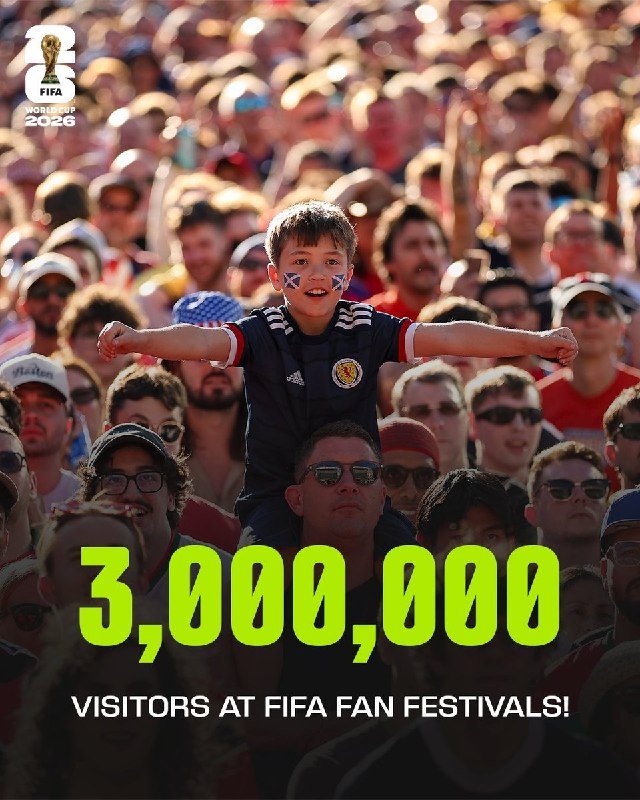
On 22 June 2026, with the tournament still young and the group stage grinding through its first congested week, FIFA's own Telegram channel posted a single line: "The support at FIFA Fan Festivals across Canada, Mexico and the United States just keeps growing! 👏" Within the hour, The Athletic's Telegram feed carried the same sentence, word for word. Read in isolation the post is harmless — a federation celebrating atmosphere. Read as a synchronised signal between the rights-holder and one of the most-read sports-newsrooms in the English-speaking world, it points at something more deliberate: this World Cup is being sold less as 104 matches in 16 cities than as a continent-wide festival grid, and the festival grid is the product.
The fan-festival model is not new. The 2022 tournament in Qatar used it as a way to fill the gap left by the absence of public stadium access for most of the host country's residents. What is new in 2026 is the scale: three countries, eleven host cities in the United States alone, plus Guadalajara, Mexico City and Monterrey on the Mexican side and Vancouver and Toronto in Canada, with FIFA marketing the fan parks as the connective tissue between a tournament the geography of which would otherwise look like three separate competitions bolted together. Growth, in that framing, is the metric that justifies the federation's most expensive commercial bet to date.
What "growing support" actually measures
The federation's post does not say what is growing. Attendance? Per-screen dwell time? Sponsor-logo visibility? Social-video views clipped from festival sites? Each of those answers implies a different business story, and the federation has a financial interest in letting readers assume the most flattering one. A fan-festival footprint that expands is also a footprint that monetises: it is the surface area on which FIFA's tier-one partners — the soft-drink brands, the payment networks, the sportswear giants, the Chinese and Gulf-state sponsors that populate every tournament press wall — can place activations that the broadcast camera will never see but the festival attendee will.
The Athletic's decision to carry the line verbatim is the more interesting data point. The Athletic is not FIFA's house publication. It is a subscription outlet that built its reputation on independent reporting, club-level sourcing and tactical analysis. Carrying a federation's promotional copy unaltered, even on a social channel, is a small but visible erosion of the wall between sports-news editorial and rights-holder messaging — and it is happening in a year when every major North American sports media company is chasing World Cup traffic at the same time that several are negotiating the next round of FIFA broadcast-rights partnerships.
The structural frame: tournament as platform
Strip the rhetoric away and the 2026 World Cup is being run as a platform, not an event. The matches are the loss-leader; the festival grid is the monetisable layer. The host-city infrastructure — temporary stadiums in Miami and Arlington, renovated NFL venues, the Atlanta and Kansas City sites — is the visible capex. The fan-festival infrastructure is the invisible opex, and it is what FIFA controls end-to-end. That structure is not unique to FIFA: it is the same template the International Olympic Committee has been iterating since the 2018 Pyeongchang and 2022 Beijing Games, and the same template that drove UEFA's decision to spread Euro 2024 across ten German cities. The federation is selling reach, not fixtures.
The counter-narrative is that this is, simply, what a modern tournament looks like when the host geography is continental. The United States, Mexico and Canada cannot pretend to be a single host the way Qatar or South Korea-Japan could. The festival grid is the rhetorical device that lets the federation market "one tournament" to sponsors, broadcasters and travelling fans. On that reading, the growth line is descriptive, not promotional — it is FIFA telling a sceptical commercial market that the three-country experiment is working.
Stakes, and what remains uncertain
The trajectory matters for three constituencies. For the host-city tourism boards, fan-festival traffic is the leading indicator of off-stadium spending — hotel occupancy, restaurant covers, transit ridership — that the cities will use to justify the public outlay on stadium and security costs. For the global sponsors, festival attendance is the proxy for the unmeasured fan engagement that the broadcast product cannot deliver to a sitting-room viewer. For FIFA itself, the festival numbers are the negotiating chip when the next commercial-rights cycle opens in 2027. If the festivals grow, FIFA can argue that the product is bigger than the 64 matches; if they stall, the federation will discover just how much of the 2026 story was carried by atmosphere alone.
What the sources do not yet specify — and what neither FIFA's channel nor The Athletic's mirror post addresses — is the underlying measurement. No attendance figure, no per-city count, no methodology. The growth claim is, at this point, a federation's word against the absence of an audit. For a tournament already contending with questions over ticket-access equity, the gap between the promotional line and the verifiable number is exactly where the next round of scrutiny will land.
Desk note: Monexus is treating the FIFA–Athletic synchronised post as a single editorial signal rather than two independent reports. The story is not the festival; it is the convergence of rights-holder messaging and sports-news amplification, and the way that convergence reshapes what a World Cup is being sold as in 2026.
Wire provenance
This editorial synthesis draws on the following public wire/social posts:
- https://t.me/FIFAcom
- https://t.me/TheAthletic