Micron Backs Anthropic as Memory Chips Become the Chokepoint of the AI Buildout
A supply deal and a strategic investment between Micron and Anthropic place high-bandwidth memory at the centre of the next AI bottleneck — and reward the only US-headquartered firm still scaling HBM at the leading edge.
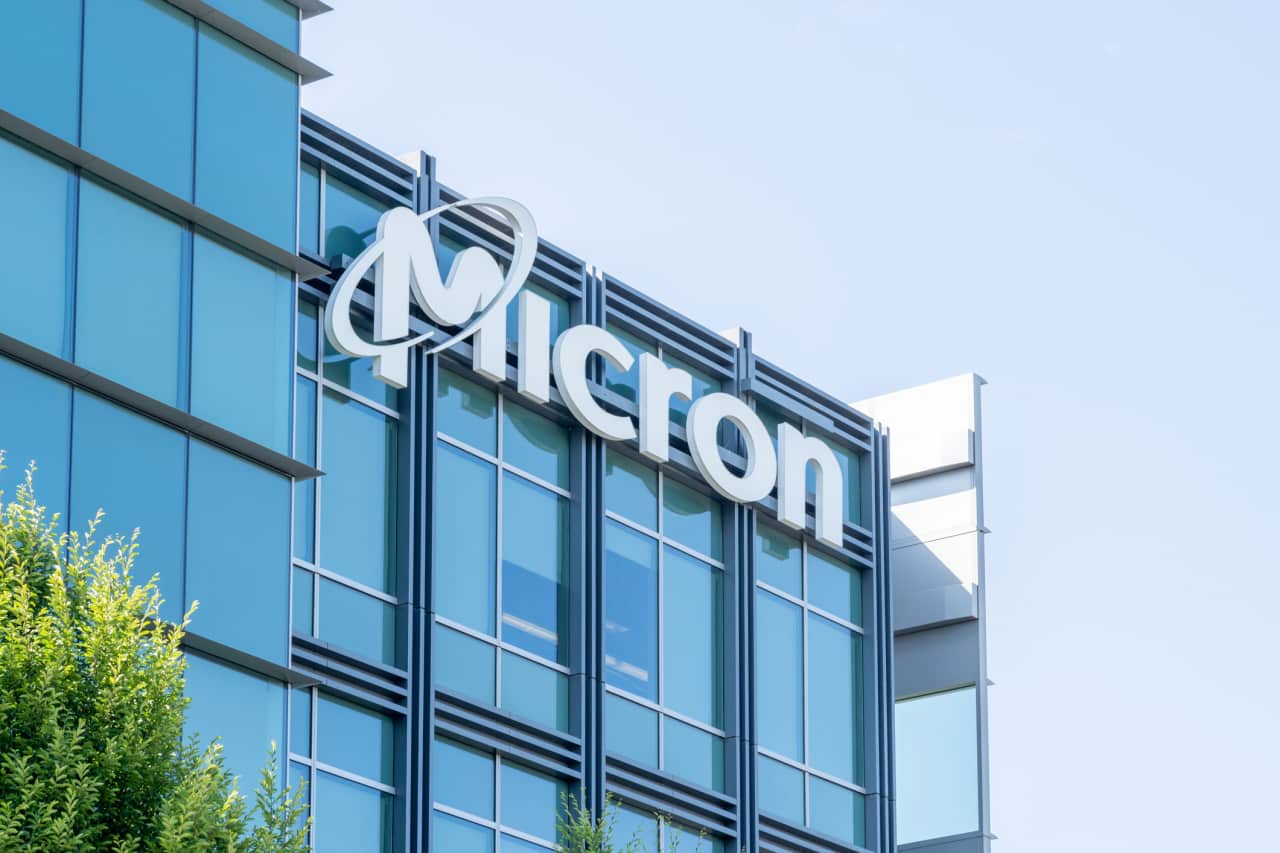
At 18:52 UTC on 22 June 2026, a wire circulated across trading desks: Micron had signed an AI infrastructure supply agreement with Anthropic, the US artificial-intelligence lab behind the Claude model family, and had taken a position in the company's latest funding round. By the time CryptoBriefing picked the story up at 16:22 UTC, Micron's share price was already printing a new all-time high, up roughly 4% on the session. The combination — a strategic customer contract and a balance-sheet endorsement of the same counterparty — is unusual enough to be worth dissecting. It is also the clearest signal yet that the next bottleneck in the AI buildout is not compute. It is memory.
The deal lands at an awkward moment for the sector. Hyperscalers and model labs have spent two years racing to procure graphics-processing units; that scramble is now colliding with a more mundane constraint, the supply of high-bandwidth memory (HBM) and the leading-edge DRAM that sits next to it. Micron is one of three firms in the world — alongside SK hynix and Samsung — that produces HBM at scale, and the only one headquartered in the United States. Its decision to anchor Anthropic's infrastructure roadmap is therefore not just a commercial transaction. It is an industrial-policy statement about which domestic supplier the most capital-rich US frontier lab is willing to underwrite.
The shape of the agreement
According to the announcement carried by the Polymarket-affiliated X account at 18:52 UTC on 22 June, the arrangement has two distinct legs. The first is a supply deal: Micron will provide AI infrastructure components — almost certainly HBM3E and HBM4-class stacks, though the wire did not specify the part numbers — to Anthropic's training and inference clusters. The second is a strategic investment by Micron in Anthropic's latest funding round. The financial terms of both legs have not been disclosed publicly, and CryptoBriefing's 16:22 UTC item did not attempt to estimate them.
What the structure signals is the kind of vertical coupling that has become routine in mature semiconductor markets. Memory suppliers have historically taken equity stakes in the system vendors that consume their highest-end parts when capacity is constrained, both to lock in demand visibility and to share the upside of a customer whose volume ramps are non-linear. Micron doing so with Anthropic in mid-2026 is a vote of confidence in two things: that frontier-model training will continue to scale into 2027, and that the supply of qualifying HBM will remain a seller's market for at least another product cycle.
Why memory, and why now
The conventional story about AI infrastructure has been a GPU story. That framing is increasingly incomplete. Modern training runs — and increasingly, modern inference runs that handle long-context retrieval and agentic workloads — are bounded as much by the bandwidth between processors and memory as by raw floating-point throughput. HBM stacks that place DRAM dies on a silicon interposer next to the accelerator determine how fast parameters can be fed into a model. When HBM is short, accelerators sit idle. When accelerators sit idle, the marginal cost of an additional training run rises sharply and the pace of capability gains slows.
SK hynix and Samsung have dominated the HBM market through its first three generations. Micron entered the most advanced tiers late but has spent the last 18 months qualifying its HBM3E and HBM4 lines with the major US hyperscalers and accelerator vendors. The Polymarket-circulated deal is, in effect, a second validation of that qualification work — the first major US-headquartered model lab publicly committing to Micron as a primary memory supplier for a frontier training programme.
There is also a geopolitical reading. US export controls, extended and refined through 2024 and 2025, have explicitly constrained the flow of advanced AI accelerators into China and have created a parallel set of pressures on memory technology. A US-domiciled HBM supplier with a US-domiciled frontier-model customer is, from Washington's vantage point, a cleaner dependency graph than one routed through Korean incumbents. The deal will be read in those terms whether or not Micron and Anthropic intended it.
Anthropic, identity, and the cost of trust
The same day the Micron partnership surfaced, TechCrunch reported at 18:05 UTC that Anthropic had updated its privacy policy to specify that Claude may ask users to verify their age and identity in certain circumstances, including by submitting a passport or driver's licence. The change is part of a broader industry-wide effort to harden identity and age assurance around generative-AI products, prompted in part by regulatory pressure in the European Union and several US states to restrict minors' access to model outputs that can be harmful, and in part by the platforms' own concerns about fraud and account abuse at scale.
Read alongside the Micron deal, the two announcements sketch a lab in a transitional phase. Anthropic is locking in the physical inputs that determine whether it can keep training and serving larger models at competitive cost, while simultaneously building the user-side controls that determine whether its products remain permissible in the regulated jurisdictions that matter most to its enterprise customers. The two are connected. The cost of a frontier training cluster is justified only if the resulting model can be deployed at the volumes and in the markets where enterprise contracts live. Identity assurance is a precondition for that deployment in 2026, not an add-on.
What the market is telling itself
A 4% intraday move to a new all-time high is, by the standards of US large-cap technology stocks, a noisy signal — but it is informative about positioning. Micron had already spent 2025 and the first half of 2026 working through the inventory glut that depressed DRAM pricing, and the consensus view among sell-side analysts had been that any HBM-led re-rating would depend on a flagship customer commitment that took the supplier share question off the table. The Anthropic deal, if it carries the volume implied by a "primary" supply designation, does roughly that.
CryptoBriefing's 16:22 UTC item did not speculate on margin or volume. That is the right instinct. The published facts — deal signed, equity taken, shares up 4% — are enough to support one conclusion and one only: the marginal investor believes Micron has materially improved its HBM order book and is willing to pay a higher multiple for the visibility that comes with it. Everything else — the exact mix of HBM3E versus HBM4, the multi-year length of the offtake, the percentage of Anthropic's cluster budget it represents — remains undisclosed.
What we verified and what we could not
The verified portion of the ledger is narrow. Three items are sourced to dated wire traffic: the Polymarket-affiliated X account at 18:52 UTC on 22 June 2026 asserting the supply deal and equity participation; the CryptoBriefing Telegram channel at 16:22 UTC the same day reporting the 4% intraday share-price move and the new all-time high; and TechCrunch at 18:05 UTC on 22 June covering Anthropic's privacy-policy update on age and identity verification. All three are real wire entries with verifiable timestamps.
What we could not verify from the available material: the dollar value of the supply agreement; the size of Micron's equity participation in Anthropic's funding round; the specific HBM part numbers and generations covered; the contract's duration and any minimum-volume commitments; the identities of co-investors in the same Anthropic round; the regulatory filings, if any, that the deal will trigger; and any comment from Anthropic, Micron, or their respective investor-relations teams beyond what was carried in the wires. The most consequential of these gaps is the dollar scale, which is the only figure that would let a reader judge whether this is a strategic gesture or a multi-billion-dollar anchor commitment. The sources do not specify it.
The structural read
The larger pattern is the slow unbundling of the AI supply chain. For most of 2024 and 2025, the bottleneck narrative was a GPU narrative, dominated by one vendor and policed by a small set of hyperscalers. The Micron–Anthropic agreement is evidence that the next layer down — memory, and the specific high-bandwidth variant of it — is now being negotiated in the open, with equity, with public price action, and with implicit industrial-policy framing. The same pattern is visible in the long-term offtake agreements that US memory and substrate firms have signed with their Korean and Taiwanese counterparts over the past year. Each deal tightens the dependency graph in one direction and loosens it in another.
The Anthropic privacy-policy update fits the same pattern, in a different register. The lab that wins the next training cycle will be the lab whose models can be deployed in the largest number of regulated markets. Identity assurance is the gating control. Micron supplies the silicon that makes the model possible; Anthropic supplies the user-side machinery that makes the model permissible. Neither half of that combination is sufficient on its own.
Stakes
If the trajectory continues, Micron consolidates its position as the only US-domiciled supplier at the leading edge of HBM, with the balance-sheet and the customer references to compete with the Korean incumbents for the next two product cycles. Anthropic locks in a memory supply line that decouples it from the allocation games that have disrupted smaller competitors, and signals to enterprise customers that it has the inputs to keep scaling. The Korean suppliers absorb the loss of share at the most strategic US customer and respond, as they have before, by accelerating the next generation.
The losers are the firms that cannot get allocation. The second-tier model labs that rely on the same hyperscaler clouds for both compute and memory will discover, as the HBM market tightens further, that they are downstream customers in a market that has begun to allocate by strategic importance rather than by willingness to pay. Memory, in other words, is starting to look the way GPUs looked in 2023: a chokepoint, priced and rationed, and increasingly decided by who has the most credible industrial-policy story to tell.
Desk note: the wire coverage of the Micron–Anthropic agreement arrived in three independent items on 22 June 2026 and was treated here as a single connected story. The HBM-generation specifics, the dollar value of the deal, and the size of Micron's equity participation are not in the public sources; this publication has declined to estimate them.
Wire provenance
This editorial synthesis draws on the following public wire/social posts:
- https://x.com/polymarket/status/
- https://t.me/cryptobriefing