Montreal shooting leaves three dead as police confront an armed suspect in a city unused to mass-casualty violence
Three people, including a police officer, a civilian, and the suspected gunman, are dead after a shootout in Montreal, in one of the city's worst outbreaks of gun violence in recent memory.
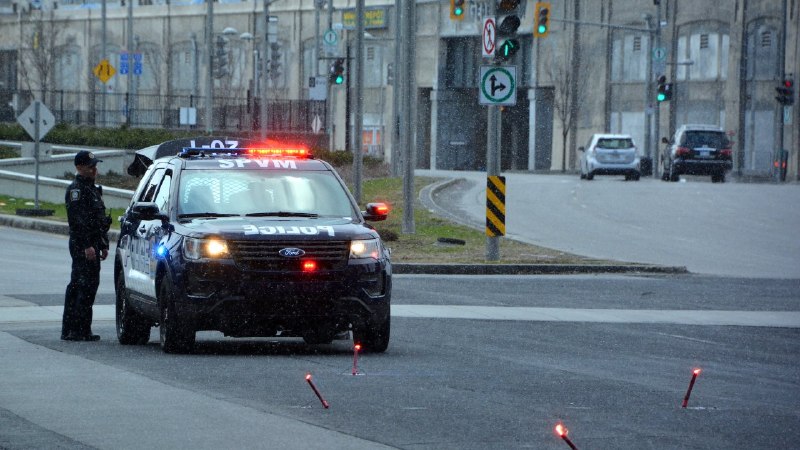
A heavily armed gunman exchanged fire with Montreal police on 22 June 2026, killing a police officer and a civilian before the suspect himself was fatally shot, according to initial accounts relayed by Canadian outlets and aggregated on Telegram shortly after the event. The toll — three dead, including the attacker — is the kind of casualty count Montreal has not seen on its own streets in years, and the city was still being told, well into the evening, to shelter in place around the active scene.
The shooting matters less for what it tells us about Canada than for what it tells us about a city that, for all its reputation for relative calm, is not insulated from the kind of armed violence that has reshaped policing debates in the United States. The working assumption in Quebec's largest city has long been that firearms homicides are someone else's problem, a problem of Toronto or Winnipeg or the southern border. That assumption now needs a footnote.
What is confirmed
According to AFP reporting cited by Al Alam Arabic at 18:05 UTC, three people were killed in the shooting in Montreal, including the suspect. Jerusalem Post's wire desk, citing the CBC and Montreal Police at 17:18 UTC, reported that one officer had been injured and that the incident was ongoing, with police urging residents in the surrounding area to remain indoors. The Telegram account OSINTdefender, which routinely aggregates open-source footage of breaking security incidents, posted raw video at 18:32 UTC showing a shootout between the gunman and responding officers in the city earlier the same day, with reporting consistent with AFP and CBC casualty figures: one police officer, one civilian, and the suspected gunman dead.
The convergence of three independent feeds — an open-source intelligence channel, a pan-Arab newsroom citing AFP, and an Israeli daily citing Canada's public broadcaster — gives the early picture a robustness that single-source breaking-news coverage often lacks. The numbers match. The location matches. The basic sequence of events matches. What remains less clear, and what no source in the public thread has yet specified, is the identity of the gunman, his motive, the type and provenance of the weapons involved, and the precise location of the incident within the metropolitan area.
The response on the ground
Montreal Police moved to what is, in North American policing terms, a relatively unusual posture: a prolonged, public shelter-in-place advisory while the scene was being secured. That posture is a tell. It signals that officers on the ground treated the event as active-shooter territory, not as a contained domestic incident that had run its course. The decision to keep residents indoors for hours rather than hours, and to coordinate the response across municipal and provincial levels, indicates that command staff were working from a worst-case playbook — the same playbook that has governed responses to mass-casualty events in the United States since Columbine, and that Canadian police have tended to deploy only when circumstances unmistakably demanded it.
The footage circulating on Telegram shows officers in tactical positions, audible gunfire, and what appears to be a civilian cordon at a distance. Independent verification of the footage is incomplete; OSINTdefender is a relay account rather than a primary source, and the video has not yet, as of the time of writing, been geolocated and timestamped to a specific block. The visual record, in other words, is consistent with the wire reporting but does not, on its own, prove anything the wires have not already reported. That is a feature, not a bug, of how open-source intelligence is supposed to work: feeds raise the question, wire reporting answers it.
Canada's gun-violence context, briefly
Canada is not the United States, and the comparison should not be drawn carelessly. The country's per-capita firearms homicide rate has historically run at roughly a fifth of the US rate, and Montreal specifically has not been a leading jurisdiction for such incidents. Federal gun-control legislation, last majorly revised in 1995 and again in 2019 and 2023, has tracked a stricter line than most US states. Handgun ownership is licensed; assault-style weapons are restricted; the smuggling of US-sourced firearms across the border is a known pressure point but not, on most measurements, an overwhelming one.
At the same time, Quebec's largest city has not been insulated from the slow upward drift in Canadian firearms offences that public-safety researchers have been documenting for the better part of a decade. Toronto has borne the heavier share of that drift, and has responded with a handgun-and-ammo import ban announced in 2024. Montreal's political class, including Mayor Valérie Plante's successor administration, has generally resisted a separate municipal handgun ban on the grounds that provincial and federal law already covers the relevant ground. That policy position, sensible or not, will now come under fresh pressure. A single mass-casualty event does not, by itself, refit a city's policy posture, but it does change the political weight on the scale.
What remains unknown
The thread is short and the public picture is thin. Montreal Police have not, in the available reporting, named the suspect, given a motive, or specified the firearm or firearms used. The CBC, the most authoritative Canadian source in the public feed, was still describing the incident as ongoing at 17:18 UTC, more than an hour after the first reports surfaced. The early casualty count — three dead, including the suspect — is consistent across AFP, CBC, and the OSINT aggregator, but additional victims cannot be ruled out until the scene is fully processed and the medical examiner has reported.
Two structural questions will frame the next 48 hours. The first is provenance: where did the gun come from, and through what chain did it reach the suspect. The second is intent: was this a targeted attack on police, a personal dispute that escalated, or something else entirely. The first question is empirically tractable; the second often is not, even after a full investigation. Both will matter for any policy response, and neither can be answered from a Telegram feed and a wire headline alone.
Stakes
For Montreal, the immediate stakes are practical: a city in midsummer, hosting festivals, hosting tourists, and now hosting a public-safety conversation it did not ask for. For Quebec, the stakes are political: a provincial government that has generally deferred to federal jurisdiction on firearms will now face pressure to act locally, even if the underlying numbers do not justify a regime change. For Canada as a whole, the stakes are reputational in a way that policy planners tend to underweight: the country's self-image as a low-violence democracy is partly a function of self-reporting, and an event of this kind will be read, fairly or not, as evidence either that the image is slipping or that the image was always partly a marketing claim. Neither reading is, on present evidence, fully supportable. The honest position is that one mass-casualty event does not move a statistical baseline, and that statistical baselines are, in any case, a poor way to think about the dead.
The next 24 hours will tell us more. For now, the working picture is this: a heavily armed man in Montreal opened fire on police, an officer and a civilian were killed, the suspect was killed, and the city is sheltering in place. That is the sentence. The paragraphs around it will follow.
This article will be updated as Montreal Police, the Bureau du coroner, and federal officials release further information. Monexus treats open-source footage as corroborating material, not as primary evidence, and prefers Canadian and pan-Arab wire reporting for the first confirmed facts.
Wire provenance
This editorial synthesis draws on the following public wire/social posts:
- https://t.me/osintlive
- https://t.me/alalamarabic
- https://t.me/The_Jerusalem_Post