Moscow air defence scrambles as Ukrainian drone salvo hits refineries and airports
Russian authorities briefly halted flights into several Moscow airports in the early hours of 22 June 2026 after a wave of Ukrainian drones penetrated the capital's air defences, days after a separate strike hit the city's oil refining capacity.
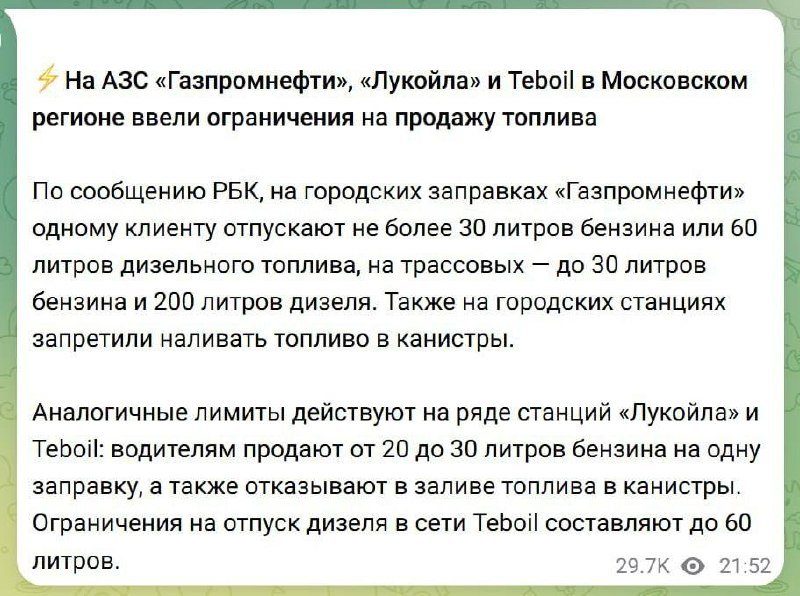
Russian air-defence units shot down dozens of drones over Moscow and the surrounding region in the early hours of 22 June 2026, and local authorities briefly suspended flights into several airports, according to wire and Russian official reporting. The salvo landed days after a separate Ukrainian strike hit an oil refinery in the Russian capital, and it came as Moscow accused Kyiv of an overnight ballistic-missile and drone barrage against Ukrainian cities.
What is unfolding, on the evidence available at 06:00 UTC on 22 June, is not a single dramatic strike but a sustained exchange of deep-penetration strikes in which each side is now reaching regularly into the other's rear. The pattern — Russian ballistic missiles and Shahed-type drones against Ukrainian cities, and Ukrainian long-range drones and loitering munitions against Russian energy and transport infrastructure — is reshaping the geography of the war. The capital of the invading power is now, in operational terms, a frontline city.
What Moscow said, and what Kyiv said
Russian authorities, as relayed by Reuters, reported that air-defence units had destroyed dozens of drones over Moscow and the Moscow region in the early hours of 22 June and that flights into several of the capital's airports had been suspended as a precaution. The Russian statement framed the operation as a defensive success; the practical effect was a multi-hour disruption of civil aviation serving a city of more than 13 million people.
On the Ukrainian side, the public-facing hromadske newsroom reported at 05:44 UTC that Russia had struck Ukraine overnight with an Iskander-M ballistic missile and 88 strike UAVs, and that Ukrainian air-defence forces had neutralised 79 of those drones, with a missile and five attack UAVs recorded as having hit their targets. The figures, attributed to the Ukrainian air force, are not independently verifiable in real time, and Russian-aligned channels would be expected to give a different count; what is consistent across the two sides' public claims is that both are being hit, and that both are claiming to be hitting back.
The asymmetry is real and runs in both directions. Russia is firing ballistic missiles and dozens of Iranian-designed long-range drones at Ukrainian cities; Ukraine is firing smaller, cheaper airframes at Russian refineries, military airfields and air-defence nodes, often hundreds of kilometres from the front line. The two campaigns differ in cost, in payload, and in the political weight of the targets they are choosing — but they are now running on overlapping timelines.
The targeting logic: refineries, airfields, and the question of pressure
The drone wave that briefly closed Moscow's airports followed a separate, earlier Ukrainian strike on an oil refinery inside the Russian capital, which Reuters reported in the preceding days. The sequence is consistent with a discernible Ukrainian targeting logic: degrade Russia's fuel production for both military and civilian use, and stretch Russian air-defence coverage by forcing Moscow to defend multiple axes at once. A city whose residents were told, for the first 18 months of the war, that the conflict was contained to the south and east is now subject to routine aerial harassment.
Russian state messaging, in parallel, has been trying to keep that fact off the front pages. The pattern, familiar from earlier coverage of strikes on Belgorod and the Kerch bridge, is to absorb each incident with a confident statement about air-defence performance, then to move the camera on. There is no suggestion in the available reporting that the latest salvoes will change that script. But the script is doing more work each month, and the question of how long the Russian public is prepared to read it as a string of separate, containable events — rather than as a structural shift in the war — is now live in a way it was not a year ago.
Counterpoint: the read that downplays the strikes
The sceptical read, the one Moscow's foreign-facing channels prefer, is that the drones are nuisance strikes with limited military effect, that Russian air-defence is performing as designed, and that the airport suspensions are a temporary inconvenience rather than a strategic signal. There is something to that: a refinery strike that knocks out a few distillation columns is not the same as a strike that puts a refinery permanently offline, and a city that is briefly closed to civil aviation is not the same as a city that has lost its air-defence umbrella. Russian officials have an interest in framing each night as a victory, and there are reasons, on the evidence, to take that framing partly seriously.
But the cumulative picture is harder to dismiss. The capital's oil refining capacity has now been hit; the capital's airports have now been suspended; and the tempo of Ukrainian deep strikes has been trending up, not down, over the past quarter. The dominant framing — that Russia is winning the strategic war and absorbing the deep strikes without consequence — does not account for the fact that the strikes are now landing closer to the centre of Russian political life, and on a more regular cadence, than at any previous point in the conflict.
What remains uncertain
The exact number of drones that crossed into Russian airspace overnight, the number actually shot down, and the targets that were hit are all contested. The Russian count tends to emphasise interceptions; the Ukrainian count, when it is available, tends to emphasise the strikes that got through. The two sets of numbers cannot both be complete pictures, and a third independent count — from satellite imagery, from Russian regional emergency-services reporting, or from open-source investigators on the ground — is not in the public record for this latest wave at the time of writing. Reuters's reporting, drawn from Russian official sources, is the most credible current wire account, but it is necessarily Moscow's framing of Moscow's performance.
What is not in dispute is the direction of travel. Ukrainian long-range strike capacity is increasing. Russian air-defence is being forced to defend a wider and more politically sensitive perimeter. And the night of 21–22 June 2026 was, on the public record, one of the more visible illustrations of that fact so far.
Stakes
If the trajectory continues, the political pressure inside Russia compounds even if the military cost does not: the war is now visibly arriving in Moscow, not just in Belgorod, not just in Rostov, not just in the border oblasts. For Kyiv, the strategic question is whether strikes of this kind shorten the war, harden Russian public opinion behind the war effort, or both. The early evidence from this latest wave will be in the Russian official response and in the next round of Ukrainian deep strikes, both of which, on the pattern of the last twelve months, will not be long in coming.
Desk note: Monexus has treated the overnight exchange as a paired event — Russian strikes on Ukrainian cities, Ukrainian strikes on Russian infrastructure — rather than as two disconnected stories, because the evidence indicates they are now operating on a shared tempo. Russian-aligned claims about the air-defence outcome are reported with attribution; they are not adopted as the article's frame.
Wire provenance
This editorial synthesis draws on the following public wire/social posts:
- https://t.me/TSN_ua
- https://t.me/hromadske_ua
Follow the event.
These dated source records provide context. They do not retrospectively verify this archive article.
A dated voting record is evidence of one decision. Use the original UN record before turning it into an alignment label.
Visual explainer · historical vote of 2022-03-02 →