Qatar Brokers a New Round of US–Iran Talks in Lucerne as the Gulf Mediation Track Returns to Centre Stage
Doha confirms a first round of US–Iran negotiations hosted in Switzerland, with Vice President JD Vance and Jared Kushner in the room and the Qatari prime minister shuttling into the small hours.
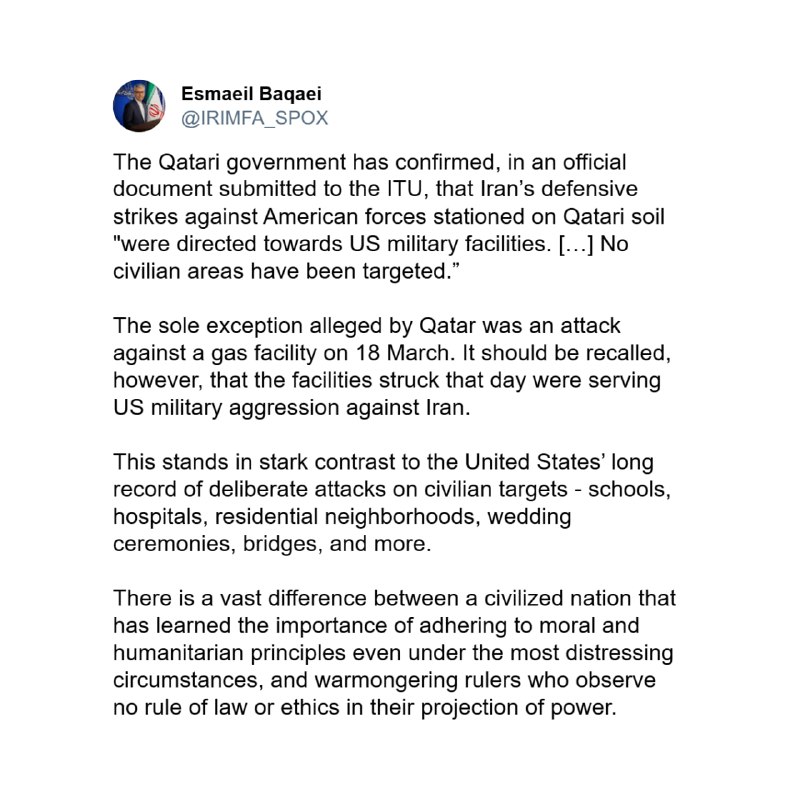
The negotiations began in a small Swiss city and ended, for the night, with a Qatari-mediated handshake that almost did not happen. On 21 June 2026, in Lucerne, the first formal round of talks between the United States and the Islamic Republic of Iran concluded after several hours of late-night diplomacy, with Qatari Prime Minister and Foreign Minister Mohammed bin Abdulrahman bin Jassim Al Thani shuttling between delegations and posting, in the small hours, a photograph of himself alongside U.S. Vice President JD Vance and the president's son-in-law, Jared Kushner. The Qatari foreign ministry confirmed the round in a statement carried by Iranian and regional wires, and Iran's foreign ministry framed the meeting as a first, partial step. The diplomatic choreography was delicate: a Gulf monarchy hosting two adversaries on Swiss soil, with the most visible American face in the room a vice president whose portfolio now visibly extends to Middle East peacemaking, and a presidential envoy whose role in the Abraham Accords era has not been formally re-stated but whose presence here needs little explaining.
What is being negotiated, on the public evidence, is the narrow question of whether the United States and Iran can find an off-ramp from a standoff that, for two decades, has repeatedly threatened to widen. Qatar's return to the role of honest broker — it hosted the 2023–2024 indirect exchanges that produced the short-lived ceasefire in Gaza and, before that, the prisoner-swap architecture of 2023 — is the most consequential operational fact of the night. It signals that Washington, having spent eighteen months discounting Gulf intermediaries, has concluded it cannot run this track without one.
The shape of the round
Doha's statement, relayed by Iran's Fars News International shortly after midnight UTC on 22 June, described the meeting as a "first round" and emphasised that work would continue. That phrasing is deliberate. It allows both sides to claim momentum without conceding substance. Iran's foreign ministry, in a parallel readout, said the talks addressed "foundational issues" — code, in Tehran's lexicon, for sanctions architecture, the fate of frozen Iranian funds, and the technical limits any future nuclear deal would impose on enrichment. The U.S. side, as is its custom in such openings, said less; Vice President Vance's social media account reposted the Qatari photograph without comment.
The Lucerne venue is itself a piece of the message. Switzerland has, since the 1990s, been the default neutral ground for U.S.–Iran contacts — the Almaty talks of 2013, the Lausanne framework of 2015, and the 2022–2023 backchannel that ran through Muscat and Geneva all share a template. Choosing Lucerne over Geneva or Lausanne this time is small but readable: it places the meeting closer to the German border and to a less-trafficked diplomatic infrastructure, and it allows the Qatari team, which is small and which depends on personal relationships, to run the logistics without the press scrum of a Geneva hotel. The Qatari prime minister's own post, datelined Lucerne, was the principal evidence that the round was substantive. The wartime-witness account from the @wfwitness channel noted that Doha had said work would continue "overnight," a detail consistent with the practice of marathon sessions that have produced every previous interim arrangement between the two governments.
What Doha wants from this
Qatar's mediation is not a free good. Since 2023, Doha has used its relationship with Hamas's political leadership in Doha, its energy-export leverage through the expanded LNG expansion at Ras Laffan, and its post-2021 rehabilitation with Tehran to position itself as the Gulf state most capable of talking to every party in the room. The 2023 ceasefire, the 2024 hostage negotiations, and the quiet backchannel that produced the reopening of the Strait of Hormuz to Qatari-LNG traffic in late 2024 all trace to the same small team around the prime minister. Hosting a U.S.–Iran round in 2026 lets Doha convert that accumulated capital into something durable: a recognised role in any future architecture, immunity from the secondary-sanctions pressure Washington has applied to other Gulf intermediaries, and a measure of insurance against an Iran-Israel escalation it cannot survive.
For Washington, the cost of accepting Qatari mediation is, in the short term, modest. Vance's presence signals the administration's willingness to put senior political weight behind the track without the political cost of re-engaging the State Department's Iran desk, which Congress has kept on a short leash since 2023. Kushner's presence, eighteen months after his formal Middle East portfolio was wound down, suggests the White House sees the negotiation as a legacy question for the president's first term rather than a technical file. Neither man is a traditional Iran hand. Both are trusted by the president. The combination is an attempt to substitute personal political authority for institutional capacity.
What Tehran reads into it
Iran's public posture is calibrated. The foreign ministry's readout, as reported by Fars, characterised the round as preliminary and described the agenda as covering "nuclear, sanctions, and regional issues" in that order. That ordering matters. Tehran insists on the sequencing nuclear first because it is the file on which Iran believes it has structural leverage — a threshold nuclear capability that is now, by all open-source estimates, months rather than years from weaponisation if the political decision were taken. The Iranian delegation, reportedly led by Deputy Foreign Minister Majid Takht-Ravanchi or his successor, has spent the past year signalling, in backchannels and in MFA briefings, that it will accept constraints on enrichment levels and on centrifuge numbers in exchange for the unfreezing of roughly $100bn in overseas assets and a credible sanctions-relief mechanism. The Trump administration's declared position — that any deal must include a full cessation of enrichment, the dismantling of advanced centrifuges, and a longer-duration arrangement than the 2015 JCPOA — is, in private Iranian telling, a non-starter.
The Lucerne round therefore functions, on the public record, as a testing of whether the gap between these two positions can be narrowed by intermediaries before either side has to take a domestic political hit for moving. The Qatari role is to manage that testing. It is the same role Oman played in 2012–2013; the same role the Swiss Federal Department of Foreign Affairs played in 2018–2019; the same role Qatar played in the 2023 Gaza track. The pattern is consistent: when Washington and Tehran cannot talk directly, they talk through a Gulf state, and the Gulf state earns a margin in political influence and economic access.
Counterpoint: the deal that isn't there
A first round is, by long precedent, a moment for procedure rather than substance. The 2013 Almaty process produced no agreement; the 2015 Lausanne framework took four additional months and two more cities to finalise. The most plausible read of the Lucerne round is therefore modest: both sides have agreed to keep talking, both sides have agreed to allow the Qatari channel to operate without public sabotage, and both sides have reserved their maximalist public positions for domestic audiences. The Iranian foreign ministry's choice of the word "progress" — as relayed in the Fars wire — is a long way from an Iranian commitment to dismantle centrifuges or a U.S. offer to release frozen funds.
Two alternative readings are worth taking seriously. The first is that the U.S. side is using the Qatari channel to test whether Tehran is willing to accept a longer, less-ambitious interim arrangement — a six-to-twelve-month freeze-for-freeze — that would lower the temperature without resolving the underlying dispute. This is the model that worked between 2023 and 2024 in Gaza; it is a model the vice president's office, more than the State Department, is institutionally predisposed to favour. The second is that Iran is using the round to buy time against an Israeli strike window that, by several open-source Israeli accounts, narrowed in May. Either reading is consistent with what is publicly known; the sources do not adjudicate between them.
Structural frame
The deeper pattern here is the persistent inability of the post-2018 U.S.–Iran architecture to produce a stable equilibrium. The U.S. withdrawal from the JCPOA in 2018, the maximum-pressure campaign that followed, and the gradual accumulation of Iranian nuclear capability during 2019–2025 produced a situation in which neither side could afford the cost of escalation but neither side could afford the cost of conceding first. Mediation by a Gulf state, hosted in Europe, is the institutional answer to that deadlock. It works, when it works, by moving the public narrative off the question of whether a deal is possible and onto the question of who is in the room. Qatar's success in 2023 was not a function of its diplomatic genius; it was a function of its willingness to absorb the political risk of hosting the principals.
What this round does is reintroduce that function. The U.S. is no longer pretending it can isolate Iran without an intermediary. Iran is no longer pretending it can wait out maximum pressure indefinitely. The Gulf state, for its part, is signalling that the post-October-2023 Gulf is a place where mediation is itself a strategic asset. The larger pattern — a redistribution of diplomatic weight away from the State Department and toward personal envoys, and away from the transatlantic and toward the Gulf–Levant corridor — sits inside this single night's work.
Stakes
If the Lucerne track holds, the most immediate consequence is a delay in any Israeli decision to act unilaterally against Iranian enrichment sites. The window for such a decision, on most public estimates, runs from mid-2026 into early 2027; a U.S.–Iran process, even a slow one, compresses that window. The second consequence is a partial unfreezing of Iranian assets through third-country channels, with Qatar likely the principal conduit. The third is a regional normalisation round, with Saudi Arabia and the UAE likely to follow Qatar's lead in engaging Tehran on security and energy questions.
If the track fails, the consequences run in the other direction. A collapse here would, on the public record, vindicate the harder-line view inside the U.S. administration and accelerate rather than delay the sanctions-and-pressure track. It would also damage Qatar's standing as a mediator, which has been built up carefully over five years of investment. The Iranian cost of failure is steeper still: a return to a sanctions regime tighter than the one in place at the start of 2026, and a narrowing of the diplomatic space Tehran has spent three years carefully opening.
What remains uncertain
The publicly available record does not specify the size or composition of the U.S. delegation, the precise agenda of the round, or whether a second round is already scheduled. It does not confirm whether the Israeli government was consulted in advance, or whether the Saudi and Emirati foreign ministries have been briefed. The Qatari prime minister's photograph and the Qatari foreign ministry's readout are the principal primary sources; the Iranian readout is mediated through Fars News International, a state-adjacent outlet whose framing choices are not neutral. Any further analysis will have to wait for confirmation from a U.S. or Swiss official source, which neither Doha nor Washington has, on the public record, yet provided.
This publication framed the round as a diplomatic event mediated by a Gulf state, not as a bilateral U.S.–Iran negotiation. The Qatari channel is the operative fact; the U.S.–Iran substance is, at this stage, the question the round exists to defer.
Wire provenance
This editorial synthesis draws on the following public wire/social posts:
- https://t.me/s/osintlive
- https://t.me/s/FarsNewsInt
- https://t.me/s/wfwitness
Follow the event.
These dated source records provide context. They do not retrospectively verify this archive article.
Separate what the nuclear watchdog reported from what it could not determine after the June 2025 strikes.