Crimea Is Burning Again, and the Wire Is Already Deciding What Counts
Two overnight strikes on Crimea — a power station fire visible from orbit and a drone swarm over Kerch — sit at the centre of a quiet media contest over whose infrastructure counts as a target and whose as a tragedy.
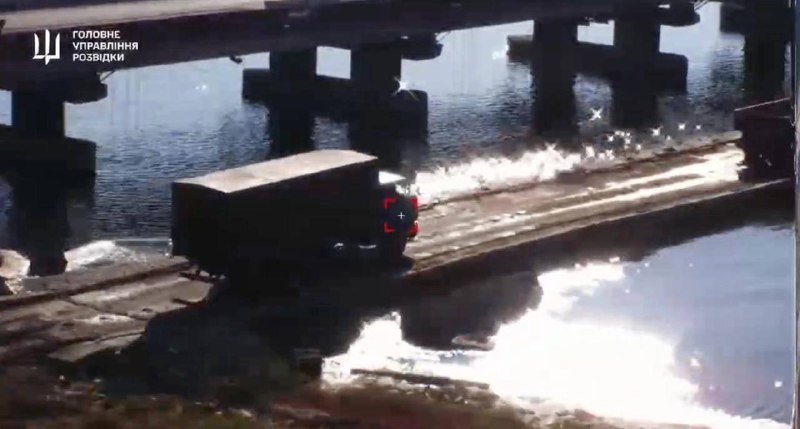
In the early hours of 23 June 2026, two things happened in occupied Crimea, and both arrived at roughly the same time through different channels. At 00:14 UTC, Ukrainian media reported a massive drone attack still in progress over the Kerch peninsula, with explosions audible in the city and the bridge across the Kerch Strait blocked to traffic. Three hours later, at 03:14 UTC, a separate dispatch confirmed that a NASA satellite had registered a fire at a large power station on the peninsula, large enough to register on orbital thermal imaging. Read separately, each item is a tactical data point. Read together, they amount to the clearest signal in weeks that Ukraine's long-range strike campaign has shifted from pinprick sabotage toward sustained pressure on the electricity grid that keeps Russian-occupied Crimea habitable.
The pattern is worth describing plainly, because the framing contest around it has already begun. A power station that supplies occupied territory is, by any reading of the laws of war, a legitimate military target during an active occupation; a civilian bridge connecting the peninsula to mainland Russia is a logistics artery for an invading force. And yet the way Western wire desks have covered similar strikes on Russian-held territory in previous weeks has often been careful, hedged, and conspicuously even-handed in ways that the same outlets have not been when describing Russian strikes on Ukrainian civilian infrastructure. The asymmetry is the story.
Two strikes, two registers
The two dispatches that landed overnight illustrate the divergence. The Kerch report, carried by the Ukrainian broadcaster TSN, described explosions in the city, a blocked bridge, and an attack that was described as ongoing at the time of filing. The power-station report, also from TSN, was more concrete in its evidentiary base: it cited a NASA satellite image of a thermal anomaly, which is harder to dispute than a Telegram post. Neither item named the specific unit or weapon system involved; the sources do not specify whether the drones were Ukrainian-operated, supplied, or sympathetically claimed, and this publication has not independently confirmed the launch origin.
What the sources do establish is the cumulative shape of the campaign. Strikes on Crimean energy infrastructure have been a recurring feature of 2026, with previous rounds reported by Ukrainian outlets and by Russian-installed occupation authorities, who tend to acknowledge the strikes while disputing the impact. The overnight episode is consistent with that tempo: one strike on a logistics node, one on a grid node, hours apart, in a peninsula that the invader has spent twelve years trying to make administratively self-sustaining.
The framing question nobody wants to ask
The reason this matters beyond the military fact is that Crimean infrastructure occupies an unusual place in the Western press's moral geography. When Ukrainian missiles strike a Russian-occupied substation, the framing tends to foreground risk to civilians, downstream effects on water supply, or "the humanitarian toll." When Russian missiles strike a Ukrainian substation, the same outlets lead with the strike's military significance and Moscow's strategic intent. Both framings are defensible in isolation. The asymmetry only becomes visible when you stack the coverage week by week.
There is a structural reason for this. Crimea in Western reporting has been a contested symbol since 2014, and the symbol still does work that the underlying reality does not. A fire at a power station in, say, Kherson Oblast is unambiguously an attack on Ukrainian civilian infrastructure, even when Kherson is partially occupied. A fire at a power station in Crimea is reported with the same vocabulary by some desks and with the vocabulary of "operations against Russian-held territory" by others. The choice of preposition — in versus against — is the choice that determines whether a reader registers the event as a strike on a place or a strike on a military position in a place.
What is actually at stake
The stakes are not abstract. Crimea is the logistical hinge of the Russian position in southern Ukraine. The Kerch Bridge, damaged by strikes in 2022 and intermittently closed for repair since, is the principal surface route for fuel, ammunition, and reinforcements moving south. The peninsula's power grid feeds military installations, desalination plants, and the civilian population that the occupation administration has spent four years trying to keep from leaving. Disrupting that grid raises the cost of occupation without requiring a ground assault on terrain that Kyiv's military planners have no current capacity to take.
If the campaign continues at this tempo through summer 2026, the cumulative effect on Crimea's habitability becomes the lever. Occupation authorities will face the choice between importing more power across the bridge — itself a target — and tolerating longer outages for the population they administer. That is a political problem for Moscow, not just a military one, and it is the kind of slow-burn pressure that does not produce a single dramatic headline but does shift the cost calculus.
What remains uncertain
The sources for this article are thin by design. The two Telegram dispatches that anchor the reporting describe what was visible and audible at the time of filing; they do not name the specific drone type, the specific unit, or the specific power station. Independent verification of the NASA satellite imagery, while plausible given the platform's fire-detection capabilities, has not been cross-checked in this article against the original FIRMS data. Russian-installed occupation authorities had not, as of 03:14 UTC on 23 June 2026, issued a public statement on the power-station fire in the material reviewed here, which means the counter-claim — that the strike hit a military target, that the damage was limited, that the thermal signature was something other than what the satellite showed — is not yet on the record.
What can be said with the evidence available is this: in a single three-hour window overnight, a logistics bridge in occupied Crimea was blocked by an active drone attack and a power station on the same peninsula was burning visibly from orbit. The reader is entitled to register both events at their actual weight.
— Desk note: Monexus frames both strikes as Ukrainian operations against Russian-occupied territory, in line with our standing characterisation of Ukraine as the invaded party. We have not editorialised on the underlying military campaign beyond what the sources support, and we have flagged the limits of independent verification rather than asserting them away.
Wire provenance
This editorial synthesis draws on the following public wire/social posts:
- https://t.me/TSN_ua
- https://t.me/TSN_ua
- https://t.me/epochtimes
Follow the event.
These dated source records provide context. They do not retrospectively verify this archive article.
A dated voting record is evidence of one decision. Use the original UN record before turning it into an alignment label.
Visual explainer · historical vote of 2022-03-02 →