Iran on the eve of disruption: a supreme leader's empty chair and a 24% market
A mourning ritual photographed without its paramount figure. A prediction market pricing a US blockade at 24%. And an IEA warning that the crisis will reorder how the world powers itself.
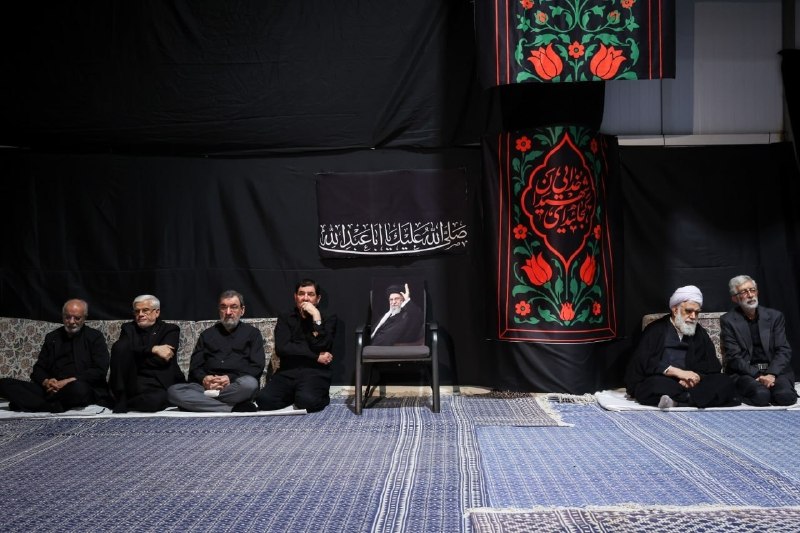
On the eve of Ashura, mourners in Iran gathered before a vacant chair. The seat carried the photograph of Ali Khamenei, the country's longtime supreme leader, and a small child, caught mid-smile, stood in the foreground of the frame. The Telegram channel Abu Ali Express, which posted the image at 18:22 UTC on 23 June 2026, did not narrate the absence. It named it: "the supreme leader who was eliminated," in phrasing that treats his removal from public life as a settled fact rather than an unfolding event. The image is devotional in form and political in content. What it documents is not who spoke at the mourning ceremony but who did not.
Three hours earlier, the prediction-market platform Polymarket put the odds of a new US naval or economic blockade on Iran at 24% for the relevant contract window, a figure that is neither negligible nor alarming, but that sits inside a market which has been visibly repricing Middle East risk for weeks. By mid-morning UTC the same day, the market-data account Unusual Whales circulated an unattributed summary of an International Energy Agency finding: the Iran-linked energy crisis, the IEA said, will accelerate global electrification as states seek energy autonomy and insulation from supply shocks. Three separate inputs, three separate registers — devotional, speculative, technical — and a single underlying proposition: that the regime in Tehran and the energy regime around it are both being redrawn, and that the second half of 2026 will be defined less by what happens between Washington and Iran than by what the rest of the world decides to do about energy in their absence.
What the photograph does and does not tell us
An Ashura tableau is, in normal Iranian political religion, a curated setting: senior clerics in the front row, a portrait of the supreme leader at centre, religious banners flanking the assembly. The image Abu Ali Express circulated on 23 June does not contain the leader. The portrait remains; the man does not. The framing the channel offers — "the supreme leader who was eliminated" — is a unilateral characterisation. It is the framing of a channel sympathetic to the Iranian opposition and to the line that Khamenei's grip on power has effectively ended; it is not the framing one would find in Iranian state media, which continues to refer to him as the supreme leader of the Islamic Republic without qualifying language.
The visual is therefore evidence of one thing and a claim about another. As evidence, it tells us that at least one mourning gathering, somewhere in Iran, on 23 June 2026, occurred without the supreme leader present in person, and that this fact was photographed and circulated by a channel that chose to draw attention to it. As claim, it asserts that this absence is tantamount to elimination. The distinction matters. Khamenei's exact status — whether he is incapacitated, in hiding, under house arrest, or simply absent from a specific mourning occasion — cannot be settled from a single photograph and a Telegram caption. The image is consistent with several readings, including the prosaic one that a head of state does not personally attend every observance in his country's calendar. What it is not consistent with is the routine of recent decades, in which the supreme leader's physical presence at major Shi'a commemorations has been treated as politically non-negotiable.
The channel's editorial choice to publish and to annotate is itself a piece of the picture. Telegram channels aligned with the Iranian diaspora opposition have, through 2025 and into 2026, increasingly framed Khamenei in past tense — a stylistic choice that is also a political wager. That wager may yet prove wrong. For now, the photograph is a data point in a contested narrative rather than a confirmation of it.
The blockade question, priced by the crowd
The Polymarket contract is the cleanest of the three inputs because it is denominated in probability rather than allegiance. As of 15:37 UTC on 23 June 2026, traders on the platform assigned a 24% probability to the United States announcing a new blockade on Iran within the contract window. A blockade, in this market's phrasing, implies a sea-and-air interdiction regime rather than the incremental sanctions architecture that has been in place since the early 2010s; it implies a deliberate disruption of Iranian petroleum exports, which is the country's single largest source of foreign currency.
Twenty-four percent is a meaningful number. It is far below the levels that would suggest traders view a blockade as the central scenario for the second half of 2026. It is also far above the level that would suggest traders consider it a tail event. Read against the energy-market commentary circulated the same morning by Unusual Whales, it implies a coherent portfolio view: there is a non-trivial chance that the physical flow of Iranian hydrocarbons is interrupted in a way that sanctions did not achieve, and that contingency is enough to justify accelerated investment in domestic electrification across importing countries.
A blockade is not the same as a war, and the market is not pricing a war. It is pricing the policy preference of an administration that has, across its second-term posture, treated Iran's export economy as a legitimate target of coercion short of kinetic action. Whether that preference survives contact with oil-price pass-through into US consumer gasoline, with allied shipping insurance markets, and with the political economy of the Gulf monarchies that depend on stable sea lanes through the Strait of Hormuz, is the open question the contract is trying to price.
Why the IEA is talking about electrification
The Unusual Whales morning note, drawing on the International Energy Agency, framed the Iran-linked energy crisis as a catalyst for global electrification rather than as a localised supply shock. The structural claim is straightforward. When a major producer becomes politically unreliable, importing states do three things at once. They diversify their supplier base. They accelerate domestic production of whatever they can produce. And they electrify the demand side — replacing imported fuels with electricity generated, ideally, inside their own borders from a mix of domestic and contracted sources. The third move is the slow one, but it is the one with the longest political half-life, because once a country has rebuilt its transport, heating, and industrial base around domestic electrons rather than imported molecules, the political cost of reverting is high.
This is the part of the picture that travels furthest. The Ashura photograph is a story about Tehran. The Polymarket contract is a story about Washington and the sea. The IEA framing is a story about everyone else — the importing economies from South Asia to Europe that will, over the next decade, make capital-allocation decisions partly on the basis of how reliable Iranian, Gulf, and Russian hydrocarbons look in the second half of this decade. If those decisions harden, the political economy of the Middle East changes in a way that no single act of US policy produces on its own. The region becomes less central, in purchasing-power terms, even as it remains central in security terms.
Where the three readings disagree
The three inputs do not cohere into a single story, and the gaps between them are where the analysis has to live. The Abu Ali Express framing assumes the Iranian state is already a corpse that has not yet been carried out. The Polymarket contract assumes the Iranian state is still functional enough to be blockaded, which is to say still producing and exporting hydrocarbons at scale. The IEA framing, as paraphrased by Unusual Whales, assumes the Iranian state will remain a swing factor in global energy markets for the medium term, because otherwise the policy advice about accelerated electrification would not need to be issued at all. These are not reconcilable in a single sentence. They are consistent with a country that is politically fractured at the top while remaining economically operative at the wellhead — a state whose command authority is contested even as its export machinery runs.
That is also the configuration in which a US blockade becomes a coherent policy option rather than an unnecessary one. If the Iranian state were already politically collapsed, a blockade would be redundant. If it were politically unified and deterrent, a blockade would be reckless. The space in which a blockade makes sense as a coercive tool is the space in which the Iranian state can still hurt an adversary by what it does with its oil, but can no longer reliably command the political obedience of its own population. The market price is, in effect, a bet on whether Washington reads the situation that way.
Stakes over the next eighteen months
The distribution of outcomes matters more than any single point estimate. If the Polymarket contract drifts toward 40% or higher over the summer, expect insurance markets for Gulf shipping to widen their risk premia, expect OPEC+ communications to harden, and expect importing ministries from New Delhi to Brussels to accelerate the kind of long-cycle electrification programmes the IEA is already nudging them toward. If it drifts below 10%, expect a partial normalisation of Iranian export flows, a corresponding softening of European and Asian buying patterns, and a slower build-out of the demand-side electrification that the IEA is recommending.
The photograph from Ashura eve will not, on its own, move these numbers. But it is a reminder that the Iran question in 2026 is not only a question of oil, sanctions, and the Strait of Hormuz. It is also a question of political legitimacy inside the Islamic Republic — a question whose answer will, in turn, determine whether the energy transition the IEA is urging on the rest of the world is a response to a temporary shock or a permanent restructuring.
What remains genuinely uncertain is the relationship between the political signal and the market signal. The devotional framing of an empty chair is not, by itself, evidence of a regime's collapse; it is evidence that an opposition-aligned channel believes one is underway and is constructing a visual vocabulary to that effect. The prediction-market framing of a 24% blockade probability is evidence that traders are taking the option seriously without treating it as the base case. The IEA framing is evidence that the world's energy planners are pricing in a future in which Middle Eastern hydrocarbons are less central than they were. None of the three readings confirms the others. All three are consistent with a longer transition in which the region's political order and the global energy order change together, in slow and uneven step.
Monexus framed this piece around three inputs that read in three different registers — devotional, speculative, technical — and chose to let the disagreement between them carry the analysis, rather than picking one frame and discarding the others. The wire coverage of Iran on 23 June leaned heavily on the political and security tracks; the energy-policy track, as transmitted through the IEA note, sits behind a paywall in its original form and was surfaced through the secondary channel cited above.
Wire provenance
This editorial synthesis draws on the following public wire/social posts:
- https://t.me/abualiexpress