Tehran rejects IAEA inspection of damaged nuclear sites as it defends indirect talks with Washington
Iran's foreign ministry says it has no plan to grant the UN atomic watchdog access to facilities struck in recent attacks, even as a quadrilateral meeting with the United States opens in Switzerland.
Iran's foreign ministry said on 23 June 2026 that it has no plan to allow International Atomic Energy Agency inspectors into facilities damaged in recent strikes, even as the country's negotiators sat down with the United States under mediation in Switzerland. The two messages, delivered within hours of each other, capture the dual track Tehran is now running: engagement on its own terms, refusal of accountability on others.
The position matters because the gap between the negotiating table and the inspection chamber is where any durable deal will either be built or collapse. Tehran's readout, delivered by foreign ministry spokesperson Esmail Baqaei, sets the line clearly: a quadrilateral meeting with the United States and two mediators began in Switzerland at roughly 15:00 local time, and the country will not be opening the doors that American and Israeli bombs recently broke open.
What Tehran said
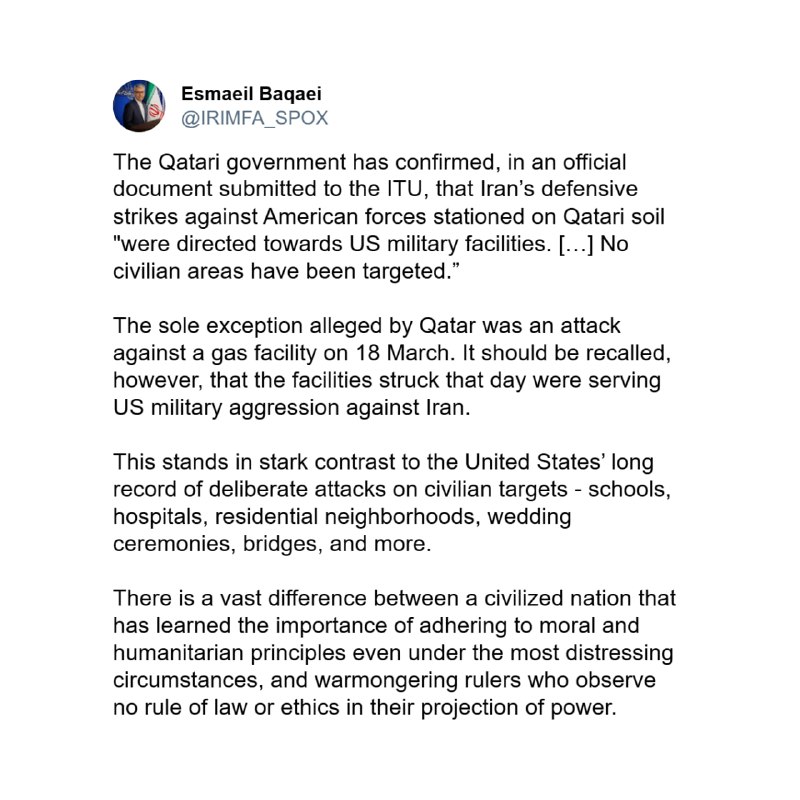
Baqaei told reporters at the ministry's weekly press briefing on 23 June 2026 that Iran does not intend to host IAEA inspectors at the damaged facilities, according to a state-affiliated wire. He framed the position as a continuation of existing policy rather than a new posture. The briefing also produced a second, more pointed message. Asked about claims by US officials, including President Donald Trump, that regional governments — Jordan and the United Arab Emirates among them — were involved in the recent attack on Iran, Baqaei dismissed the allegations without naming the capitals directly, in a reply that was clipped and reposted by Iranian state media.
The third piece of the readout concerned the Switzerland meeting itself. The quadrilateral format — Iran, the United States, and two mediators, widely understood to be Oman and either Qatar or Switzerland — convened in the afternoon. Iranian state media described the meeting's start in matter-of-fact terms, with no claimed breakthrough and no announced venue beyond the Swiss canton. The lack of a public Iranian readout on substance is itself the message: Tehran does not want to feed a news cycle that its negotiating partners can shape unilaterally.
What the wider diplomatic corridor looks like
The Swiss track sits inside a longer arc of crisis management that has run, on and off, since Israeli and US strikes hit Iranian nuclear and military sites. Indirect talks have been Iran's preferred vehicle for two decades, both because the channel preserves deniability for the domestic political base and because mediators can absorb the political cost of any walkout. A quadrilateral format adds a third variable: each mediator carries its own relationship with Washington and its own incentive to claim credit. That makes the choreography of the meeting — who reads out first, who issues a joint statement, who speaks in Arabic versus English — as significant as the technical content.
The regional allegation, with Trump publicly implicating Jordan and the UAE, lands in that choreography. Arab Gulf states have spent two years building quiet back-channels with Tehran even as they hosted American air assets; being named as part of an attack on Iran forces them into a public position they have carefully avoided. Baqaei's clipped reply preserves the option of escalation without committing to it, in the same way that the Swiss meeting preserves the option of diplomacy without committing to it.
The IAEA question
The inspection refusal is the more consequential of the two signals. The IAEA is the only institution with a legal mandate to verify what happens inside Iran's nuclear infrastructure, and the agency has spent the last three years documenting an erosion of access that predated the strikes. Damaged facilities, by contrast, present a verification problem the agency has rarely faced in real time: a building that may or may not contain undeclared material after a bombing run, with the host state now declaring in advance that inspectors will not see it.
Iran's stated reason for refusing is procedural — the foreign ministry said there is no plan to grant access, framing the issue as a matter of timing rather than principle. Western capitals will read that framing as the same obstruction under new management. Moscow and Beijing, by contrast, have used the strikes themselves to argue that the verification regime is now subordinate to the security guarantees the strikes were meant to enforce; Tehran's inspection refusal sits comfortably inside that line. The structural pattern is a familiar one: when international institutions are perceived as vehicles for adversary intelligence, the host state reclassifies access as a sovereignty question rather than a technical one.
What the deal, if there is one, has to solve
A durable arrangement would have to close three gaps at once. The first is the inspection gap: a credible answer to what happened to material and equipment at the struck sites, with the IAEA restored to a role that the Iranian foreign ministry will not be able to dismiss as illegitimate. The second is the sanctions gap: a clear, time-bound path on enrichment, missile activity, and regional armed partnerships, sequenced against sanctions relief that Tehran can bank rather than promise. The third is the security gap, the one Baqaei pointed to when he rejected the regional-complicity framing: an Iranian guarantee that it will not target the Arab states that hosted the strikes, in return for a US guarantee that the strikes will not be repeated.
None of the three is technically easy, and the quadrilateral format is not designed to resolve any of them in a single afternoon. The Swiss meeting is closer to a procedural checkpoint than a negotiating round, a way to keep the channel warm while the harder conversations happen elsewhere. The risk for Tehran is that procedural patience is read in Washington as diplomatic victory; the risk for Washington is that procedural patience is read in Tel Aviv as diplomatic drift.
What remains uncertain
The public reporting on the Swiss meeting is thin, and Iranian state-media readouts tend to flatten disagreement into consensus. It is not clear from the available wire whether the two mediators are the same pair that ran the earlier Muscat channel, or whether the venue in Switzerland is Geneva or Lausanne or Bern — a meaningful distinction for which officials can plausibly claim credit. The claims about Jordanian and Emirati involvement, similarly, are sourced to the US side; the Arab states named have not, in the available reporting, confirmed the role attributed to them. Until they do, Baqaei's clipped reply is technically a non-denial denial, and the diplomatic weight of the allegation depends entirely on whether it sticks. The IAEA question, by contrast, is unambiguous: Iran will not allow inspectors in, and the diplomatic cost of that refusal will compound with every week the door stays closed.
This piece is built on Iranian state-media readouts of foreign ministry briefings on 23 June 2026. Where the framing is Tehran's, the piece says so. Where Western reporting is needed to fill in the room — the mediator identities, the venue, the Arab-state responses — the wire has not yet provided it.
Wire provenance
This editorial synthesis draws on the following public wire/social posts:
- https://t.me/FarsNewsInt/1
- https://t.me/FarsNewsInt/2
- https://t.me/FarsNewsInt/3
Follow the event.
These dated source records provide context. They do not retrospectively verify this archive article.
Separate what the nuclear watchdog reported from what it could not determine after the June 2025 strikes.