Israeli drone strike hits parked car in southern Lebanon as West Bank raids continue
Two Israeli airstrikes on Beit Yahoun in southern Lebanon on 25 June 2026, reported alongside a Hezbollah ambush and Israeli ministerial defiance of a Trump request to draw down, expose the fraying architecture of the post-2024 ceasefire.
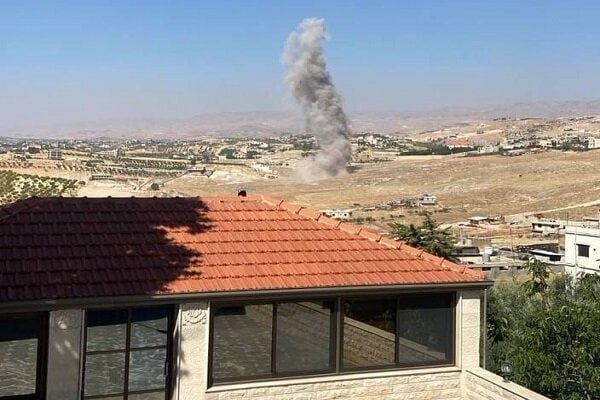
Two Israeli airstrikes hit the town of Beit Yahoun in the Bint Jbeil district of southern Lebanon on the evening of 25 June 2026, regional Telegram channels reported, in what Iranian-aligned outlets immediately framed as a fresh breach of the ceasefire that has technically governed the frontier since late 2024. The first strike landed shortly after 22:00 UTC, the second followed within minutes, and by 22:26 UTC the conflict-monitor channel GeoPWatch was reporting that Hezbollah fighters had ambushed an IDF unit attempting to operate in the area three hours earlier. Press TV, citing the wording of Israeli officials, called it a ceasefire violation; the Israeli military had not publicly commented at the time of writing. The picture, drawn almost entirely from Telegram traffic, is fragmentary: a town name, two strikes, a reported ambush, and a hospital in Haifa receiving wounded by helicopter.
Beit Yahoun, again
Beit Yahoun is not a new name in the ledger of cross-border violence. The town sits in the Bint Jbeil district, the same ridge-and-valley terrain where Israeli forces and Hezbollah fought a grinding ground war in 2024, and where Israeli troops have maintained an occupation-style presence in a small number of hilltop positions ever since. The geography explains why the same handful of place names recur each time the wire lights up: Wadi al-Salouqi, Qounine, Beit Yahoun form a triangle that controls the high ground looking north toward the Litani. Al-Jadeed television, relayed by the @wfwitness channel at 21:50 UTC, reported Israeli tanks moving through Wadi al-Salouqi and onto the outskirts of Qounine and Beit Yahoun. That ground movement, plus the airstrikes, is what regional reporting is now treating as a coordinated operation rather than a single fire mission.
What is harder to verify from the open-source record is the human toll. Press TV reported at 22:07 UTC that an Israeli helicopter had transported several wounded soldiers to Rambam Hospital in Haifa following the clashes. Mehr News, citing Israeli media, put the count at four soldiers wounded. Both figures are consistent with the description of an ambush by a Hezbollah cell, and both are uncorroborated by an Israeli military spokesperson as of the latest available reporting. On the Lebanese side, no casualty figures have yet appeared in the channels surveyed. Telegram footage from @wfwitness shows the second strike landing in or near the town; the angle does not permit a civilian-casualty count, and Lebanese state media have not yet issued a preliminary figure.
The ceasefire that isn't
The backdrop to every Israeli strike in southern Lebanon since November 2024 has been the ceasefire arrangement that paused formal hostilities between Israel and Hezbollah. The deal, brokered under United States auspices, was never publicly described as a peace treaty by either party; it was sold as a calibrated pause in which Israeli forces would withdraw from populated areas while a five-nation monitoring mechanism oversaw the buffer zone. The arrangement has frayed in plain sight for months. The Iranian state-aligned channel @rnintel, posting at 22:56 UTC, described the Beit Yahoun strikes as a clear violation of the so-called U.S.-Iran Memorandum of Understanding on Lebanon. That memorandum has not been publicly published, and the framing reflects Tehran's preferred reading: that the United States has a side agreement with Iran to keep the frontier quiet, and that Israel is now breaking it unilaterally.
From the Israeli side, the political signal is the opposite of de-escalation. Energy Minister Eli Cohen told Channel 14, as relayed by the Tasnim-affiliated @JahanTasnim channel at 22:01 UTC, that Israel has no intention of withdrawing from Lebanon. A separate Israeli official, cited by Mehr News at 23:21 UTC, pushed back against a reported request from President Donald Trump to wind down the southern Lebanon presence, framing it as a position the Israeli government will not accommodate. Defence Minister Israel Katz, in remarks reported by Middle East Eye at 22:02 UTC, cast the confrontation with Iran as an economic campaign alongside the military one, and tied Israeli security to the final settlement being negotiated with Tehran. The two messages read in sequence: the diplomatic track is moving, and Jerusalem is asserting that nothing about it requires a physical pullback from Lebanese territory.
The West Bank ledger runs in parallel
While the Beit Yahoun strikes were unfolding, a separate and older pattern of violence continued in the West Bank. The Canary, posting a leaked-letter analysis at 21:39 UTC, described a document signed by Israeli figures from the security, political and cultural establishments threatening legal action over what they called an ideology of ethnic cleansing in the occupied territories. The letter, as summarised by the outlet, is the latest artefact in a running argument inside Israeli elite circles about settler movement and state responsibility; it does not, on its own, document a specific raid or operation. That specific documentation has been steady, almost routine, throughout 2026, and regional Telegram channels have carried the daily count of Palestinian detentions and the location of overnight incursions without prompting the same volume of international coverage that a southern Lebanon strike now reliably draws.
The asymmetry is worth naming plainly. A Beit Yahoun airstrike generates an immediate, multi-source wire: Iranian state media, Lebanese outlets, Israeli government spokespersons by way of press interviews, and open-source monitors. A night raid on a West Bank village typically surfaces in Palestinian press, the UN Office for the Coordination of Humanitarian Affairs, and the occasional Israeli human-rights NGO. The first is treated as geopolitics; the second as humanitarian reporting. The conflation matters because the two stories are now politically joined in the way Israeli officials describe their security perimeter: the West Bank and southern Lebanon are both framed, in different ministries, as front lines of the same contest with Tehran and its regional axis.
What the next 48 hours will test
The operational questions are narrow. Will the Israeli military confirm the Beit Yahoun strikes, and at what scale of engagement? Will the Lebanese health ministry produce a casualty figure for the town, given that Bint Jbeil district has been a recurring site of overnight Israeli operations since the ceasefire? Will Hezbollah's official media arm publish a claim of responsibility for the alleged ambush, or maintain the ambiguity that allows the group to absorb a strike without an escalatory response? The political questions are wider. The Trump administration's reported request for an Israeli drawdown now sits in direct contradiction with statements from two senior Israeli ministers in the same 24-hour window. If the U.S.-Iran track is approaching a final settlement, the Beit Yahoun strikes will be read by Tehran as either an Israeli spoiler operation or a hard-bargaining tell. If that track stalls, the strikes are a foretaste of a re-eroded ceasefire. Either reading points in the same operational direction: more Beit Yahouns, sooner rather than later.
Sources: Telegram, @wfwitness (25 June 2026, 21:50 and 22:33 UTC); Telegram, @GeoPWatch (25 June 2026, 22:26 UTC); Telegram, Press TV (25 June 2026, 21:45, 22:07 and 23:10 UTC); Telegram, @rnintel (25 June 2026, 22:56 UTC); Telegram, @alalamarabic (25 June 2026, 22:45 UTC); Telegram, @tasnimnews_en and @JahanTasnim (25 June 2026, 22:01 and 22:33 UTC); Telegram, @mehrnews (25 June 2026, 21:48 and 23:21 UTC); Telegram, @tasnimplus (25 June 2026, 21:28 UTC); Telegram, The Canary (25 June 2026, 21:39 UTC); X, Middle East Eye (25 June 2026, 22:02 UTC).
Desk note: This article is built from Telegram-channel breaking-news alerts and Iranian- and Lebanese-aligned state media. None of the specific casualty figures, Israeli official statements, or Hezbollah claims have been independently verified by an Israeli military spokesperson, a United Nations agency, or a Western wire service in the window covered here. The drone-strike framing in the headline reflects the regional-channel account; the underlying record supports Israeli airstrikes by fixed-wing aircraft, not confirmed drone strikes.
Follow the event.
These dated source records provide context. They do not retrospectively verify this archive article.
Separate what the nuclear watchdog reported from what it could not determine after the June 2025 strikes.