Pakistan and Iran move to deepen ties as Sharif courts Tehran, rules out missile MOU
On a Tehran visit marked by effusive Farsi-language flourishes, Prime Minister Shehbaz Sharif signed a memorandum of understanding with President Masoud Pezeshkian and publicly downplayed Israeli and Western speculation about a missile component.
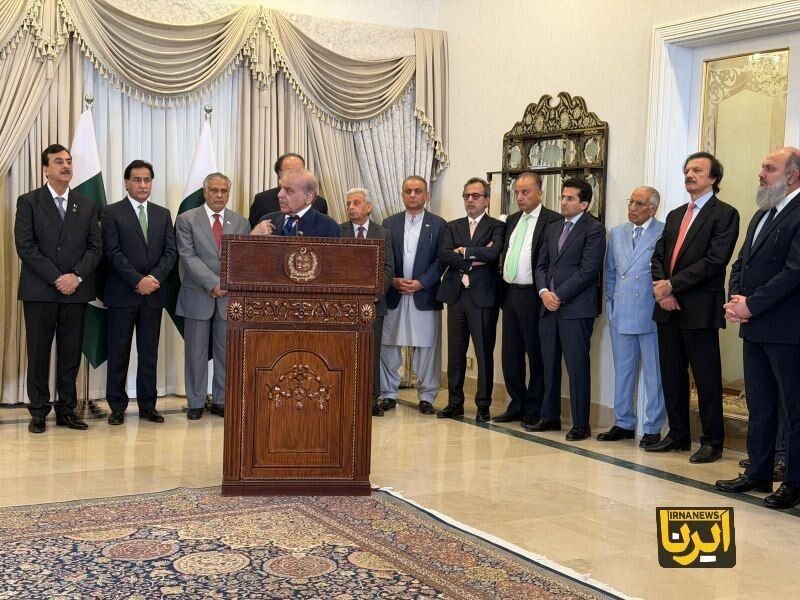
Pakistan's prime minister, Shehbaz Sharif, used a 23 June 2026 visit to Tehran to sign a memorandum of understanding with Iranian President Masoud Pezeshkian, declare an intention to return to the Iranian capital within a week, and publicly rebut the suggestion that the document touched on Iran's ballistic missiles. The choreography — Farsi-language flourishes, praise for Iran's leadership, and an explicit denial of any missile linkage — sets a deliberate frame. The substance of the MOU was not disclosed in any of the readouts circulated on 23 June; the readouts concentrated on civilisational rhetoric, economic potential, and mutual political solidarity.
The optics of the visit matter as much as its text. Pakistan, a nuclear-armed state of more than 240 million people, is the largest Muslim-majority country by population. Iran sits at the pivot of the Gulf, the Caucasus and Central Asia. A formal framework between the two has regional consequences: for the China-mediated Saudi-Iran rapprochement that Islamabad witnessed from the side-lines, for the United States' sanctions architecture around the Islamic Republic, and for the question of whether South Asia's nuclear powers can, in extremis, find a shared vocabulary with the Islamic Republic on conventional deterrence.
What was signed, and what was not
Sharif's most concrete public statement of the day was a negative one. According to the readout carried by Israeli defence correspondent Amit Segal, the prime minister told his hosts and the press that "the memorandum of understanding that was signed does not include any reference to Iran's ballistic missiles. This issue was not part of the negotiations." That formulation is unusually direct. Pakistani leaders do not typically volunteer a denial of a non-existent clause in agreements reached with a sanctions-hit partner; doing so suggests the speculation was anticipated, was unwelcome in the room, and was seen as worth extinguishing on the record.
Iranian state outlets, including PressTV, Mehr News and Fars, ran the visit as a story of political alignment. PressTV quoted Sharif telling Pezeshkian that "under your visionary leadership, Iran will transform into one of the fastest-growing economies in the world one day soon." Fars carried the prime minister's closing words in Farsi and his pledge to "come to Tehran next week to participate in the ceremony" — a follow-on commitment the readout did not name in detail. Mehr News and Al-Alam aired a passage in which Sharif praised "Ayatollah Seyyed Mojtaba Khamenei," the second son of Supreme Leader Ayatollah Ali Khamenei, for "leading his country well in critical situations."
There is a complication in that last line. On the same day, Fars separately reported Sharif offering "condolences on the martyrdom of the supreme leader of Iran, Ayatollah Seyyed Ali Khamenei." The two statements cannot both stand. Either the supreme leader has died — an event that would dominate global wire coverage within minutes and would not be carried as an aside in a single Fars caption — or the prime minister used a martyrdom formula loosely, and Iranian state media transmitted two inconsistent characterisations. The most parsimonious read, given the absence of any independent confirmation of a leadership change in Tehran, is that the readouts are confused in transmission rather than substantive. The official Iranian state line on the Supreme Leader's status has not changed in 2026; reporting to the contrary would warrant verification from Reuters, AFP, or the Fars English service before being treated as anything other than a translation artefact.
Why the rhetoric was this warm
Read together, the Farsi-language closing speech, the invocation of shared "civilisational links," and the explicit disavowal of missile content form a single piece of stagecraft. The Pakistani side is making plain that it intends to deepen bilateral trade and political contact with Iran, but is not currently prepared to take on the diplomatic cost of a missile-related partnership — one that would put it in direct collision with the United States' snapback posture and with Israel. The Iranian side is welcoming the gesture without making any public claim that would embarrass the visitor.
Both governments have reasons to want this read of the day to prevail. Pakistan's economy is under sustained pressure; an Iranian route to Central Asia, and access to Iranian energy at competitive prices, are tangible prizes. Iran is rebuilding its regional posture after the blows of 2024-25, and a public, on-the-record visit from the leader of a major Muslim-majority nuclear state is itself a deliverable. The hard strategic content can be left for the announced follow-on visit next week.
What is being left out of the public framing
Two absences stand out. First, no readout circulated on 23 June named the substantive economic deliverables of the MOU — energy imports, gas pipeline progress via the long-stalled IP project, electricity interconnection, border market access, or sanctions-evasion architecture. PressTV referenced an aspirational economic transformation; it did not cite a number. Second, there is no public Iranian readout that engages with the ballistic-missile question on its own terms, which leaves the door open for the original speculation to be re-asserted by observers who did not hear the Pakistani denial.
For the United States, the visit reads as another data point in a regional picture in which Iran is rebuilding a network of partners that includes Saudi Arabia, Russia, and now, formally, Pakistan. For Israel, the optics of an Iranian-aligned readout from a nuclear-armed neighbour are uncomfortable, even if the missile denial is taken at face value. For India, the visit sits in the long shadow of the China-brokered Saudi-Iran détente of 2023 and the marginalisation of New Delhi in Tehran's recent diplomatic traffic.
The structural shift is straightforward to describe without rhetorical inflation: a sanctions-hit state is accumulating high-visibility diplomatic engagement with a series of large, non-aligned or selectively aligned Muslim-majority governments, and is doing so in language carefully calibrated to avoid crossing US red lines on its missile programme. The visit does not change the missile file; it changes the political weather around it.
Stakes and the week ahead
The concrete stakes for the rest of June 2026 are narrow but real. The follow-on visit Sharif announced, nominally to attend a ceremony in Tehran, will be the next test. If the second trip produces a signed energy or border-trade instrument with named volumes and dates, the MOU acquires substance. If it produces only another round of civilisational rhetoric, the document will join the long shelf of bilateral frameworks that never operationalised. The ballistic-missile question is unlikely to surface again publicly until either a US administration chooses to raise it or a leak forces the issue; Sharif's on-the-record denial is, for the moment, the last word from the Pakistani side.
What remains genuinely uncertain — the readouts do not resolve it — is whether the translation in the Fars and Mehr captions describing the Khamenei situation reflects a transmission error, an emerging Iranian framing, or something the readouts elide. That single ambiguity is the largest unknown in an otherwise carefully stage-managed day.
How Monexus framed this vs the wire: Western wires had not, at the time of writing, circulated an English-language readout of the MOU. This article is built from the Iranian state and Telegram-channel readouts of 23 June 2026, cross-checked against the Israeli side's on-the-record reporting of the Pakistani missile denial.
Wire provenance
This editorial synthesis draws on the following public wire/social posts:
- https://t.me/ClashReport
- https://t.me/amitsegal
- https://t.me/presstv
- https://t.me/farsna
- https://t.me/mehrnews
- https://t.me/alalamfa