Pakistan's mediation moment: Sharif's Tehran trip and the limits of "neutral ground" in the Iran crisis
Pakistan's prime minister walked into Tehran promising peace and walked out denying a missile deal. The performance says more about regional diplomacy than either claim does.
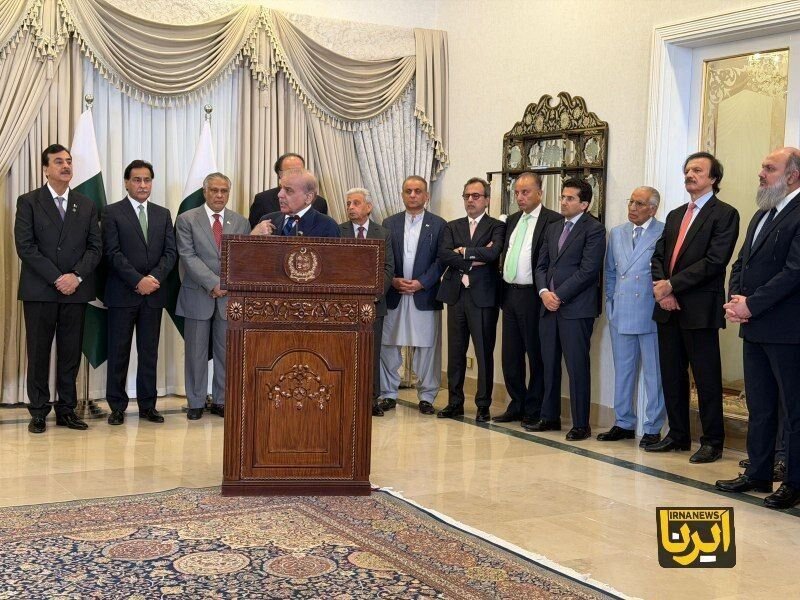
Pakistan's prime minister, Shehbaz Sharif, landed in Tehran on 23 June 2026 and immediately did what Islamabad's political class does best: declared itself indispensable. In remarks carried live by Iran's Al Alam Arabic channel at 20:41 UTC, Sharif praised Iranian leadership as "wise" and "brave," thanked Tehran for its "constant trust in Pakistan as a sincere friend, neighbour and mediator," and committed the two countries to "work closely for peace, progress and prosperity." Twelve minutes later, at 20:53 UTC, he struck a more transactional note, framing the relationship as a partnership that benefits the broader region. By 20:58 UTC the script was fully baked: Pakistan, he announced, was ready to be the honest broker the Middle East apparently did not know it needed.
Strip away the choreography and the trip is a study in the politics of a specific kind of mediation — the kind that gets a leader photographed in both cities and produces a memorandum of understanding that carefully avoids the one subject everyone wants to know about.
What was actually signed
The substantive product of the visit, according to a statement Sharif gave to Iran's state broadcaster Press TV at 20:45 UTC, is an MOU whose first duty, it seems, is to define itself by what it is not. "This MOU does not mention ballistic missiles," the prime minister said flatly. "It was never on the table; it was never on the agenda. Iran's side never wanted to even discuss about it." That denial is the news. Missile cooperation between a nuclear-adjacent Iran and a nuclear-armed Pakistan has been the regional security community's worst-kept whispered fear for two decades. Islamabad's decision to volunteer the denial — unprompted, in capitalspeak, on Iranian state television — tells you two things at once: somebody, somewhere, was going to ask; and the question is now on the record as asked.
The mediation pitch, decoded
Pakistan's offer to act as mediator is not new. Islamabad has spent the better part of two years positioning itself as the Gulf's favourite back-channel — to Tehran, to Riyadh, and, more discreetly, to Washington. The pitch is structural as much as sentimental. Pakistan shares a long, porous border with Iran. It is one of the few Muslim-majority states with a working relationship with both the Islamic Republic and the Gulf monarchies. Its army, for all its domestic controversies, is a NATO- and Gulf-trained force that has spent decades operating in the same counter-insurgency and border-security space as the Iranian Revolutionary Guard Corps. Sharif is selling competence, not just good intentions.
The counter-narrative is straightforward and unkind. A mediator with a five-thousand-kilometre border, a failing economy, and a civil-military compact that has historically told its civilian prime minister when to sit down does not, in practice, get to set the agenda in a Middle Eastern crisis. Saudi Arabia, the UAE, Qatar and Oman all have deeper diplomatic tradecraft in this specific game. Even Iran's own positioning, after the 12-day war of 2025, has tilted away from South Asian interlocutors and toward Turkey and the Gulf states. Sharif's "mediator" framing works best in the regional press releases; on the ground in Tehran, it functions more as diplomatic cover for a bilateral relationship that has to be managed whether or not the rest of the region is watching.
The structural read
What is really going on in Tehran this week is a recalibration of a relationship that the 2025 Iran-Israel war scrambled. Pakistan is one of the few countries in the region with a non-trivial Shi'a minority, a Sunni-majority polity, and a security establishment that has, on paper, the kind of conventional muscle that deterrence theorists used to care about. In a Middle East where the old Arab-Persian fault lines are now overlaid with a new Israeli-Iranian one, that combination gives Islamabad a specific, narrow kind of relevance. It also gives the relationship its specific, narrow kind of fragility: too close to Tehran and Pakistan's Gulf patrons get nervous; too distant and Tehran stops taking the calls. The MOU, whatever it contains beyond its denials, is the diplomatic instrument that lets both sides claim the relationship is being managed without either having to specify what they are managing it toward.
What remains unresolved
The sources available as of the close of 23 June do not specify the full text of the MOU, the sectors it covers, or the timeline for implementation. Iranian state media carried Sharif's remarks live but did not, in the items available to this publication, publish a joint communique. The denial of a missile component is, on the face of it, reassuring — but denials issued from foreign capitals on state television are a particular genre of speech act, and regional security services will read the language for what is omitted as carefully as for what is stated. Whether the visit produces a follow-on summit, a working group, or another round of press releases is the open question.
What is not open is the political fact. Sharif walked into Tehran selling mediation, walked out selling the same product, and in between got the one thing he actually needed: a bilaterally framed, publicly visible, regionally deniable relationship upgrade. That is not nothing. It is, however, a long way from the regional settlement his talking points implied.
This publication framed Sharif's Tehran visit as a bilateral relationship-management exercise with a regionalist wrapper, rather than as the breakthrough mediation that Iranian and Pakistani state-aligned channels were at pains to project.
Wire provenance
This editorial synthesis draws on the following public wire/social posts:
- https://t.me/alalamarabic/
- https://t.me/alalamarabic/
- https://t.me/presstv/
- https://t.me/alalamarabic/