Pezeshkian lands in Islamabad with a deal to enforce and a region to balance
Tehran's president touched down in Islamabad on 23 June 2026 to a six-jet escort, saying Iran wants the MoU with the US implemented in full. The visit is as much about Pakistan's balancing act as it is about Washington's deal.
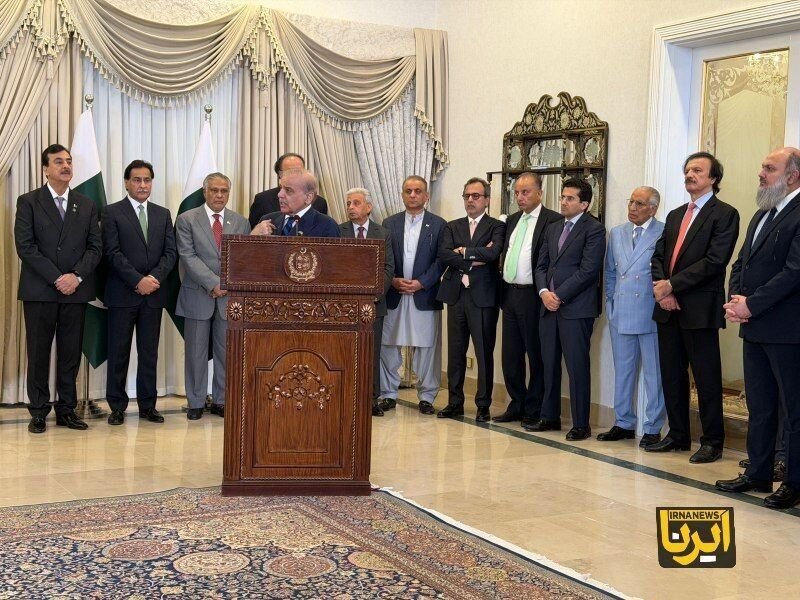
Iran's President Masoud Pezeshkian walked into Islamabad on Tuesday 23 June 2026 to a welcome that no other regional visitor has been offered in recent memory: a six-jet Pakistani Air Force escort, a guard of honour, and the personal reception of both President Asif Ali Zardari and Prime Minister Shehbaz Sharif at Nur Khan Airbase. The choreography was deliberate. Tehran came looking for partners, and Islamabad was making clear, in front of every camera in the capital, that it intends to be one of them.
The substance of the day was narrower than the optics. Pezeshkian used the visit to say, in plain terms, that Iran wants the memorandum of understanding signed with the United States implemented in full — "in line with national rights and international law," as the official read-out put it. That phrasing, coming from a president who took office promising to reopen every channel closed under his predecessor, is the clearest signal Tehran has sent that it wants the deal to hold.
What Iran is actually asking for
The MoU at the centre of the visit is the same framework that emerged from the Omani-mediated track earlier in 2026, after months of quiet shuttling between Tehran, Washington, Muscat, and Doha. Pezeshkian's framing — sovereignty and law, not victory — is the language Tehran has been instructed to use. The Iranian position, as repeated on state media, is straightforward: sanctions relief tied to verifiable nuclear constraints, security guarantees that survive a change of administration in Washington, and an end to the pattern in which agreements are signed and then unilaterally re-interpreted. The state's English-language read-out leans heavily on the word "implementation," and not "negotiation," because for Tehran, the negotiating phase is over.
What the read-out does not say is what Tehran is prepared to give up if implementation stalls. That is the part the world outside the region is watching.
Why Pakistan matters more than usual
Pezeshkian's one-day visit lands at a moment when Islamabad is doing something few regional capitals have been willing to do: position itself simultaneously as a US security partner, a Chinese economic partner, a Gulf-aligned diplomatic actor, and a neighbour to a sanctioned Iran. Hosting the Iranian president with full ceremonial honours is a way for Pakistan to signal that none of those relationships is exclusive.
For Tehran, the value of the visit is symbolic and concrete at the same time. Symbolically, a major Sunni-majority nuclear-armed state rolling out a fighter escort for a Shia Iranian president reopens a corridor that has been narrower than the rhetoric on both sides would suggest. Concretely, the two governments have an interest in border security, energy transit, and the question of how any US-Iran deal affects the Chabahar and Gwadar calculus. Pakistan's read-outs of the visit, as relayed through Iranian state media, stress "regional stability" and "brotherly ties" — the standard vocabulary, but vocabulary that is now being deployed in a more crowded diplomatic room than it was a year ago.
The counter-reading: optics over outcomes
The sceptical case is the obvious one. State visits between Iran and Pakistan have been regular and mostly inert for two decades. Six-jet escorts do not move sanctions architectures, and an MoU whose text has not been published does not become real because a red carpet is rolled out. Regional analysts who have watched this corridor for years will reasonably ask whether Pezeshkian is delivering a message to Washington — we have alternatives — rather than a message to Islamabad. Tehran has historically used visits to third capitals as signalling to a fourth, and the audience for Tuesday's ceremony may have been as much in the Gulf and in the White House as in the prime minister's office.
That reading holds some weight. But it understates what has changed since Pezeshkian took office. The Iranian president has made the deal the centre of his foreign policy in a way his predecessor never did. The visit to Islamabad is, on the evidence, less a pivot away from Washington than an insurance policy around it.
What remains genuinely uncertain
The Iranian state read-outs are useful but partial. They do not specify what Pezeshkian and Sharif discussed behind closed doors; they do not say whether any new bilateral agreement was signed in Islamabad, or whether the trip was strictly about reinforcing the US-Iran track. The text of the MoU itself has not been released publicly, which leaves every commentator — including this one — describing an agreement whose exact terms remain opaque. Pakistan's own official read-out of the visit is not yet reflected in the available wire material. Until those gaps are filled, the most that can be said with confidence is that Pezeshkian left Tehran carrying a message of implementation, and arrived in a capital that was visibly willing to amplify it.
The stakes, on the longer horizon, are not just bilateral. A US-Iran deal that holds changes the geometry of Gulf security, of Israeli calculations, of Chinese energy procurement, and of the price of the political cover Pakistan has been selling to multiple buyers. Pezeshkian's one day in Islamabad is, fairly or not, a small variable inside that larger equation.
This publication framed the visit as a signalling event inside an ongoing US-Iran track, rather than as a stand-alone diplomatic breakthrough; the wire read-outs emphasise ceremony, and the analytical work is in separating signal from staging.
Wire provenance
This editorial synthesis draws on the following public wire/social posts:
- https://t.me/presstv/
- https://t.me/presstv/
- https://t.me/Irna_en/