Pezeshkian's patience has a shelf life
Tehran's president insists on strict adherence to agreed text — a warning shot across the bow of any deal that drifts into atmospherics.
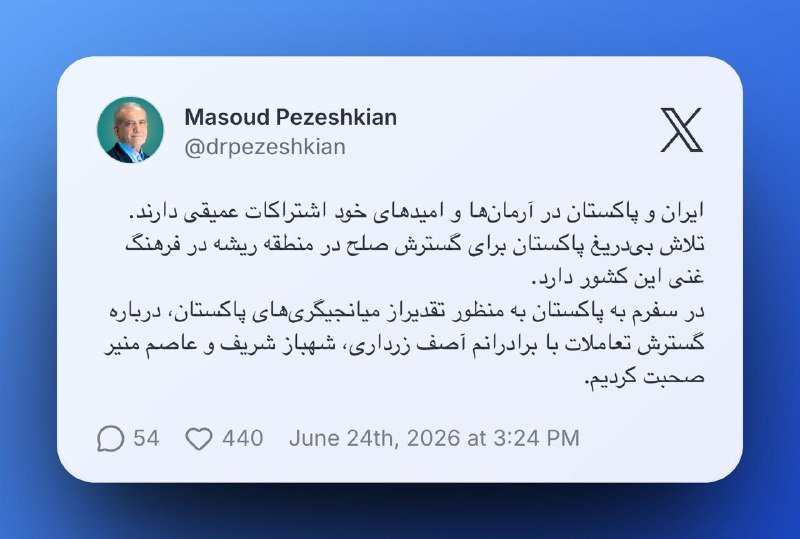
Iranian President Masoud Pezeshkian used a string of public statements on 23 June 2026 to set a hard edge on the diplomacy of the hour: any negotiated outcome with Washington stands or falls on whether both sides implement what was already agreed, line by line, and not on what is improvised in front of the cameras. The framing — "effectiveness of the talks depends on full commitment to the agreed obligations and their precise implementation" — was published by PressTV at 06:40 UTC and amplified in parallel by Al Alam Arabic at 05:18 UTC, including the pointed addendum that "statements outside the agreed-upon text do not contribute to moving the negotiations forward." [1][2][3][4]
The Iranian presidency is signalling, deliberately and in three different formulations within ninety minutes, that Tehran is no longer willing to underwrite an atmospherics track. The next move, in this telling, belongs to whoever is leaking to the microphones.
What the president actually said
Strip the language down and the message is narrow. Pezeshkian is not negotiating in public; he is auditing. Three lines, circulated by Iranian state-aligned outlets within the same news cycle, say the same thing: progress will be measured by practical adherence to accepted responsibilities, by strict implementation of agreed pledges, and by the discipline of staying inside the negotiated text. [1][2][3][4] That is the language of a government that has concluded previous rounds of talks produced communiqués the other side treats as decoration.
The implication is procedural, not theatrical. A deal that lives in the joint statements and dies in the technical annexes is, from Tehran's vantage point, not a deal at all — it is a permission slip for the next crisis. The president's choice of the word "practical" matters. It tells the Iranian negotiating team to score outcomes in cubic metres of centrifuges, kilograms of stockpiled material and the calendar of sanctions relief, not in the number of handshakes in Muscat, Geneva or Rome.
The counter-read from inside Iran
The hardliners in Tehran — and there is no shortage of them — will read Pezeshkian's restraint as weakness. To that constituency, the correct response to perceived US bad faith is to harden, not to clarify. Snapback acceleration at the International Atomic Energy Agency, a third-generation centrifuge cascade at Natanz, or a high-profile visit to the Russian-built Bushehr units would all send the signal the principlists prefer. Pezeshkian's language is also designed to foreclose that option, at least for now: by tying progress to "agreed obligations," he anchors any walk-away to a prior document, not to a domestic mood swing.
That is a real choice, and the Western press has been slow to register it. The dominant wire framing still treats Pezeshkian as the moderate holding the line against the Islamic Revolutionary Guard Corps, when the more accurate picture is of a president who knows that without deliverable commitments from Washington, the moderates lose the next Iranian parliamentary election by default.
Why the Iranian side is signalling this way now
The timing is not accidental. The first half of 2026 has been heavy with leaks about a possible framework — sanctions architecture, verification sequencing, the fate of highly enriched uranium stockpiles — and light on signed documents. Iranian state media, traditionally the most cautious megaphone, has been instructed, in effect, to remind external audiences that the only version of events that matters to Tehran is the one Tehran can read in writing. The phrase "agreed-upon text" is doing a lot of work. It tells interlocutors that off-the-cuff ministerial commentary, think-tank speculation, and the choreography of hostage-style press availabilities are no longer admissible as progress. [2]
This is also a measured warning to Iran's own negotiation team. The statement that "statements outside the agreed-upon text do not contribute" reads, in Farsi and in context, as a reminder that Iranian officials are bound by the same discipline as their counterparts. Tehran has watched rounds of talks die because a deputy minister said something one evening that the prime minister had to disavow the next morning. The president is closing that door from his side too. [2][3]
The structural picture
What is on display is not a personality contest between Pezeshkian and a US administration. It is the well-rehearsed pathology of late-stage nuclear diplomacy: the moment when both sides want an agreement enough to keep meeting, and distrust each other enough to keep undermining the meeting's product. Iran insists on written text because its previous negotiated wins have been quietly reversed by executive-branch discretion in Washington. The US side leaks optimistically because its domestic political base requires the appearance of movement, and Iranian state media pushes back because the only way to discipline the leak machine is to deny the leak's evidentiary standing. [1][2][3][4]
There is no theorist needed to describe it. Two governments, neither able to trust the other's word, are using language as a compliance mechanism. That is the test Pezeshkian is setting, and it is the test any deal that emerges from this round will be measured against, in capitals far beyond Tehran and Washington.
What remains uncertain
The materials published on 23 June do not name the counterpart, the negotiating venue, the stage of the technical track, or the sanctions package under discussion. They do not specify which "agreed obligations" the president means — the Joint Comprehensive Plan of Action framework, a successor text, or a narrower channel of confidence-building. PressTV and Al Alam Arabic are credible Iranian state-aligned channels, but they reflect the official Iranian framing; an independent read from Western, Gulf or IAEA sources would be needed to test whether the disciplined tone matches the actual state of play in the room. [1][2][3][4] Until that read is on the page, the most that can be said is that the Iranian side has chosen to discipline the public conversation, and that the next move belongs to whoever blinks first.
Desk note: Where the wires this week will likely run with personality-led framing — moderates versus hardliners in Tehran, hawk-versus-dove theatre in Washington — this publication reads Pezeshkian's statements as a procedural instrument. The signal is not who wins in Tehran; it is what counts as a deal.
Sources
- PressTV (Telegram): "Pezeshkian on the effectiveness of the talks" — 23 June 2026, 06:40 UTC — https://t.me/presstv
- Al Alam Arabic (Telegram): "Pezeshkian: Statements outside the agreed-upon text do not contribute to moving the negotiations forward" — 23 June 2026, 05:18 UTC — https://t.me/alalamarabic
- Al Alam Arabic (Telegram): "Pezeshkian: Progress on this path will be measured by practical commitment to accepted responsibilities" — 23 June 2026, 05:18 UTC — https://t.me/alalamarabic
- Al Alam Arabic (Telegram): "Pezeshkian: The effectiveness of the talks depends on full commitment to the agreed pledges and their strict implementation" — 23 June 2026, 05:18 UTC — https://t.me/alalamarabic
Wire provenance
This editorial synthesis draws on the following public wire/social posts:
- https://t.me/presstv
- https://t.me/alalamarabic
- https://t.me/alalamarabic
- https://t.me/alalamarabic
Follow the event.
These dated source records provide context. They do not retrospectively verify this archive article.
Separate what the nuclear watchdog reported from what it could not determine after the June 2025 strikes.