Pakistan's Sharif arrives in Tehran as mediator — and as salesman
Islamabad's prime minister used a condolence visit to float a peace deal, defer the missile question, and position Pakistan as the honest broker the Gulf cannot ignore.
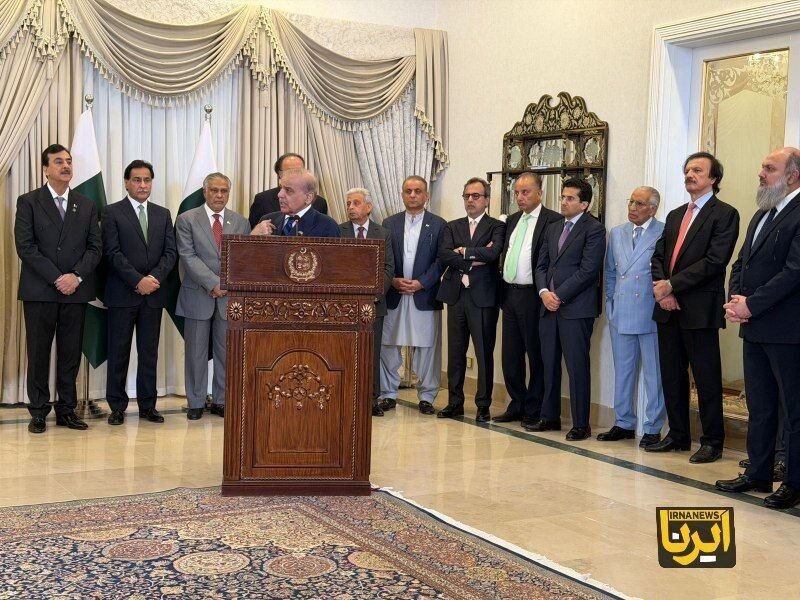
Pakistan's prime minister landed in Tehran on the afternoon of 23 June 2026 carrying two incompatible briefs. One was a condolence mission for an Iranian civilian toll now running "into the thousands," including children, in a war that the Pakistani leader did not name. The other was a sales pitch: Pakistan as the mediator whose honesty Iran can trust, and as a Muslim-majority nuclear power willing to say out loud what the Gulf will not — that the rules on long-range missiles are not applied evenly.
The optics of the visit, captured in real time by the Telegram channel Clash Report, are less interesting than the sequencing. Sharif opened by extending "warmest regards" to Ayatollah Mojtaba Khamenei; he closed by telling President Masoud Pezeshkian that Iran will become "one of the fastest-growing economies in the world" under his leadership. In between, he performed the move that defines a particular kind of South Asian statecraft: he thanked Tehran for trusting Pakistan to mediate, then used the platform to publicly scold the international order for its double standards on ballistic missiles.
The double-standard play
Sharif's argument, delivered in remarks to Pezeshkian and broadcast on Iranian state-linked channels, was pointed and quotable. "There cannot be double standards where some countries can have ballistic missiles and Iran should not," he said, before adding: "You cannot digest this kind of duplicity." The line is not new — Pakistani officials have used similar language at the UN for years — but the venue matters. Speaking it from Tehran, hours after a still-unnamed war, reframes the complaint from abstract arms-control rhetoric into a direct accusation against whichever powers struck Iran and now expect it to disarm. It also positions Islamabad as the diplomatic capital willing to articulate an argument that Saudi Arabia, the UAE, and Qatar will not.
The subtext is that Pakistan has its own ballistic-missile programme, an open nuclear deterrent, and a defence relationship with Beijing that gives it cover. Sharif was not offering Pakistan as a neutral arbiter; he was offering it as a peer.
The MOU that does not exist
What Sharif was not willing to put on the table is just as telling. "This MOU does not mention ballistic missiles," he said of the agreement he was signing in Tehran. "It was never on the table; it was never on the agenda. Iran's side never wanted to even discuss about it." That single sentence, more than any of the condolence language, tells the diplomatic reader what the document is and is not.
The memorandum is, on the evidence available, a political-brokered peace framework — or a step toward one — with a mediation role carved out for Islamabad. Sharif was emphatic that "spoilers all over the world" want the deal to fail and "do not want the Iranian nation, a great nation, to come out of the ashes of war and touch the" heights of economic recovery. The MOU is the diplomatic infrastructure for that recovery, not a security bargain. Whether the Iranians and their adversaries treat it that way is the open question.
What Tehran heard, and what was left out
Pezeshkian's government, battered by an Israeli-American military campaign that Sharif acknowledged only obliquely, received the Pakistani leader as a near-equal. Sharif assured him that Pakistan "will never let you d"own — the clip cuts off, but the construction is clear. He thanked Iranian leadership for trusting Pakistan's "ability to mediate with honesty." The phrase "with honesty" is doing work; it implies that other would-be mediators, unnamed, cannot be trusted to play it straight.
What the published exchange does not contain is any mention of who struck Iran, who is being held responsible for the civilian casualties, or what a future security architecture would look like. The deal Sharif is selling is about stopping the bleeding, not adjudicating the wound. That is a real service — and also a deferral of the hardest questions to a later, harder round.
The stakes for everyone else
If the Sharif-Pezeshkian understanding holds, three things shift. First, Pakistan's diplomatic stock in the Gulf rises at exactly the moment Saudi Arabia and the UAE are absorbing the consequences of having let the war happen on their doorstep. Second, the question of Iran's missile programme moves from a non-negotiable Western red line to a deferred item in a longer negotiation — a meaningful precedent. Third, the legitimising vocabulary of "double standards," once confined to NAM statements, becomes a working language of shuttle diplomacy between two Muslim-majority capitals.
The counter-read is simpler: a peace MOU signed while Iranian cities are still being struck is a press release, not a settlement. Sources do not specify which adversary Iran is being mediated with, what the military situation on the ground is, or whether the "spoilers" Sharif named include the very governments that flew him to Tehran. What is on the record is a Pakistani prime minister who arrived as mourner, performed as broker, and left having made the case that the rules of the non-proliferation order do not apply equally — and that this is a fact the region will now have to negotiate with, not around.
This publication notes that the wire reporting on the Tehran visit is dominated by Telegram clips from channels that publish Iranian and Pakistani state-aligned content; readers should treat the quoted remarks as on-the-record statements by named principals, while the broader strategic picture remains under-corroborated.
Wire provenance
This editorial synthesis draws on the following public wire/social posts:
- https://t.me/ClashReport
- https://t.me/ClashReport
- https://t.me/ClashReport
- https://t.me/ClashReport
- https://t.me/ClashReport
- https://t.me/ClashReport
- https://t.me/ClashReport
Follow the event.
These dated source records provide context. They do not retrospectively verify this archive article.
Separate what the nuclear watchdog reported from what it could not determine after the June 2025 strikes.