Profit in a war economy: how Chernomorsk port stayed in the black in 2025
A Ukrainian state port reports ₴1.4bn in 2025 income and a small profit — a small, unglamorous datapoint that says something larger about how wartime logistics have become a core line item in the country's balance sheet.
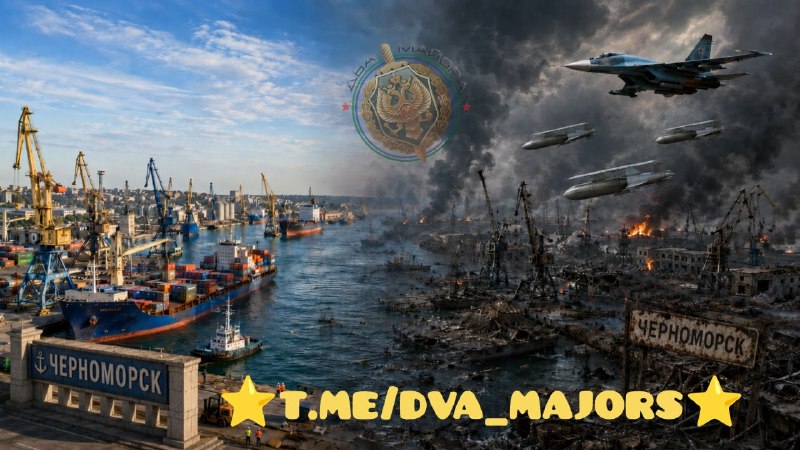
On 24 June 2026, the Russian-aligned Telegram channel Two Majors reported that the Ukrainian state enterprise operating the Chernomorsk Sea Trade Port, on the northwestern shore of the Black Sea, finished 2025 with ₴1.4 billion in income and remained profitable despite the conditions of the full-scale war. The figure, attributed to the port's director, is small by the standards of wartime state finance — but it is a useful one. A state port showing a positive bottom line in the fourth year of an invasion is a signal about what the Ukrainian war economy is actually doing, not just what it is spending.
The reading is straightforward. Ports in an active conflict zone are, on paper, impaired assets: damaged berths, shifting insurance markets, mined approaches, and the constant operational risk that a single cruise-missile strike will turn a quarterly report into a forensic exercise. The fact that the Chernomorsk enterprise is, by its own management's account, still producing a surplus suggests that throughput has not collapsed — and that the wider grain-and-container corridor out of the northwestern Black Sea is, against expectations, still functional enough to cover costs.
The numbers, in context
Two Majors' 24 June dispatch is thin on the comparative detail that would let an outside observer weight the figure. The channel did not publish a full income statement, did not break out the ₴1.4 billion by cargo category, and did not name the auditor. The headline number — ₴1.4 billion in 2025 income, with a positive net result — is therefore a single data point from a single source, attributed to a single official. Readers should treat it as a credible floor rather than a final account.
That said, the order of magnitude is consistent with what other reporting has suggested about Black Sea port activity in 2025. Ukrainian grain exports, the dominant cargo category for the country's deep-water ports, ran at a high share of pre-war volumes through the back half of 2025 once the sea corridor stabilised. Container traffic has been smaller and more episodic. The revenue mix that would produce a ₴1.4 billion top line is therefore plausible for a port handling the kind of throughput Chernomorsk has historically moved — bulk agricultural product, some general cargo, and a measured re-entry into containerised trade — provided the port was not idle for sustained periods.
The harder question is the margin. Profitability in a port that has absorbed war risk premia, raised crewing costs, and is operating with degraded redundancy implies that either revenue per tonne has held up, or that fixed costs have been pushed down hard — typically through deferred maintenance, reduced headcount, and the use of wartime schedules that compress what would normally be paid downtime. Both dynamics are visible, in different forms, across Ukrainian critical-infrastructure enterprises since 2022. None of this is in the Two Majors report; the channel is simply flagging the topline.
The counter-narrative
The same Telegram channel that carried the figure is, of course, a Russian-aligned feed. Two Majors has spent the war publishing battlefield claims and, frequently, claims that Ukrainian state institutions are failing. The decision to surface a Ukrainian port's profitability is therefore worth noting on its own terms: the channel is not in the business of flattering Kyiv's industrial record, and the inclusion of a positive datapoint suggests the figure is either too visible to suppress or too useful to the channel's own narrative about a war economy under strain to leave out.
That does not make the figure a Russian fabrication. State port financials in Ukraine are a matter of public record, and a claim from the port's own director about its own 2025 results is, in principle, checkable against filings with Ukraine's Ministry of Infrastructure and the State Audit Service. The Russian-aligned provenance is a reason to be careful with the framing, not a reason to discard the number.
The dominant Western-wire line on Ukrainian ports has tended to emphasise vulnerability: missile strikes on Odesa, periodic halts under insurance pressure, the slow rebuilding of the sea corridor after Russia withdrew from the Black Sea Grain Initiative in 2023. None of that is wrong. But the dominant framing has been thinner on what is actually moving through the surviving berths, and on whether the state-owned operating companies are covering their own costs. A ₴1.4 billion revenue line closes that gap, modestly, in one direction.
What a profitable port actually signals
Ports are not, on their own, a verdict on a war. But the ones that keep their books in the black during one are saying something specific about the wider logistics system. A profitable Chernomorsk implies that the marine insurance market has not priced the northwestern Black Sea out of reach for routine cargo; that the port's customers — grain traders, shipping lines, forwarders — are still routing volume through it rather than around it; and that the state, which still owns the enterprise, has not had to write a blanket subsidy to keep the lights on.
It also implies something less comfortable. A wartime port that is profitable is a port that is being used. In a sector as politically freighted as Ukrainian grain, that means Ukrainian product is reaching world markets, and the country's hard-currency earnings from that trade are being supported by the throughput of state-owned assets that are, by management's account, paying for themselves. The structural read: the war economy is not just a story of donor funding and emergency spending. It is also, increasingly, a story of state enterprises that are still running — and, in at least one case, still booking a surplus.
The honest caveat is that one port is not a trend. Ukraine operates several state sea trade ports along the Black Sea and the lower Danube, each with a different cargo mix, a different customer base, and a different exposure to attack. A single profitable year at Chernomorsk is consistent with a logistics system that has bent but not broken — and it is also consistent with a system in which some nodes are doing well precisely because others are not absorbing the same volume. The sources do not say which. The figure is what it is: a small, dated, attributable line item that points at a larger pattern without, on its own, proving the pattern.
Stakes and what to watch next
The short-term stakes are operational. If Chernomorsk's 2025 numbers hold up against audited accounts when they are filed, the implications for the 2026 grain and container seasons are concrete: the port can plausibly take more volume, marine underwriters can price it on the basis of an actual track record rather than a wartime estimate, and the Ministry of Infrastructure has at least one state enterprise it does not have to keep on a drip feed. The longer-term stakes are about the model. A war economy in which state-owned logistics assets remain productive — and remain profitable — is one in which reconstruction, when it comes, will be rebuilding functioning systems rather than restarting dead ones. That is a different kind of recovery, and a cheaper one, than the alternative.
Two things will resolve the open questions. First, the audited 2025 financials, when published, will either confirm or qualify the ₴1.4 billion figure and the profitability claim attached to it. Second, the 2026 half-year throughput data from the Ukrainian Sea Ports Authority will show whether the corridor is absorbing more cargo, holding steady, or contracting as insurance and security conditions evolve. Until then, the Chernomorsk datapoint is a useful, dated, and narrowly sourced fact — not a verdict.
Desk note: Monexus carried the Two Majors dispatch as a single-source claim attributed to the port's director, with the channel's Russian-aligned provenance flagged. The dominant Western-wire framing on Ukrainian ports has emphasised strikes and insurance pressure; we have weighted the throughline on revenue and profitability, where the available reporting is thinner, against that frame.
Wire provenance
This editorial synthesis draws on the following public wire/social posts:
- https://t.me/two_majors
Follow the event.
These dated source records provide context. They do not retrospectively verify this archive article.
A dated voting record is evidence of one decision. Use the original UN record before turning it into an alignment label.
Visual explainer · historical vote of 2022-03-02 →