A Goal in the 54th Minute, and the Wire That Called It
A single 54th-minute goal by Ante Budimir was enough to eliminate Panama. The framing of that result, however, tells a quieter story about which wires cover which games, and in which language.
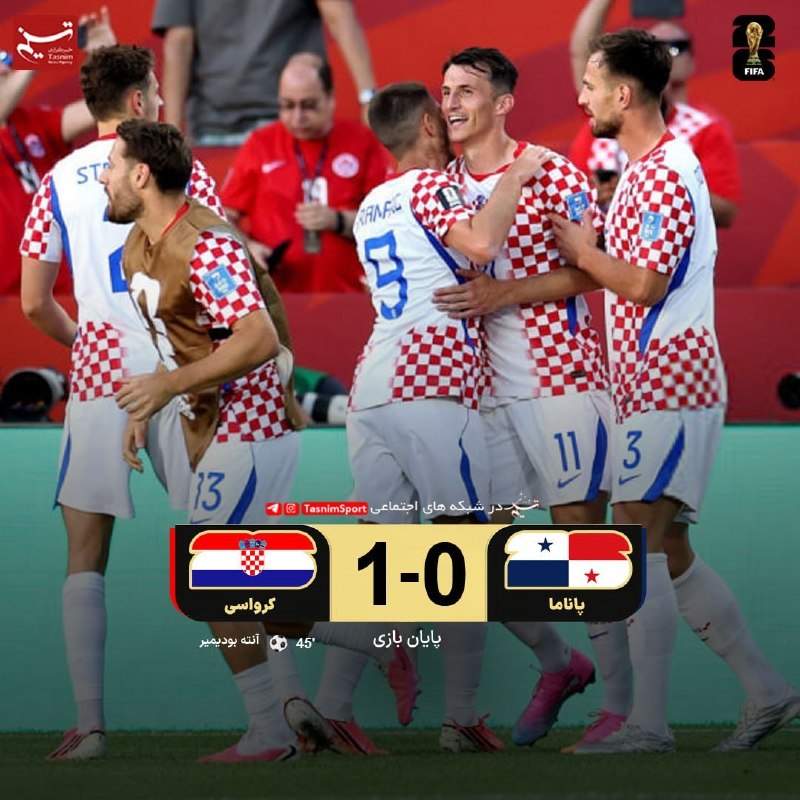
At 21:16 UTC on 23 June 2026, Iranian state-affiliated wire Tasnim News posted its customary pre-match build-up: a reminder that Croatia and Panama would meet at 02:30 local broadcast, aired on Channel 3. By 00:16 UTC on 24 June, the same wire had pushed the only goal of the game. By 00:58 UTC, the tournament's arithmetic had been confirmed: Croatia 1, Panama 0, and Panama becomes the fifth team eliminated from the group stage. Ante Budimir, in the 54th minute, scored the goal that did it.
None of this is contested. The reason it is worth pausing on is not the result. It is which desks bothered to report it, and through which pipeline the news travelled. The 2026 World Cup is a 48-team tournament, and the editorial gravity of the global football press bends sharply toward the matches that matter to large broadcast markets: Brazil, Argentina, the United States, Germany, England, France, Spain. Croatia-Panama is not that match. It is a fixture between a 2018 finalist now rebuilding and a CONCACAF side in its second-ever World Cup. It is exactly the kind of game that, in the routinised hierarchy of Western football desks, earns a paragraph at the bottom of a round-up, if that.
The 54th-minute bulletin
Tasnim's own timeline does the work of a match report. The 00:16 UTC bulletin identifies the scorer, the minute, and the score line, in that order. The 00:58 UTC bulletin reframes the same event as elimination arithmetic. Together they constitute a complete narrative spine: the goal, then the consequence. There is no attempt at colour, no description of the run of play, no tactical framing. The wire's job, as Tasnim understands it, is to deliver the headline and let downstream outlets write the prose.
That is what wires do. It is also what makes the choice of which wires cover which matches a political fact in its own right. Tasnim is an Iranian state-affiliated outlet. Its English-language sports desk exists, in part, because the Islamic Republic's media apparatus treats sporting success — Iranian athletes, Iranian-adjacent storylines, and now any World Cup fixture worth pushing out — as soft-power infrastructure. A goal by Budimir is not Tehran's story. But a clean, immediate, bilingual wire bulletin is the product Tasnim is selling, and on this fixture it was the only product on the wire at the moment the goal went in.
What the silence of the bigger wires signals
The structural story is not about Iran. It is about coverage gaps. A 48-team World Cup generates roughly 64 matches in the group stage alone. No editorial desk can treat all of them as front-page. The English-language wires that dominate global football coverage — Reuters, the BBC, the Guardian, ESPN, Sky — ration their attention by audience size and narrative weight. Croatia-Panama qualified, narrowly, for inclusion. It did not qualify for live minute-by-minute treatment in the way that England, Brazil, or the United States fixtures do.
The consequence is that for a window of around 40 minutes, the authoritative English-language bulletin on the goal that eliminated Panama was an Iranian state wire. That is not a criticism of Tasnim's reporting. The bulletin was accurate, the score was correct, the elimination arithmetic checked out. It is a criticism of the assumption, baked into Western sports journalism, that the global game is well-served when non-priority fixtures are left to whoever happens to be on the wire at the moment a goal goes in.
What the result actually meant
The result itself is more interesting than the coverage gap. Croatia, finalists in 2018 and semi-finalists in 2022, are now building a side in the post-Modrić transition. Budimir, a 34-year-old striker at Osasuna, is not a name most neutral fans would have pencilled in as Croatia's goalscoring insurance policy. The win keeps Zlatko Dalić's side in the tournament and eliminates a Panama team that had already shown it could compete technically in qualifying. The fifth team to go out, in a 48-team format, is still the fifth team to go out. There is no gentle way to read elimination, and Panama's campaign deserves more than a footnote.
Stakes and the read of the field
The honest read: Tasnim got the goal on the wire first, and the global English-language desk that most needed to report it was the one least likely to staff it. The structural pattern — non-mega-fixtures covered, when they are covered at all, by whoever is awake and on deadline — is not new. It is, however, more visible in a 48-team tournament. A bigger World Cup produces more dead rubbers, more 02:30 local kick-offs in non-host time zones, and more matches whose only authoritative English bulletin is a state wire from a country with no obvious stake in the result. That is what the 54th-minute goal by Budimir actually demonstrated, beyond the elimination arithmetic: the global football press is more stratified than the global football itself.
Desk note: Monexus covered this as a structural story about wire coverage and audience rationing, not as a match report. The score is confirmed by the Tasnim timeline; the framing of the coverage gap is this publication's analysis.
Wire provenance
This editorial synthesis draws on the following public wire/social posts:
- https://t.me/tasnimnews_en/201847
- https://t.me/tasnimnews_en/201852
- https://t.me/tasnimnews_en/201838