Tehran Names NATO in the Frame as Iran Demands Accountability for Strikes
Iran's Foreign Ministry spokesperson has called on NATO and two of its European members to be held answerable for alleged complicity in US-Israeli strikes, sharpening a diplomatic confrontation that places the alliance's southern flank in the frame.
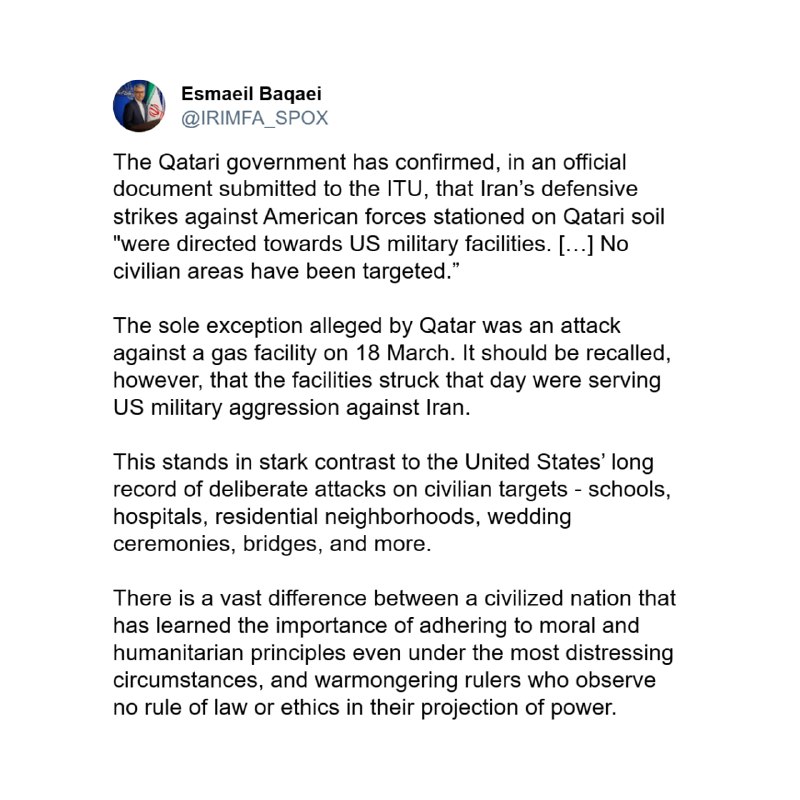
At 23:32 UTC on 24 June 2026, Iran's Foreign Ministry spokesperson Esmaeil Baqaei walked a diplomatic line that the country's own state-aligned outlets were already amplifying by the minute: NATO, together with its member states Italy and Romania, should be held accountable for any complicity in what Tehran characterises as crimes committed by the United States and Israel against Iran. The phrasing, carried simultaneously by Tasnim and Fars on their English-language wires, marks the first time Tehran has publicly dragged the alliance itself, and named individual European members, into its rhetorical frame on the strikes.
What began as a routine Israeli–Iranian exchange has now widened into a question about whether NATO, as an institution, can be held answerable for the airspace, basing, or intelligence architecture its members may have provided during a campaign against a third country. Tehran's move is rhetorical; whether it amounts to anything more will depend on whether European capitals treat it as a passing line from a podium or as a structural shift in how Iran intends to litigate the war.
From podium to protocol: what Baqaei actually said
The wording that ran across Tasnim and Fars was identical in substance. NATO, "including Italy and Romania," must be held accountable for any complicity in the crimes committed by the US and Israel against Iran. The repetition across two of Iran's most-wired official outlets — Tasnim, which carries the foreign ministry's English readouts, and Fars, the news agency closely associated with the Islamic Revolutionary Guard Corps — is itself a signal. In Iranian state-aligned media, a coordinated double-publication usually means the message has cleared the foreign ministry and the security establishment simultaneously, not merely the spokesperson's office.
Two details stand out. First, the choice of named countries. Italy and Romania are not the loudest pro-Israeli voices in NATO — that distinction would more commonly attach to the United States itself or to governments such as Germany or the Netherlands. That Tehran singled out Rome and Bucharest suggests a specific operational role, perhaps airbase access, radar cooperation, or overflight rights, that Iranian intelligence believes it can substantiate. The framing is calibrated: not "NATO in general," but NATO plus the two members whose territory or assets Iran considers most directly implicated.
Second, the language of "complicity." In diplomatic usage, complicity implies that a third party has materially enabled a violation of law by another actor. It is a term that carries weight in international legal discourse on aiding and abetting, and its appearance in a foreign ministry readout is deliberate. Iran is laying the predicate for a legal argument, not merely a political one.
The Mark Rutte backdrop: NATO's own framing of Iran
The same evening, Fars circulated video of NATO Secretary General Mark Rutte speaking at what appears to be a joint appearance with President Donald Trump, characterising Iran as a country "exporting terrorism and chaos" and crediting Trump's Iran policy as "very important." Iranian state media framed the clip as evidence of NATO's hostility, using the word "exaggeration" to describe Rutte's language.
The exchange is small in volume but large in signal. Two of NATO's most senior figures have, on the same day, been cited by Iranian outlets in diametrically opposed registers: Rutte as the public accuser, Baqaei as the public accuser of the accuser. The diplomatic traffic is now bidirectional.
For European NATO members, this creates a problem the alliance has not had to manage in quite this form. The complaint is not from a non-member government on the alliance's periphery; it is from a major regional state with second-strike capability and a developed apparatus for international legal argumentation. The line between "NATO member speaks critically of Iran" and "Iran accuses a NATO member of complicity in war crimes" has now been crossed in a single news cycle.
Why Italy and Romania: reading the operational subtext
Tehran's choice of named countries invites three readings, each with different implications. The first is that Iran has specific intelligence on basing or overflight. Italy operates from bases in the south and hosts US forward-deployed assets under NATO agreements; Romania has hosted elements of the US ballistic missile defence architecture at Deveselu, a facility Iran has objected to since its activation. Either location, or both, would be plausible candidates for inclusion in an air campaign against Iran.
The second reading is strategic: Italy and Romania are southern-flank NATO members with active Mediterranean and Black Sea postures. Naming them binds Iran's complaint to the alliance's most exposed members, forcing a discussion about burden and risk that NATO would prefer to keep internal.
The third reading is more speculative but worth naming: that Iran is constructing a catalogue of named actors that it intends to deploy across multiple international forums, including the UN General Assembly and potentially the International Court of Justice. Naming the institution first, and then the member states, mirrors the structure of legal pleadings more than it does a press release.
The structural frame: an Iran that litigates, not just retaliates
The pattern visible across the past months is an Iranian state apparatus that has moved away from rhetoric-only responses toward the slow assembly of legal and institutional pressure. The strikes themselves prompted the conventional reactions — domestic political messaging, regional proxy signalling, controlled escalation at sea. What is newer is the move to wrap those reactions in the language of international law, naming specific third-party states and inviting the world's legal architecture to do work that Iran's own arsenal cannot.
There is an obvious precedent here in how smaller states have historically confronted larger ones they could not match militarily: the courtroom, the UN, the diplomatic register. The structural bet Tehran appears to be making is that NATO's unity is brittle, that the legal exposure of its smaller members is asymmetric, and that sustained naming will produce a constituency inside Europe for disengagement. It is a long game, and one that does not require a kinetic victory to pay off.
For NATO, the harder problem is internal. A formal Iranian complaint to a UN body naming two member states creates an obligation on those states to respond, and on the alliance to decide whether the complaint is a member-state matter or an alliance matter. The two answers produce very different outcomes: a member-state response isolates Italy and Romania as bilateral defendants, while an alliance response commits NATO's collective political capital to defending a posture that several of its members may not want to defend.
The counter-reading: what Tehran's framing leaves out
The Iranian framing is not without its own gaps, and any honest account has to name them. Baqaei's statement does not specify which acts, conducted by which individuals, on which dates, would meet the legal threshold for complicity. Without that specificity, "complicity" functions as a political marker rather than a legal claim. The international-law framework requires the identification of a specific underlying offence and a material contribution to it; the readout does not yet do that work.
There is also a question of standing. The Foreign Ministry spokesperson is not a court; the statement is not a filing. Iran's pattern of public statements naming third-party states in advance of any actual legal action can be read as either careful preparation or as signalling that does not have to be borne out. Western readers will tend to default to the second interpretation; Iranian-aligned readers will tend to default to the first. The sources themselves do not specify which is correct, and the judgment depends on what Tehran does next.
What does hold up is the basic diplomatic fact: Iran has, on the record, named NATO and two of its European members as actors it considers answerable for the strikes. That fact is verifiable, sourced, and consequential regardless of whether Tehran ever files a brief in The Hague.
Stakes over the next weeks
Three watchpoints follow from the 24 June statement. First, whether Rome or Bucharest issues any direct response, and whether they coordinate with NATO headquarters or insist on bilateral handling. A coordinated response implies the alliance has decided to treat the matter as institutional; bilateral handling implies Italy and Romania believe they can manage the exposure themselves.
Second, whether Iran files anything formal at the UN, the ICJ, or the UN Human Rights Council. The legal architecture for such a filing is straightforward; the political calculation is less so. Filing would lock Iran into a specific evidentiary record and would expose its claims to adjudication. Not filing would leave the rhetorical claim hanging without enforcement.
Third, whether other NATO members — particularly France, Germany, and the Nordic-Baltic states — weigh in. Silence from the larger Western European members would be read in Tehran as acquiescence; a statement of solidarity with Italy and Romania would harden the alliance line. Either outcome reshapes the diplomatic geometry around the strikes.
The most likely near-term outcome is rhetorical equilibrium: more statements, no filings, no new commitments. But the equilibrium has shifted. The Iranian claim is now on the public record, the alliance has been named, and the diplomatic floor under the strikes has been raised. What was, a day ago, a US-Israeli campaign against an Iranian target is now also a question about whether NATO — and which of its members — is willing to be identified as part of it.
— Monexus framed this as a diplomatic accountability dispute, not a covert-operations story. Iranian state-aligned outlets were treated as primary sources for Iranian government statements, with explicit attribution, while NATO-facing outlets were used to corroborate the institutional and country-specific framing.
Wire provenance
This editorial synthesis draws on the following public wire/social posts:
- https://t.me/JahanTasnim
- https://t.me/tasnimnews_en
- https://t.me/farsna
Follow the event.
These dated source records provide context. They do not retrospectively verify this archive article.
Separate what the nuclear watchdog reported from what it could not determine after the June 2025 strikes.