Mumbai's monsoon debut exposes a city still building in the wrong places
Mumbai's first 24 hours of the 2026 monsoon delivered 300 mm of rain and a commuter killed by collapsing infrastructure. The pattern is structural, and it is not new.
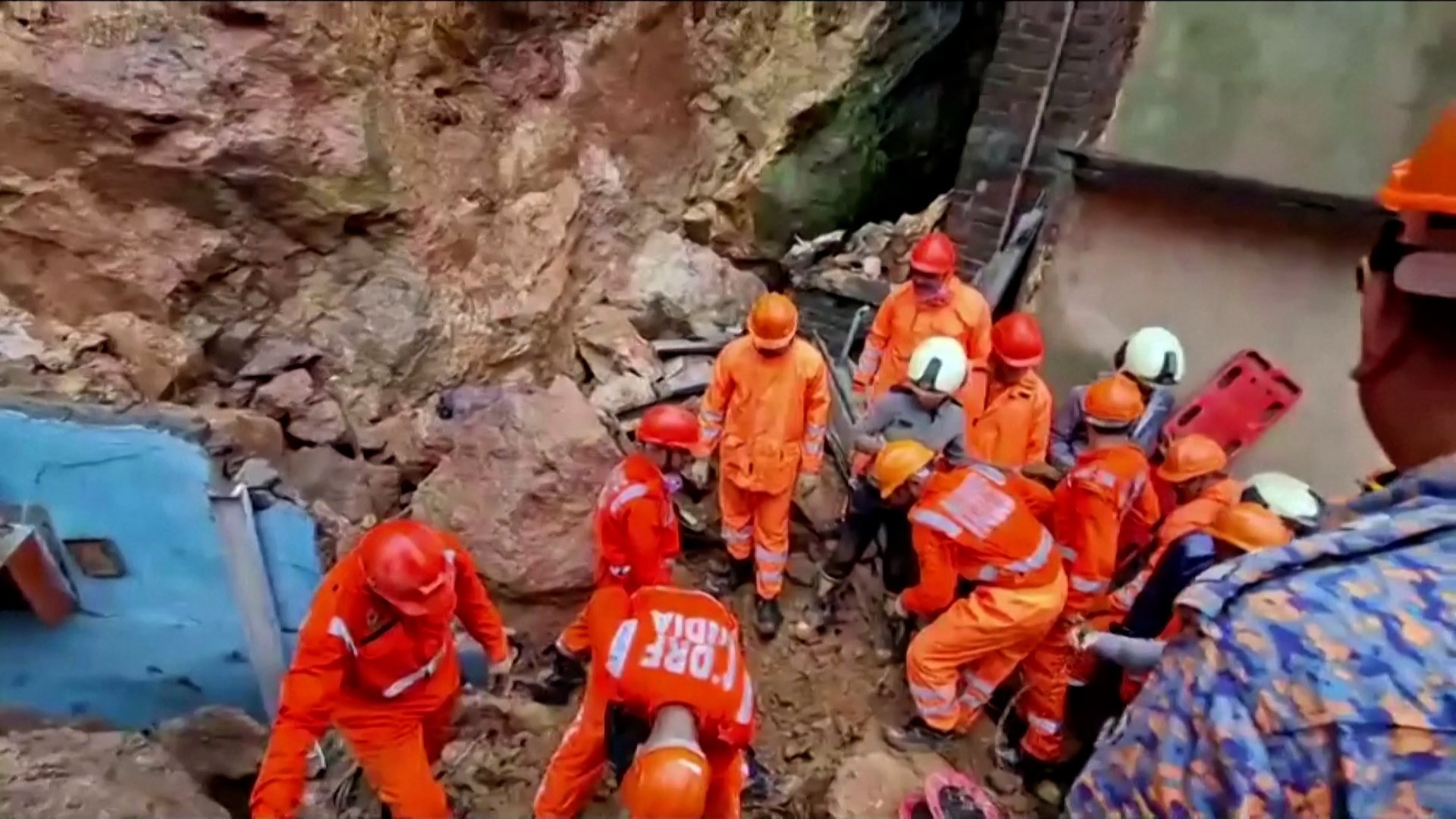
Mumbai recorded 300 mm of rain inside the first 24 hours of this year's monsoon, and a commuter was killed when a section of the city's road and rail network gave way under the load. The two events, reported separately on 24 June 2026, are the same story. They are also a familiar one. Every June, the city stages an annual ritual in which a coastline of low-lying reclaimed land, decades of informal construction on floodplains, and a storm-water system designed for a different century are asked to absorb a deluge they were never built to take. The result is a body count, a property toll, and a fresh round of official statements about drainage upgrades that rarely appear in the budget that follows.
The structural problem is older than the monsoon. Mumbai's growth, from a colonial port of roughly two million in 1947 to a metropolitan region now estimated at more than twenty million, was never matched by an equivalent expansion of the hydrological infrastructure that the city sits on top of. The original British-era drainage network, known in fragments as the Brimstowead system, was sized for a population a tenth of today's. Subsequent additions have been piecemeal, under-funded, and frequently compromised by the same encroachments they were meant to relieve. Pumping stations sit beside the Mithi river, a heavily polluted waterway that itself functions as the city's principal storm-water conduit. Each season, the river's embankments and the surrounding low-income settlements compete for the same cubic metres of runoff.
The construction story is the obverse of the drainage story. A meaningful share of Mumbai's housing stock sits on land that should never have been built on: tidal flats, mangrove zones reclaimed piecemeal, the floodplains of the Mithi, the Oshiwara and the Poisar, and the steep hillside catchment that drains straight into the city's western suburbs. When the monsoon arrives, water does not behave politely. It follows the gradient it was always going to follow, and the buildings in its path were authorised by a permitting regime that has, at multiple points in the city's modern history, been captured by the same builder lobbies that profit from the encroachments. The 2025 collapse of a structure in the Kurla area, in which seventeen people died, was the most prominent recent reminder that the supply of compliant housing has not kept pace with the demand. The June 2026 death is the same reminder, in a different postcode.
There is a tempting counter-narrative on offer, and it is worth taking seriously. The Brihanmumbai Municipal Corporation, the state government's coastal road project, the Mumbai Metro Rail Corporation, and the central government's flagship infrastructure programmes have all spent heavily on the city's resilience. A 7.5 km coastal road phase opened in 2024, with further extensions planned. The Mumbai Coastal Road Project South, an undersea tunnel segment, broke through its final headwall in 2025. Metro lines 2A, 7 and 9 are operational; line 12 is under construction. Drainage upgrades are nominally in progress in multiple wards. The rainfall event of 24 June did not catch the city completely flat-footed: the BMC's now-standard protocol of declaring a holiday for non-essential services, suspending parking on flood-prone streets, and deploying the National Disaster Response Force is a real piece of institutional learning, paid for in part by the casualties of earlier seasons.
The honest assessment is that none of this infrastructure, however welcome, addresses the underlying land-use question. A coastal road protects the road. A metro line moves people who can reach a station. A pumped drainage upgrade can only move water as fast as the receiving body can take it, and the receiving bodies in Mumbai are silted, encroached and partially blocked for most of the year. The rainfall is not getting worse, at least not in any way that the record unambiguously confirms for the 2026 season: monsoons have always been capable of producing 300 mm in a day, and the Arabian Sea branch of the monsoon has always arrived on roughly the calendar it arrived on this week. What has changed is the surface the rain falls on, the population that surface now has to absorb, and the cost of failure when the system overruns.
The arithmetic of permits
Mumbai's development plan, the city's master land-use document, is revised roughly every twenty years and revised badly in between. Between the 1991 plan and the 2014 plan, floor-space-index rules and reservation policies shifted several times, often in ways that rewarded builders with deep political connections and penalised smaller developers. The result is a built environment in which the densest, lowest-quality housing is concentrated on the most flood-prone land, because that is the only land where the poor could afford to build. Climate-adaptation finance for cities, increasingly available from multilateral lenders, tends to fund capital projects: sea walls, pumping stations, transit. It rarely funds the slower, more politically difficult work of relocating settlements, regularising tenure on safer ground, or capping the number of new units that can be authorised in a given flood zone. Until that arithmetic is changed, the monsoon will keep finding the same weak points.
What the central government is and is not doing
New Delhi has been visibly interested in Mumbai's resilience, and visibly constrained by the federal structure in which Indian cities operate. Urban land and housing are state subjects under the Constitution; the Centre can fund, exhort, and occasionally legislate around the edges. The Smart Cities Mission, which had Mumbai on its original list, has produced a mixed record. The more recent Union Budget has emphasised capital expenditure on urban transit and coastal infrastructure. The missing line item, as ever, is governance reform that would give the metropolitan authority the power to plan, permit and clear land in a single document rather than across a dozen overlapping agencies. Until that line item appears, the city's responses to the monsoon will continue to look like a sequence of well-funded projects that do not quite add up to a system.
What to watch over the next four weeks
The 24 June deluge is, by historical standards, an opening act. The southwest monsoon normally peaks over Mumbai in the second half of July, and a single 300 mm day in late June is a better predictor of strain on the system than of total seasonal rainfall. The next test points are: a second sustained rainfall event in the same week, the BMC's revised flood-management plan for the Mithi basin, any High Court proceedings on encroachment on the city's nullahs, and the Maharashtra state budget, where the gap between announced drainage spending and committed contracts is usually widest. If a commuter is killed by the same kind of failure that killed a commuter in June 2025, the failure is not a meteorological surprise. It is a planning outcome. And it is one the city has, for at least two decades, been able to see coming.