Schumer's 100-Day Clock: A Congress That Says No to War Without Saying What Comes Next
A rare bipartisan rebuke landed on 23 June 2026. The harder question — what Congress actually wants the executive to do next — remains conspicuously unanswered.
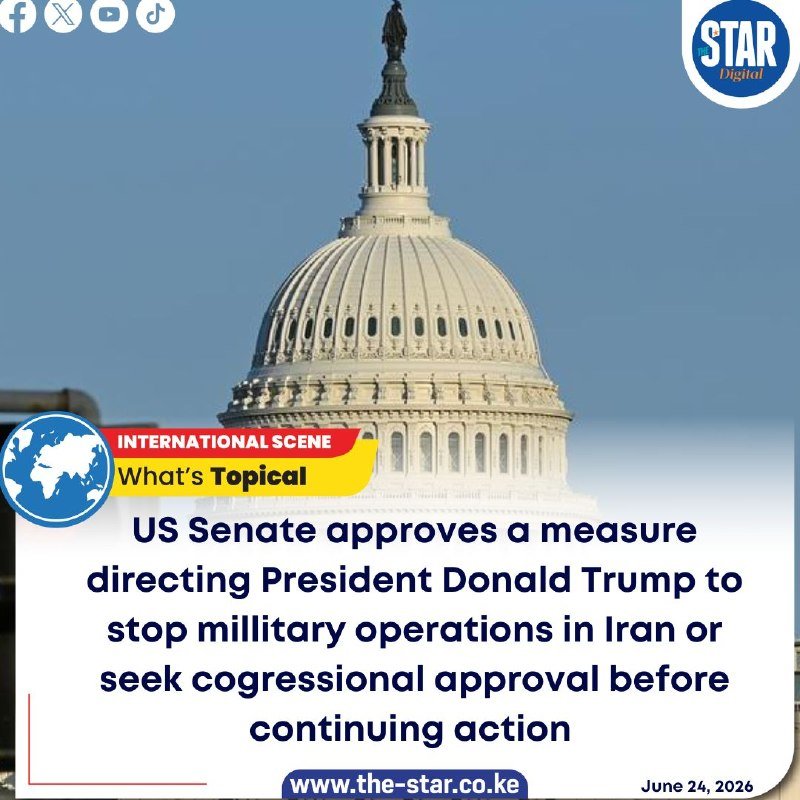
On the evening of 23 June 2026, the United States Senate's top Democrat used the word "reckless" twice in twenty minutes. Chuck Schumer, the chamber's minority leader, told reporters that for more than 100 days Congress and the American people had "demanded transparency, answers, and an end to the fighting," and that what the president had "achieved through this reckless war is the ultimate level of confusion and chaos, and the maximum loss for the American people." Within the same half-hour, Schumer confirmed that a joint war-powers resolution had cleared both chambers of Congress for the first time without requiring the president's signature — a procedural footnote that, in a town addicted to procedure, functions as a constitutional alarm bell.
That alarm is real. The political signal is also unmistakable: a Democratic leader has found language sharp enough to brand a sitting commander-in-chief's foreign war a continuing loss to the American public, and to attach that brand to a binding legislative vehicle. What the signal does not yet contain is a positive case — what Congress wants the executive to do on Monday morning, on Tuesday morning, on the morning after the next strike. The resolution says stop. It does not say with what. The harder editorial question is whether a Congress that can finally say no can also bear the cost of saying yes to a successor policy.
The "reckless war" frame, and what it actually pins down
Schumer's three-line statement is short, and the brevity is the news. The phrase "ultimate level of confusion and chaos" is not a policy critique; it is a legitimacy critique. It places the cost of the war not on a foreign adversary but on the American people — language designed to travel beyond the foreign-policy press gallery and into the cable-news middle. Combined with the 100-day clock ("for more than 100 days, Congress and the American people have demanded transparency"), the framing converts a geopolitical question into a domestic one. The argument is not that the war is unjust in some abstract sense; it is that the war is being run badly, at American expense, with insufficient answers to a co-equal branch of government.
The second line — that the resolution has cleared both chambers and "does not require the president's signature" — is the procedural heart of the moment. A war-powers resolution that bypasses the desk is, in practice, a congressional assertion of authority that an executive cannot quietly bury. The Constitution gives Congress the power to fund and to declare; the War Powers Resolution of 1973 gave the legislature a sixty-day clock and a mechanism to compel withdrawal. A bipartisan veto-proof vehicle, even one that the president will contest in court, is a different animal. It is Congress saying, on the record, that the sixty-day clock has been and gone.
The counter-narrative the White House will reach for
The Republican counter-frame, as it has run on cable and on the Hill since the spring, is structurally familiar: a war-powers rebuke is a gift to the adversary, a signal that American resolve is wavering precisely when it must not, and a vote that will be read in foreign capitals as a green light to test the next administration harder. There is a real argument underneath that rhetoric. The argument runs that war-powers votes are not free; they cost credibility; and credibility, once spent, is not refundable. Senior figures inside the administration have argued, off-record and on, that any public congressional move against the war effectively ratifies the strategic objective of the state the United States is contesting.
It is a coherent position. It is also a position that, after 100 days, asks the American public to keep extending credit on terms that the same administration has refused to specify. Schumer's statement does not pretend to answer the strategic question; it only insists that the cost question be put on the table. The counter-narrative is at its strongest when it can point to a Democratic alternative. The counter-narrative is at its weakest when, as of 23 June, the alternative is still a sentence fragment.
The structural frame: a Congress rediscovering its lever
What is unfolding is not a single foreign-policy dispute. It is a slow-motion rebalancing between branches that had quietly tilted toward the executive since the early 2000s. Two decades of post-9/11 authorisations, of continuing resolutions that funded wars without naming them, and of vote-counts that never quite arrived produced a legislature that had, in practice, outsourced war-making to the White House. A bipartisan war-powers vehicle that does not need the president's signature is the procedural device that re-opens that outsourcing arrangement. The pattern is not new in American history — Congress has periodically re-asserted itself at the seams of presidential overreach — but the device is unusually clean this time. Both chambers. No signature. A Democratic leader willing to spend the word "reckless" on the floor.
The structural risk runs the other way too. A Congress that relearns its lever without relearning its responsibilities becomes a body that says no to the war without owning the consequences of what follows. That is the unfinished business under the headline. It is also where the editorial pressure ought to land in the days ahead.
Stakes: who wins, who loses, and the time horizon
If the trajectory holds, the immediate losers are the constituencies that built the war's domestic case — the defence-industrial constituencies on Capitol Hill, the foreign-policy commentariat whose expertise is organised around continuity of the existing posture, and the executive branch itself, which loses a tool it has used almost without interruption for two decades. The immediate winners are the legislature's prerogative, an American public being told, for the first time in a generation, that the cost of the war will be debated on the floor rather than briefed in the situation room, and any adversary whose strategy assumed that American war-weariness and American war-commitment were politically indistinguishable.
The honest caveat: the sources available at the time of writing do not specify the exact operational scope of the resolution, the precise count of Republican votes in either chamber, or the administration's next procedural move. Schumer's statement is on the wire; the roll-call details are not yet. A reader who needs the parliamentary numbers should wait twelve hours. A reader who needs the constitutional point can act on what is already in the record: for the first time in this conflict, both chambers have spoken with one procedural voice, and the commander-in-chief cannot make that voice disappear with a pen.
Desk note: Monexus framed Schumer's 23 June 2026 floor statement as a constitutional-legitimacy story, not as a partisan attack line — the operative word is "reckless," used here as a domestic-cost argument, not a foreign-policy verdict. The White House counter-frame is steelmanned in the second section rather than dismissed; the structural section sits the vote inside two decades of executive war-making, expressed in plain prose.
Wire provenance
This editorial synthesis draws on the following public wire/social posts:
- https://t.me/alalamarabic
- https://t.me/alalamarabic
- https://t.me/alalamarabic
- https://t.me/alalamarabic
- https://en.wikipedia.org/wiki/War_Powers_Resolution