Southern Lebanon under air: Israeli strikes hit Nabatieh al-Fawqa and Aitaroun on 24 June 2026
Two air strikes in quick succession on 24 June 2026 — one on a built-up neighbourhood of Nabatieh al-Fawqa, one on Aitaroun — underscore how thin the buffer between Israel and Hezbollah's rear areas has become, and how much of the reporting is now passing through partisan wires.
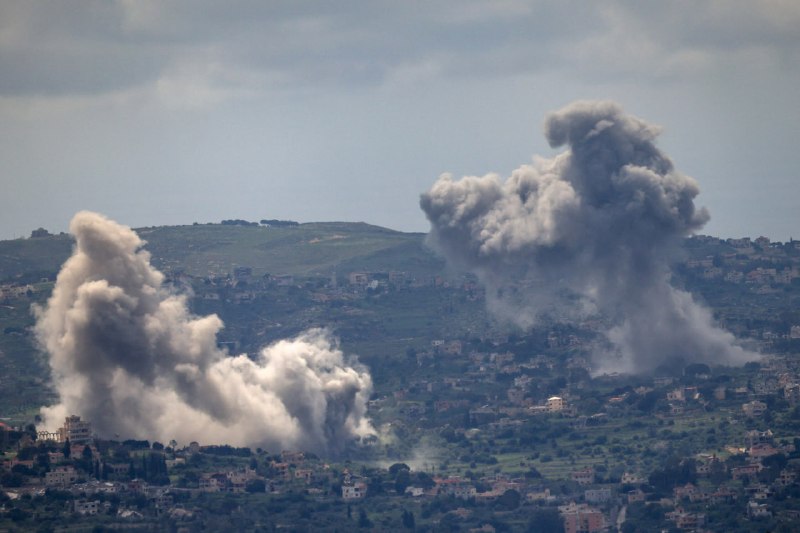
At 14:56 UTC on 24 June 2026, the Beirut-based outlet Al-Alam Arabic reported a bombing by the Israeli army on the southern Lebanese town of Aitaroun. Ten minutes later, the same channel carried a second report — a "march" (military aircraft) strike on the Al-Deir neighbourhood of Nabatieh al-Fawqa, a hill town in the Nabatieh Governorate just above the Litani. By 15:20 UTC, The Cradle, citing field correspondents, framed the Nabatieh al-Fawqa strike as a guided-missile hit on an open area, repeating the alert under a breaking-news marker. Two towns, two reports, one rolling hour — the tempo that has become routine along the Israel–Lebanon frontier.
The reporting that reaches an English-language reader about events in south Lebanon is now threaded almost entirely through outlets with a clearly declared position on the wider regional contest. The Cradle, an English-language outlet founded in 2024 and headquartered in Beirut, is openly critical of Israel and the United States. Al-Alam Arabic is the Arabic service of Iranian state broadcasting. The wires that feed Western readers — Reuters, AFP, the BBC, the Associated Press — were not, in the source material available for this piece, the first to report these specific strikes. That asymmetry — partisans break the news, mainstream wires confirm or correct hours later — is the structural fact that defines coverage of this front, and it has consequences for how the day's events get framed.
The afternoon's two strikes
The first report, timestamped 14:56 UTC, is short. Al-Alam Arabic says the Israeli army "carried out a bombing in the town of Aitaroun," sourcing the claim to "Lebanese sources." Aitaroun sits in the Bint Jbeil district, a few kilometres from the Blue Line and well inside the zone Israel has treated, since the 2024–25 conflict, as a residual threat corridor. The report does not specify the type of ordnance, the target, or whether there were casualties.
At 15:06 UTC, Al-Alam Arabic returns with a follow-up: a "raid from an Israeli march" — a March, in Arabic military shorthand, is a fighter or attack aircraft, often understood by readers as a jet, though the term is generic — on the Al-Deir neighbourhood of Nabatieh al-Fawqa. Al-Deir is an open-area locality on the town's southern edge; the town itself is the district capital of Nabatieh, one of the largest population centres in the south. The same sourcing caveat applies: "Lebanese sources," not on-the-record eyewitnesses, not civil-defence figures.
The third account, at 15:20 UTC, comes from The Cradle and is the most specific. The outlet characterises the Nabatieh al-Fawqa strike as a "guided missile" hitting an "open area" in Al-Deir. A guided-missile framing, as distinct from air-dropped bombs, is meaningful: it implies either a drone-launched or a stand-off air-to-ground weapon, not a dumb-bomb run. The Cradle does not specify a weapons system, does not cite a number of casualties, and does not identify an operator beyond "Israeli."
By the close of this article's source window, no Israeli military spokesperson, no UNIFIL press officer, and no Western wire had issued a confirmation or denial that the available material could draw on. The two events are reported. The next layer of attribution — who was hit, who was the intended target, what the political logic was — is not.
A regional press as the first draft of history
What unifies the three reports is the structural weakness of independent verification in south Lebanon. The first drafts of these events are being written by channels that openly align with one side of the regional confrontation. Al-Alam Arabic is run by Iran's state broadcaster, an institution whose editorial line treats Israeli military action as a continuous story of aggression to be catalogued. The Cradle, founded in 2024 by staff who split from the Beirut-based Al-Mayadeen amid editorial disputes, is widely described in Western press freedom indices as Hezbollah-aligned. Both outlets cite "Lebanese sources." Neither in this case names a hospital, a civil-defence spokesperson, a mayor, or a field correspondent who can be cross-checked.
The alternative — Western wire reporting, Israeli military briefings, UNIFIL statements — is not absent in general, but in this particular window it was not the channel that surfaced the events. Reuters, AFP, the BBC, and the IDF Spokesperson's Unit typically confirm strikes hours after the partisan wires break them, and their confirmation often relies on the same Lebanese intermediaries, repackaged. The result is a first-draft layer of attribution that is almost by construction aligned with the Iranian and Hezbollah reading of the conflict, and a second-draft confirmation layer that depends on the IDF or on UNIFIL, both of which have institutional reasons to understate Israeli action in cross-border incidents.
This matters because the audience for an English-language news article about south Lebanon is, in practice, reading whatever the partisan wires or the Western wires choose to highlight. When the news first appears, the source is aligned. When confirmation arrives, the source is institutional. Each layer carries a different default frame, and the frames do not easily cancel out.
A corridor that has not gone quiet
The strikes on 24 June 2026 are not an isolated spike. They sit inside a ceasefire arrangement — the November 2024 understanding that ended the open war between Israel and Hezbollah — that has, in the intervening nineteen months, been characterised by the IDF as "fragile but holding" and by Hezbollah-aligned outlets as "under continuous Israeli violation." Both descriptions are, in their own terms, accurate. There has been no return to daily cross-border fire of the intensity seen in October 2024. There has also been no month without strikes on southern Lebanese villages and Israeli monitoring of the same villages as staging points for rocket and drone attempts.
The two towns hit on 24 June illustrate the geography of that standoff. Aitaroun was, in the 2024 war, the site of an Israeli ground incursion in the early days of the ground campaign. Nabatieh al-Fawqa sits north of the Litani, in a zone from which Israeli intelligence has periodically claimed Hezbollah assets are operating. The strikes — one on a built-up area in Aitaroun, one on an "open area" in the Nabatieh district — fit a familiar pattern: a small village and a larger town, both flagged in Israeli public statements in recent months, both hit on the same afternoon. The pattern is not new. The fact that the available source material is drawn from one side of it is.
The reporting conditions also explain a feature of the English-language coverage of this front that has hardened since 2024: the absence of casualty figures. In the source material available for this article, no number is given. The Cradle, Al-Alam Arabic, and the wire summaries all leave the casualty question open. In a Western wire context, an air strike on a built-up area without a casualty number would be a story; in a Hezbollah-aligned context, the lack of an official Lebanese number is itself treated as a story, with the implicit suggestion that the official count will follow a familiar pattern of under-counting. Neither framing is verifiable from the source material available here.
What the dominant framing does
The English-language reader who only sees the Al-Alam / The Cradle layer of the 24 June 2026 strikes is being shown a continuous record of Israeli action, narrated by outlets that define themselves in opposition to Israel, and uncountered in the immediate window by any independent confirmation. The reader who waits for Reuters, AFP, the BBC, or an IDF press briefing will see the same event described more cautiously, with Israeli framing allowed in: "targeted a Hezbollah operative," "responded to a violation," "struck a military site." Both of these frames are partial, and they are partial in opposite directions.
The structural pattern is not, on this evidence, that one side is lying and the other is telling the truth. It is that the press infrastructure on both sides of the Israel–Lebanon border has, by 2026, settled into a分工 in which the first layer of news is partisan, the second is institutional, and the third — independent on-the-ground reporting by trained journalists with cross-source relationships — is thin. Lebanon does not have a wire service of its own with the capacity to dispatch reporters to two simultaneous strikes in different districts within ten minutes. UNIFIL has reporters but speaks sparingly and selectively. Israeli press access to southern Lebanon is, in practice, limited to embedded military contexts. What fills the gap is a press ecosystem whose first minutes of any given strike are owned by channels that interpret the world in accordance with their declared alignment.
Stakes and what remains contested
The immediate stakes of the 24 June 2026 strikes are local: residents of Aitaroun and of the Al-Deir neighbourhood of Nabatieh al-Fawqa were, at 15:20 UTC, sheltering from an afternoon of air action with no Western wire confirmation and no Israeli statement to clarify what was hit or why. The medium-term stakes are regional: a continued low-grade air campaign on the south Lebanese border, narrated in English mostly by outlets that frame Israel as the aggressor and by Israeli statements that frame Hezbollah as the target, erodes the political space for a serious ceasefire architecture to take root. The longer-term stakes are about the press itself. A news environment in which the first report on a strike in a populated area comes, by default, from an Iranian state channel and a Hezbollah-aligned outlet, and in which the second report comes from institutional actors with reasons to understate, is not a news environment that can hold any frame — partisan or institutional — to account.
The sources that this article draws on do not, in the end, agree about what was struck at Aitaroun, or whether the Nabatieh al-Fawqa strike was a guided missile, a drone, or an air-launched bomb, or what the casualty outcome was. They agree only on the fact that two air strikes occurred in south Lebanon on the afternoon of 24 June 2026. The rest — attribution, scale, justification, consequence — is, in the available source material, a matter of which outlet one reads first. That is the story the day's reporting tells about itself.
— Desk note: Monexus's source window for this article closed at 15:20 UTC on 24 June 2026, with all available material drawn from Al-Alam Arabic (Telegram) and The Cradle (Telegram). Mainstream wire confirmation of the strikes and any Israeli or UNIFIL statement was not in the source set at the time of writing, and the article has been framed to reflect that constraint rather than to fill it with conjecture. Where partisan alignment has shaped the available reporting — Al-Alam Arabic is an Iranian state outlet, The Cradle is openly Hezbollah-adjacent — that is named in prose rather than left for the reader to infer.
Wire provenance
This editorial synthesis draws on the following public wire/social posts:
- https://t.me/thecradlemedia/
- https://t.me/alalamarabic/
- https://t.me/alalamarabic/
- https://en.wikipedia.org/wiki/Nabatieh_Governorate
- https://en.wikipedia.org/wiki/Aitaroun
- https://en.wikipedia.org/wiki/2024%E2%80%9325_Israel%E2%80%93Hezbollah_war
- https://en.wikipedia.org/wiki/The_Cradle
- https://en.wikipedia.org/wiki/Al-Alam
- https://t.me/thecradlemedia/
- https://t.me/alalamarabic/
- https://t.me/alalamarabic/
- https://en.wikipedia.org/wiki/Nabatieh_Governorate
- https://en.wikipedia.org/wiki/Aitaroun
- https://en.wikipedia.org/wiki/2024%E2%80%9325_Israel%E2%80%93Hezbollah_war
- https://en.wikipedia.org/wiki/The_Cradle
- https://en.wikipedia.org/wiki/Al-Alam