Trump's Strait Talk: How a 'Winning' Iran War Became a Negotiation
The president says America is winning by a lot. The secretary of state says technical talks resume on the 30th. Something has to give — and the Strait of Hormuz is where the arithmetic gets real.
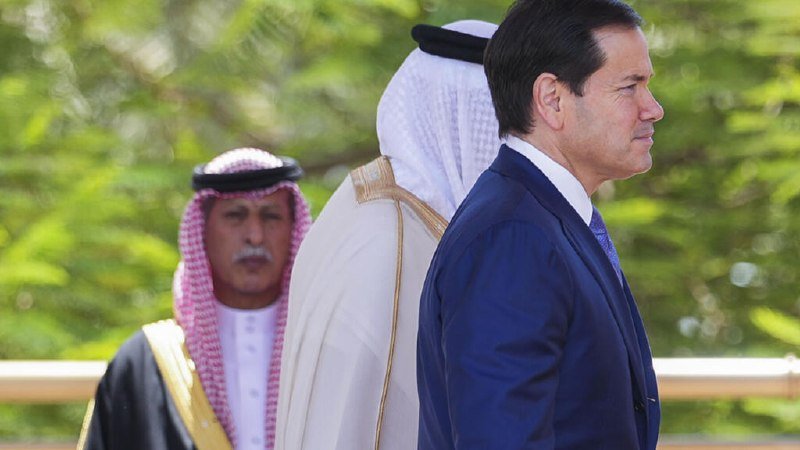
On 24 June 2026, the public messaging from Washington on the Iran war split cleanly in two — and the split is the story. President Donald Trump, speaking to reporters earlier in the day, declared that "the war is going very well. As you know, we're winning by a lot. Iran is making very big concessions." Within the hour, Secretary of State Marco Rubio was telling the same press pool something materially different: that U.S.–Iran technical talks are being conducted at the staff level, with the technical group set to reconvene on the 30th, and that "when we say open the straits, we mean open the straits free. They are international waterways."
This is the gap that defines the next two weeks of Middle East policy. The rhetorical line — maximalist, declared-victory, dominated by the president's social feed — and the operational line — technical, sequenced, anchored to a calendar — are not the same line. A reader who watches only one will form a completely different view of where the United States actually stands.
What the president is selling
The Trump framing is the one that travels. "Winning by a lot" is a slogan designed to foreclose dissent at home and demoralise the Iranian negotiating team abroad. It treats concessions as already-extracted, not as the object of an exchange still under construction. It is the language of a closing argument, not an opening one.
The structural problem with that language is that it pre-commits the U.S. side to a victory narrative whose cost has not yet been disclosed. If Iran is in fact making "very big concessions," the American public is entitled to see them: which sanctions are coming off, which nuclear facilities are being dismantled, which proxy capabilities are being wound down, and over what timeline. The thread material does not contain those specifics. It contains a posture.
What the secretary of state is actually doing
Rubio's remarks are the substantive content of the day, and they deserve to be read on their own terms. Three points stand out.
First, the channel is staff-level technical talks, with a reconvened round on the 30th. That is the standard architecture of a sanctions-or-nuclear negotiation, not a surrender ceremony. It implies a sequenced agenda: inspectors, enrichment ceilings, verification protocols, delivery mechanisms for any unfrozen assets. None of that is the choreography of a side that has already won everything it came for.
Second, Rubio drew a hard red line around the Strait of Hormuz. International waterways, no tolling, no country on the planet would support tolling in the straits. This is significant because it pre-empts a concession that Tehran's hardliners have reportedly floated in previous rounds: a tolling or transit-fee regime, in effect a recognition of Iranian coercive leverage over roughly a fifth of global seaborne oil. Washington is saying, in advance, that this lever cannot be monetised in any final deal.
Third, and quietly, Rubio reaffirmed that "we are not going to do anything that undermines the security of our long-standing allies in the region." In the diplomatic register of the Gulf, that is a coded reassurance to Riyadh, Abu Dhabi and the smaller monarchies that the U.S. will not trade their airspace or their territorial integrity for movement on the nuclear file. It is also a signal to Israel that any deal will be filtered through the requirements of regional deterrence.
The Israeli variable
The thread material also includes a statement from Prime Minister Benjamin Netanyahu, recalling that "when I came to President Trump before the Am Kalavi operation (June 2025), I told him I was going to Iran, I didn't ask for permission, I simply notified him." The line is doing two things at once: it asserts Israeli operational autonomy on the Iran file, and it reminds Washington that Jerusalem retains the capacity to act unilaterally if the technical track disappoints. For an Israeli audience, it is reassurance. For a Washington audience, it is a quiet warning that the negotiating clock is not the only clock in the room.
That complicates Rubio's "long-standing allies" formulation considerably. Israel and the Gulf monarchies are both U.S. allies; their threat models from a post-deal Iran are not the same. A settlement that the Gulf reads as stable de-escalation, Israel is likely to read as an unbacked guarantee. The administration will have to thread that needle publicly as the 30 June technical round approaches.
The structural frame
Strip away the personalities and the picture is familiar. A war entered into with maximalist objectives finds, after the first serious exchange of fire, that its principal remaining utility is as leverage at a table. The Strait of Hormuz is the operative variable: not because it is being closed today, but because the credible threat of disruption is the one card Tehran holds that no inspection regime can neutralise. The administration's task is to convert battlefield momentum into a diplomatic settlement that survives Israeli, Gulf and domestic American scrutiny — and to do it before the 30 June session becomes a public stage for Iranian counter-offers.
The plausible alternative read of the day is that the gap between Trump's rhetoric and Rubio's substance is not a contradiction but a deliberate division of labour: the president holds the victory frame for political consumption, while the secretary runs the actual file. That is a defensible reading. It is also a fragile one, because once staff-level talks become a publicly dated round, the press will hold the administration to whatever the talks produce. "Winning by a lot" is hard to reconcile with a process that needs three more sittings to land.
Stakes and what remains unclear
If the 30 June round produces a framework — inspectors, enrichment cap, sanctions sequencing — the war ends in something close to Trump's rhetorical claim, though the term "concessions" will belong to both sides. If it does not, and Israeli action resumes in parallel, the Strait becomes the trip-wire for a wider economic shock that neither the president nor the secretary can manage by press conference alone. The source material does not specify which trajectory is more likely. It does show that Washington is now operating on both at once — and that the next forty-eight hours of staff-level contact will be the period in which the gap between slogan and settlement either closes or visibly widens.
Wire provenance
This editorial synthesis draws on the following public wire/social posts:
- https://t.me/s/osintlive
- https://t.me/s/osintlive
- https://t.me/s/osintlive
- https://t.me/s/osintlive
- https://t.me/s/osintlive
Follow the event.
These dated source records provide context. They do not retrospectively verify this archive article.
Separate what the nuclear watchdog reported from what it could not determine after the June 2025 strikes.