Ashura in Iran: A regime weaponises grief
State-aligned outlets framed Ashura 2026 as a uniform show of defiance. The reporting on the ground tells a narrower, more controlled story.
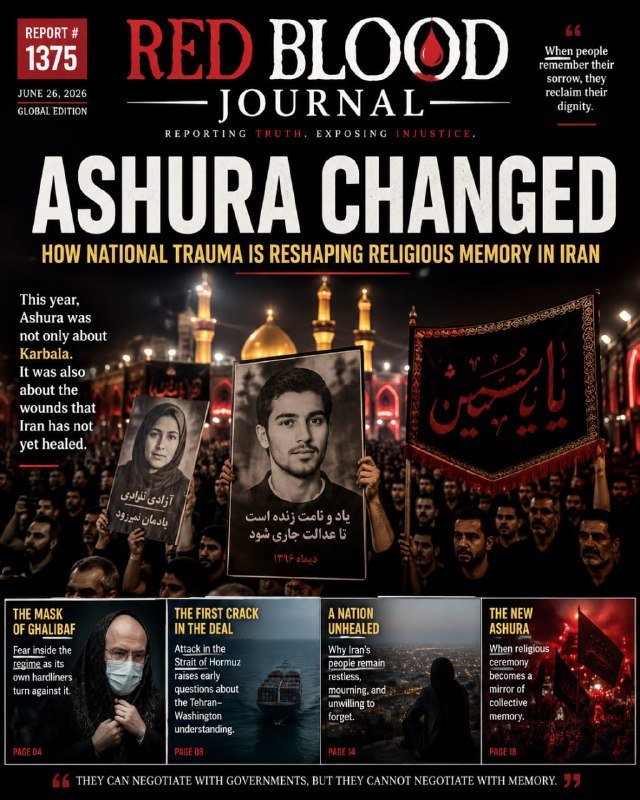
The day Iran's state-aligned press chose to lead with was Ashura, and the framing was unmistakable. On 25 June 2026, Tasnim News, the outlet closest to the Islamic Revolutionary Guard Corps, ran its noon bulletin under the headline that "red flags of revenge were waved on Kashdoorst street at noon of Ashura" — a public square in a Shia-majority country repainted, in state media's telling, as a chorus of vendetta [Tasnim, 2026-06-25T09:47 UTC]. Hours earlier, the same outlet had shown worshippers performing the Ashura afternoon prayer in the portico of Kishordoost, "near the place of martyrdom of the leader of the revolution" [Tasnim, 2026-06-25T09:18 UTC]. By morning, the camera had moved to Mashhad, framing the Imam Reza shrine as the emotional centre of gravity for the day [Tasnim, 2026-06-25T08:36 UTC]. Read together, the three dispatches are a single piece of choreography: grief managed, choreography of mourning rendered as politics, and the camera held steadily on the parts of the country the regime wants the world to see.
What follows is not a critique of Shia ritual. Ashura is observed by hundreds of millions of Muslims in Iran, Iraq, Lebanon, Pakistan, India and the diaspora, with profound internal meaning that long predates the Islamic Republic. The argument here is about who gets to define the public image of that observance — and what is left out of the frame when a state-aligned outlet does the defining.
The stage-management of public grief
The three Tasnim bulletins, taken in chronological order, describe a national mood of unified outrage. The morning piece is devotional — the shrine, the pilgrims, the colour black [Tasnim, 2026-06-25T08:36 UTC]. The mid-morning bulletin is political-religious — a prayer performed in a portico memorialising a "martyred leader" [Tasnim, 2026-06-25T09:18 UTC]. The noon item is kinetic — red flags signalling revenge in a public square [Tasnim, 2026-06-25T09:47 UTC]. The arc is the editorial point. The frame is not incidental; it is the product.
Western wire reporting on Ashura in Iran tends to receive these visuals at face value, then translates them into a single sentence about "strained regional security" or "regime messaging". That translation is incomplete. The bulletins themselves show the staging: a designated square, a designated portico, a designated shrine — each treated as a set piece. The worshippers are present, but they are inside a pre-written narrative that places them downstream of a martyred leader and upstream of a promise of vengeance. Whether individual attendees shared that reading, or arrived for purely devotional reasons, is not something the state-aligned coverage is interested in distinguishing.
What the bulletins do not say
The dominant frame in Tasnim's Ashura coverage is one of national unanimity. The plausibility check is to ask what counter-evidence would look like, and to note its absence from the thread.
First, the bulletins name no interlocutor. There is no claim, no specific grievance, no policy demand attached to the "red flags of revenge". Vengeance is invoked as atmosphere, not as programme. That is consistent with a ritual grammar of mourning — Karbala is, theologically, about injustice unanswered by empire — but it is also useful for a state that wants the emotional register of protest without committing to a specific, contestable claim that journalists or courts could later examine.
Second, no dissenting Shia voice appears in the chain. Independent Iranian outlets operating in Persian — from reformist papers to diaspora broadcasters — routinely cover Ashura with a wider lens, including sermons that critique power rather than consecrate it. None of those voices appear in the Tasnim thread. The bulletins are not lying; they are editing aggressively.
Third, the geography is selective. Mashhad, Kishordoost, the Kashdoorst street — these are visible, controllable, camera-friendly. The thread does not address Tehran's Enghelab Square, where in past years Ashura processions have produced the most contested imagery, nor the Ahvazi Arab-majority south-west, nor the Kurdish north-west, nor the Azerbaijani-speaking north-west, where Shia observance intersects with ethnic minority identity in ways the regime prefers to mute. The state-aligned camera is doing what state-aligned cameras always do: it is choosing the lens.
The structural frame, in plain prose
There is a recurring pattern in how state-aligned outlets cover mass ritual under authoritarian conditions. The pattern does not depend on the religion, the country, or the calendar. It works like this: the regime's media apparatus treats the ritual as a resource, deploys the camera to capture the most photogenic version of it, edits out dissent, and re-imports the footage into the global news cycle as evidence of public mood. Western wires then paraphrase the visuals. The result is a feedback loop in which the most managed version of a national event becomes the canonical version abroad.
The loop is not unique to Iran, but Iran is unusually good at it. Tasnim, structurally aligned with the IRGC, has institutional reasons to produce tightly-curated imagery on Ashura specifically: the day commemorates a battle in which a small community stood against a larger empire, and the parallel to the Islamic Republic's own self-image — besieged, righteous, refusing to bend — is too convenient to leave to chance. The bulletins are not journalism in the conventional sense; they are ritual infrastructure, dressed as journalism.
Stakes, and what remains uncertain
The stakes for ordinary Iranians are concrete. A regime that can choreograph Ashura can choreograph other things: election visuals, protest funerals, disaster coverage. Each successful piece of staging builds the muscle memory for the next. The cumulative effect is not that Iranians are forced to grieve in a particular way — millions of them participate in Ashura sincerely, and would do so regardless of the camera — but that the political space around the grief is narrowed. Public mourning that doubles as a controlled demonstration of resolve leaves less room for public mourning that is, simply, grief.
What the available coverage does not resolve is whether the bulletins reflect a hardening of the regime's domestic position, a routine production cycle, or both. The thread is too thin to tell. A fuller account would compare this Ashura's Tasnim frame with previous years', weigh it against independent Persian-language coverage, and benchmark it against foreign-wire reporting from Mashhad and Tehran on the same day. None of that is present here, and this publication will not pretend otherwise. What the three bulletins do show, clearly enough, is that on Ashura 2026 the regime's preferred image of Iran was uniform, defiant, and entirely its own construction.
Monexus framed this piece around a single Tasnim thread rather than chasing a Western-wire paraphrase of the same visuals. The wire version of this story would have been a short religion-and-security note; the more honest read is that a state-aligned outlet is doing editorial work, and the global news cycle is downstream of it.
Wire provenance
This editorial synthesis draws on the following public wire/social posts:
- https://t.me/tasnimnews_en
- https://t.me/tasnimnews_en
- https://t.me/tasnimnews_en