Caracas Trembles: A 7.1 Quake Tests Venezuela's Fractured State
A 7.1-magnitude earthquake jolted northern Venezuela on Wednesday evening, with Interior Minister Diosdado Cabello reporting structural damage in Caracas. The test of institutional capacity arrives at a moment of contested political legitimacy.
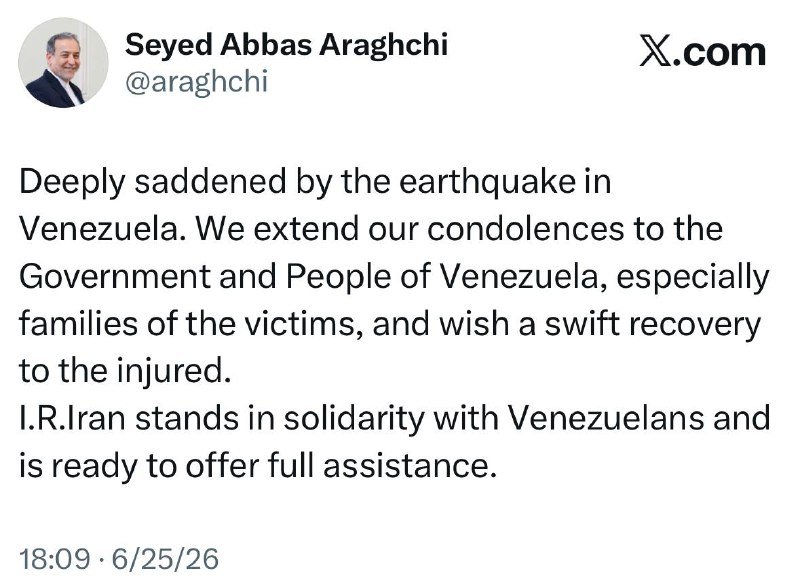
A 7.1-magnitude earthquake struck northern Venezuela shortly before midnight UTC on 24 June 2026, sending shockwaves through Caracas and prompting Interior Minister Diosdado Cabello to deliver the country's first official assessment within the hour. The tremor, centred near the capital, was felt across several regions and produced visible structural damage in multiple districts of the city, according to initial accounts from Venezuelan state media. Footage shared from El Ávila National Park and from inside Caracas apartments showed buildings swaying and residents pouring into streets. At the time of writing, no casualty toll had been released, and the Ministry of Interior, Justice and Peace urged citizens to remain in open spaces and follow official safety protocols.
The quake is the first major test of Venezuela's disaster-response architecture since the political crisis of 2024-25, and the speed of the official response is itself a piece of information. Within roughly thirty minutes of the event, Cabello was on state television framing the situation as "highly alarming" in several areas of Caracas while urging calm, an acknowledgement that the authorities understood the political stakes of a slow or confused initial read. Emergency crews were deployed across the capital, and reporting from the Altamira neighbourhood confirmed continued operations in the early hours of 25 June.
The official frame
Caracas's initial messaging has been calibrated, not panicked. The Interior Ministry's advisory language — stay outside, avoid damaged structures, monitor official channels — is the standard playbook of any post-disaster authority, but in Venezuela it carries a particular subtext. Trust in state institutions, including the national civil defence apparatus and the Bolivarian National Guard, is not uniform across the population, and visible competence in the first hours of a crisis is treated by the Maduro government as a legitimacy dividend worth protecting. Cabello, who also serves as one of the senior figures inside the ruling party and a frequent public face of the Chavista security apparatus, is an unusual choice of lead communicator. He is neither the defence minister nor the civil protection chief. That he fronted the briefing suggests the government wanted to signal gravity without conceding any operational vacuum.
Reporting from the ground, including first-hand dispatches from the Altamira neighbourhood and wider Caracas, has so far emphasised structural damage rather than casualties. Galipán-area footage from El Ávila National Park showed the quake's force vividly; apartment-interior videos circulating on Telegram and X depicted furniture shifting, ceilings cracking, and immediate evacuations. These are the early indicators the public uses to gauge severity before official statistics arrive.
The structural exposure
A 7.1-magnitude event near a capital city of three million is, on any engineering reading, a serious test of building stock and emergency coordination. Caracas sits in a seismic zone along the boundary of the Caribbean and South American plates; the city has lived through catastrophic quakes before, most notably the 1812 tremor that destroyed the colonial city and the 1967 event that killed more than 200 people. Modern Caracas combines reinforced high-rise construction — much of it built during the oil-boom decades — with extensive informal settlements on the hillsides, where building standards are inconsistent and where landslide and structural-collapse risk is concentrated in heavy rain or seismic activity.
The deeper exposure is institutional. Years of economic contraction, mass out-migration, and contested governance have hollowed out parts of the public-administrative state. Civil defence agencies have continued to function, but resources, training, and pre-positioned supplies are reported by international observers to be thin. A major event near Caracas will quickly become a logistical problem that outruns any single ministry's capacity. The political economy of disaster response — who coordinates, who distributes aid, who is permitted to enter affected areas — is therefore not a footnote to the story. It is the story.
The contested frame
Opposition voices and independent Venezuelan outlets will, in the hours ahead, push for a parallel count: damaged buildings, displaced families, hospitals operating, power and water. The credibility of that count will depend on access. Coverage of earlier disasters and crises in Venezuela has shown that the gap between official framing and external verification can widen quickly when information is managed. Independent seismological confirmation of magnitude, depth, and epicentre from international observatories will be the first anchor; ground-level reporting from Caracas, Maracay, and other affected cities will follow.
The framing question is not whether the government responded — it did, and visibly — but whether the response was adequate to a 7.1 event. The available footage suggests damage serious enough to require a national-level mobilisation; the early official tone suggests the authorities are bracing for that conclusion.
The stakes
In the short term, the calculus is humanitarian. Aftershocks, building integrity, and the status of the electrical grid in affected municipalities will be the first operational questions. In the medium term, the political stakes are larger. A poorly handled disaster would deepen the legitimacy crisis that has shadowed the Maduro government since the contested 2024 election. A competently handled one, particularly one delivered through Cabello's public-facing role, would be absorbed into the government's narrative of institutional stability. The next 48 hours of official communiqués, and the parallel reporting from independent outlets, will tell readers which way the evidence points.
This article leans on state-media and rapid on-the-ground reporting, which are the only first-pass sources available within an hour of the event. It will be updated as independent seismic confirmation and casualty figures emerge.
Desk note
The wire cycle for this story is dominated by Venezuelan state-aligned outlets, with early on-the-ground footage moving through Telegram and X. Monexus carried the official and eyewitness accounts as the primary first-pass evidence while flagging, in plain prose, the structural reasons to expect a contested casualty and damage count within 24 hours.
Wire provenance
This editorial synthesis draws on the following public wire/social posts:
- https://t.me/osintlive/26234
- https://x.com/telesurenglish/status/2070031026261571084
- https://x.com/telesurenglish/status/2070031916346032198
- https://x.com/telesurenglish/status/2070032015524782082
- https://x.com/telesurenglish/status/2070032294974992663
- https://x.com/telesurenglish/status/2070033298889048282
- https://t.me/osintlive/26234
- https://x.com/telesurenglish/status/2070031026261571084
- https://x.com/telesurenglish/status/2070031916346032198
- https://x.com/telesurenglish/status/2070032015524782082
- https://x.com/telesurenglish/status/2070032294974992663
- https://x.com/telesurenglish/status/2070033298889048282