Roadblocks and silence: what Nairobi's gridlock tells us about Kenya's security reflexes
Police checkpoints on Thika Road and in Mlolongo on 25 June exposed how Kenya's security apparatus still defaults to road theatre — and what that means for a capital of five million.
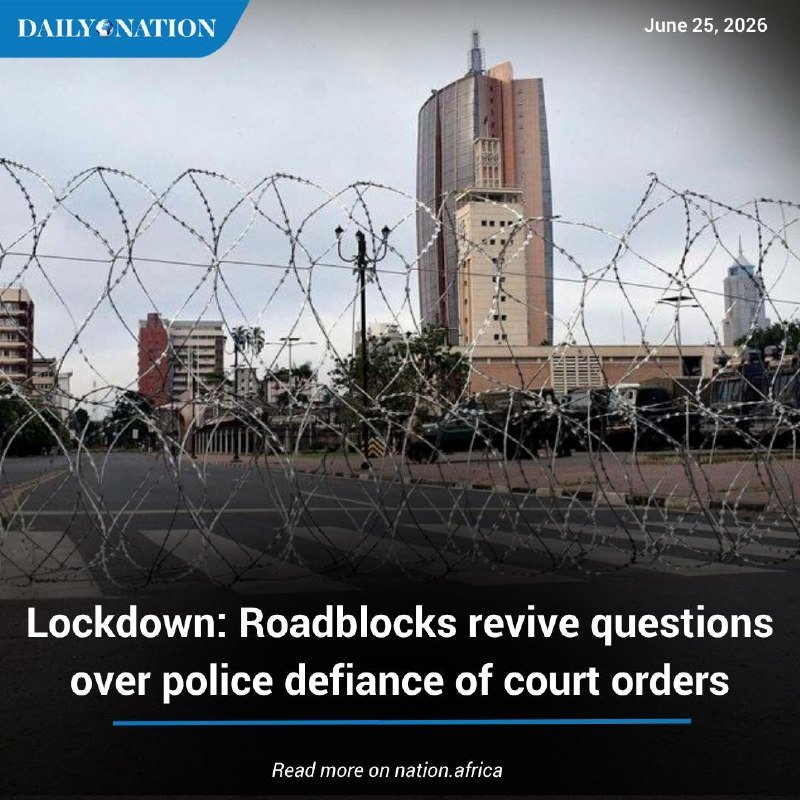
On the morning of 25 June 2026, Nairobi's main commuter artery became a filter. By 03:53 UTC, security personnel had set up checkpoints at Ruiru, Githurai and Allsops along Thika Road, blocking matatus from entering the central business district and screening private motorists. Two hours later, the cordon had thickened: the Standard Kenya reported roadblocks at Allsops and in Mlolongo, with traffic grinding to a halt in several parts of the city as vehicles moving to and from Rongai were pulled over. The operation was public, conspicuous, and unexplained.
The first question any observer should ask is the obvious one: what was the trigger? The reporting describes the action in granular operational terms — where the barriers sat, which vehicles were allowed through, which were turned back — and then stops. The two outlets that carried the bulletins offered no official statement, no incident prompting the screening, and no timeline for removal. That silence is itself the story.
A familiar reflex
Kenya's security services have a well-rehearsed playbook for moments of perceived threat, and it almost always involves the road. Checkpoints multiply, matatus are rerouted, and the capital's traffic, already notorious, becomes a lever. The pattern recurs after terror alerts, during political anniversaries, and around protests. Each iteration produces the same public effect: hours of gridlock, an opaque screening exercise, and a press release hours or days later that names the disruption as a precaution.
The problem is not that the state screens traffic. In a city of roughly five million people, periodic vehicle checks are a reasonable security instrument. The problem is the architecture: the cordon extends from peri-urban nodes — Ruiru, Githurai, Mlolongo, Rongai — into the central business district, with no published legal basis, no published criteria, and no published endpoint. Citizens who are stopped have no way to know whether they are caught in a routine sweep, a manhunt, or a politically-targeted filter.
The information vacuum
Both bulletins were filed as short, factual items. Daily Nation's dispatch, time-stamped 03:53 UTC, gave the geography and the categories of vehicle affected. Standard Kenya's update, two hours later, added the screening of Rongai-bound traffic. Neither carried a quote from the Inspector-General, the National Police Service spokesperson, or any named official. The Ministry of Interior was not on the record. The Office of the President was not on the record. Kenyans, including the journalists filing the bulletins, were reading the security state through its road cones.
This is how opacity compounds. The absence of a triggering event means readers are free to imagine one, and the imagination is rarely generous. Within hours, social channels were full of speculation — some plausible, some wild, most unverifiable. By the time any official statement surfaces, the narrative will have hardened around rumour rather than evidence.
What the cordon actually does
It is worth taking the operational description seriously. Roadblocks at Ruiru, Githurai, Allsops and Mlolongo cover the northern and north-eastern approaches to the city. Screening of Rongai traffic extends the net south-west. The selection of matatu operators for exclusion is significant: matatus carry the bulk of Nairobi's working-class commuters, and blocking them from the central business district during morning peak means a substantial proportion of the labour force cannot reach work on time. Private motorists are screened, not excluded — implying a search for persons or vehicles rather than a general lockdown.
That is a meaningful security operation by any measure. It is also, by any measure, a heavy imposition on a metropolitan economy already running on congested infrastructure. The trade-off is defensible if there is a known threat, communicated in time for citizens to adjust. It is harder to defend when the public learns about the cordon from Telegram channels before it learns from the state.
Counterpoint: security in a real-risk environment
The Kenya police service is not operating in a vacuum. Kenya has faced persistent threats from al-Shabaab, sectarian political mobilisation, and organised criminal networks. Officers manning the kind of checkpoints described on 25 June have, in past incidents, intercepted suspects, recovered weapons, and prevented attacks. The instinct to filter traffic into the city is grounded in real risk, and the public should not assume that an unannounced cordon is theatre by default. A 24-hour security sweep is not the same thing as a permanent checkpoint state, and the day's disruptions will, in the most likely reading, be lifted within a day or two.
What that reasonable framing cannot redeem is the absence of communication. Operational security is a legitimate reason to delay details in the first minutes of an action. It is not a legitimate reason to leave a capital city guessing through the working day.
The stakes
Nairobi is one of the most important economic and diplomatic nodes in eastern Africa. The city's image, both to its residents and to the foreign investors and institutions that fund the region's development, depends on its functioning as a predictable capital. Recurrent, unexplained roadblocks cost that predictability in small doses. Each one chips at the contract between the security state and the citizen: the citizen consents to be screened, but the state owes a reason.
If the pattern continues, the cost compounds. Commuters build workarounds; businesses price in delay; diplomatic and corporate visitors learn to avoid certain windows. The cordon becomes a tax on everyone, and a useful filter for no one. The state that depends on its citizenry's voluntary cooperation cannot afford to let that cooperation drift.
What remains uncertain is the trigger. Neither bulletin names an event, a suspect, or a category of threat. Until the National Police Service or the Ministry of Interior speaks on the record, the public record is exactly what the two wire items contain: roadblocks at named junctions, screening at named nodes, and silence everywhere else.
This publication will update when an official statement is filed. The wire bulletins at 03:53 and 05:53 UTC on 25 June 2026 are the only verified source material currently available; everything else is still rumour.
Wire provenance
This editorial synthesis draws on the following public wire/social posts:
- https://t.me/DailyNation/
- https://t.me/StandardKenya/