The Senate Just Told Trump to Stop. The White House Wants $87 Billion to Keep Going.
A 50-48 vote to halt operations collides with an $87.6 billion supplemental request — and a president who says the world may never know what hit a girls' school.
At 22:58 UTC on 24 June 2026, the United States Senate voted 50 to 48 to pass a resolution directing President Donald Trump to cease military operations against Iran. Less than twelve hours later, at 21:36 UTC the previous evening, the White House had asked Congress for roughly $87.6 billion in emergency spending to keep those operations funded. Somewhere in that gap between the two votes — between a chamber of the U.S. legislature telling the commander-in-chief to stand down and the executive demanding the cash to keep fighting — sits the constitutional question of the year.
Both signals are now in the public record on the same 48-hour cycle: a binding, if non-enforceable, expression of senatorial will on one side; a nine-figure supplemental on the other. The administration is also privately absorbing pointed criticism from members of its own party over the conduct of the war, according to a Reuters dispatch timed at 02:35 UTC on 25 June, which described a closed-door meeting in which fellow Republicans challenged the president shortly before the funding request went out. The juxtaposition is not subtle. One branch is voting to end the war; the executive is asking for the means to widen it.
What the resolution actually does
The 50-48 vote is the kind of number that means more in constitutional logic than in operational effect. A war-powers resolution passed by one chamber does not, on its own, compel a president to halt combat operations. The War Powers Resolution of 1973 allows Congress to compel the withdrawal of U.S. forces engaged in hostilities without authorisation, but only when both chambers agree and the political mechanics of override survive a presidential veto. The House has not yet weighed in. The resolution as passed is therefore best read as a political instrument: a public, recorded, partisan-shaped statement that a substantial slice of the Senate believes the Iran campaign has exceeded the president's mandate.
The closeness of the count — two votes — tells its own story. The measure passed almost entirely along party lines, with only a small handful of Republicans joining the majority. That is a narrower coalition than the bipartisan majorities that backed the Gulf War authorisation in 1991 or even the Iraq authorisation in 2002. It is closer, in shape, to the 2022 vote on the Saudi Arabia security relationship, where a White House facing uncomfortable questions about a partner's conduct had to spend weeks corralling its own side. Whatever else this resolution is, it is not a national-consensus moment.
The administration, for its part, did not pretend the vote did not happen. It simply continued doing what it was already doing: asking for money.
The $87.6 billion ask
The funding request — $87.6 billion, per the figure circulating on 24 June — sits in the long American tradition of emergency supplementals, those end-of-fiscal-year bundles that combine munitions replenishment, intelligence support, civilian-aid lines, and the operational overhead of an ongoing conflict. The dollar number is itself a story. The first Gulf War cost roughly $61 billion in 1991 dollars; the Iraq war's supplemental bills ran into the hundreds of billions across a decade; the Afghanistan supplementals were smaller per year but lasted longer. $87.6 billion is not, by U.S. war-spending standards, a wartime-redefining figure. It is the cost of a few months of a serious air-and-sea campaign, plus the rebuilding of stockpiles of precision-guided munitions that have been visibly depleting across the last six months of operations.
The political question is not whether the U.S. can afford the request. It can. The question is whether Congress will pay it while simultaneously telling the executive to stop firing. That contradiction has shown up before — most pointedly in the late stages of the Vietnam war, when Congress cut appropriations while refusing to cut off the executive outright, producing a slow strangulation rather than a clean end. The pattern in those cases was that supplemental funding was the leverage Congress actually used, and resolutions were the speeches Congress gave about wanting to use it.
The girls' school, and the politics of unknowable attribution
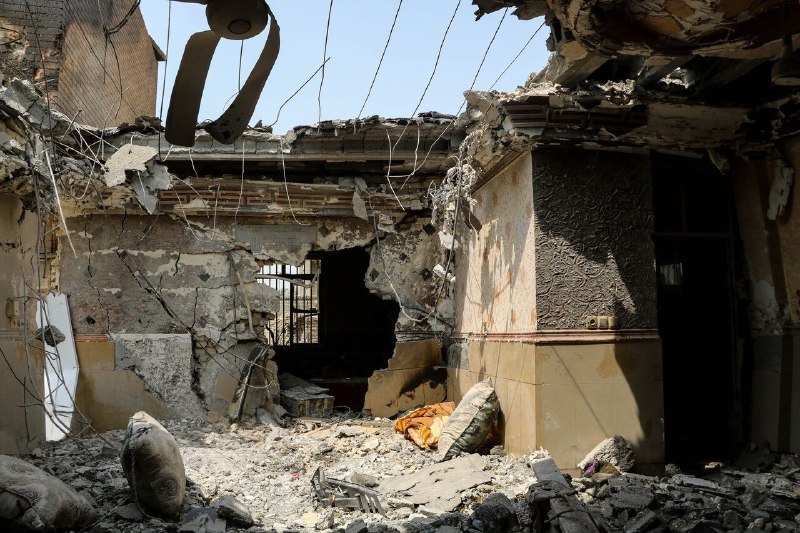
At 01:50 UTC on 25 June, Reuters reported that Trump had said it may never be known who was responsible for a strike on a girls' school in Iran. The phrasing — "may never be known" — is itself a political artefact. In modern warfare, attribution for an individual strike is rarely instantaneous; crater analysis, fragment forensics, electronic-intelligence cross-reference, and survivor testimony take weeks. But "we do not yet know" and "we may never know" are different sentences with different political uses. The first buys time for investigators. The second pre-empts the question.
The structural context matters. Iranian state media and Western human-rights monitors have, across this campaign, given different accounts of who struck which civilian target and with what munition. Mainstream Western wire reporting has, in turn, treated those accounts unevenly, sometimes reflecting Iranian state-media casualty figures as raw data, sometimes qualifying them heavily. When the U.S. president publicly moves the goalposts from "we will find out" to "we may never know," the predictable effect is to push the question out of the news cycle before the forensic record is established. That is not a uniquely American behaviour; every major military in the last quarter-century has, at some point, declined to attribute strikes it had a strong interest in not claiming. But the move is now being made by name, on the record, from the White House podium.
The Republican rebellion — and what its shape tells us
The Reuters report timed at 02:35 UTC on 25 June described a closed-door meeting in which the president faced "pointed criticism" over the Iran war from fellow Republicans, just before the funding request went to Capitol Hill. The detail that matters is not that Republicans criticised a Republican president. That has happened routinely on tariffs, on aid packages, on cabinet nominations. What matters is the timing: criticism in a closed caucus, hours before an emergency-spending request that the caucus will be asked to fund, is a signal that the war has become an internal liability.
The shape of the dissent tracks the shape of the war's domestic coalition. Republicans facing competitive 2026 races in districts with significant defence-contractor employment have a different incentive structure from those facing districts with large Iranian-American or Muslim-American populations, or large veteran populations sceptical of open-ended deployments. The 50-48 Senate vote is, in effect, a mirror of those competing pressures — a war whose public rationale has not collapsed, but whose political coalition has begun to fray at exactly the points where the costs are most concrete.
What this leaves unresolved
The Polymarket-flagged remark attributed to the president — that "grass has a life just like people have a life" — does not, on its own, move the policy question. But it is a useful reminder of the information environment in which this debate is happening. Public commentary on the war now includes statements that range from constitutional law to metaphysics, and the markets and the wires are both treating both as data.
What the sources on the table do not specify: the exact text of the war-powers resolution; the timetable for House consideration; the line-item breakdown of the $87.6 billion request; the identity of the school struck, beyond the descriptor "girls' school in Iran"; the names of the Republican senators who crossed over in the 50-48 vote; and the casualty figures, if any, associated with the school strike. Those are the gaps a reader should hold open. Any account that fills them in with specifics not present in the reporting on the table is, at best, guessing.
Stakes, plainly stated
If the trajectory holds, three things follow. First, the U.S. will fight a war in the Middle East with at least one chamber of its legislature publicly on record against it, with predictable effects on coalition diplomacy and on the willingness of partners to commit politically to the campaign. Second, the funding mechanism becomes the real battlefield: whether the $87.6 billion is approved in full, in part, or as a vehicle for a forced withdrawal through appropriations conditions, will determine whether the war's duration is set by the Pentagon or by the Senate Appropriations Committee. Third, the politics of attribution — what the U.S. government says it knows about its own strikes, and what it says cannot be known — will set precedents that outlive this particular war. Future administrations, of either party, will inherit the rule that a president can move from "we will investigate" to "we may never know" without political cost, if the present one does.
The deeper pattern is older than this war. American military operations that begin with broad coalitions tend to end when the coalition narrows, and the narrowing usually happens not in a single dramatic vote but in a slow sequence of resolutions, supplementals, and closed-door objections. The 50-48 vote and the $87.6 billion request are two notes in that sequence. There will be more.
This publication treats the war-powers resolution and the emergency-spending request as concurrent data points on the same trajectory, rather than as separate stories. Mainstream wires have generally covered them in sequence; the simultaneous read is the point.
Wire provenance
This editorial synthesis draws on the following public wire/social posts:
- http://reut.rs/4g0BEUw
- https://t.me/s/reuters/2069904814553595904
- https://t.me/s/polymarket/2069904814553595905
- https://t.me/s/polymarket/2069904814553595906
Follow the event.
These dated source records provide context. They do not retrospectively verify this archive article.
Separate what the nuclear watchdog reported from what it could not determine after the June 2025 strikes.