Magnitude 7.1 quake strikes northern Venezuela, killing at least 32 and triggering a tsunami warning
A 7.1-magnitude earthquake struck northern Venezuela on Thursday, killing at least 32 people and injuring more than 700, while a tsunami warning extended across the Caribbean.
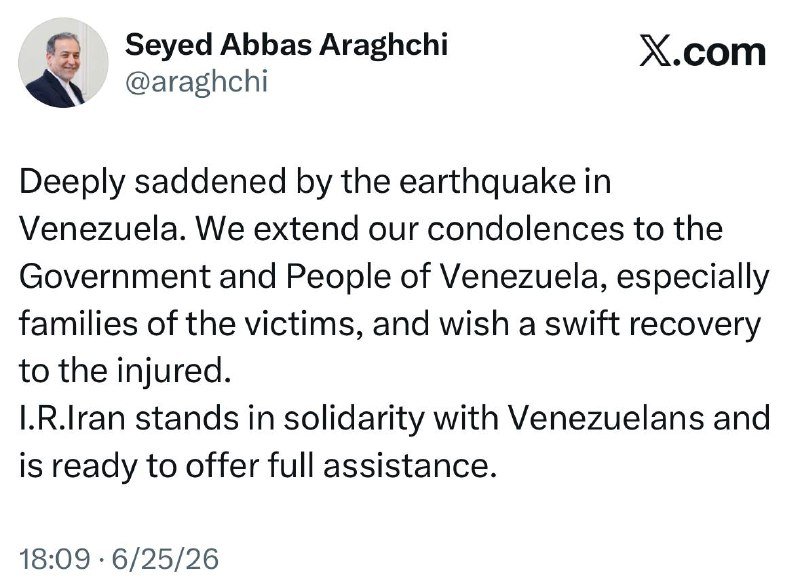
A magnitude 7.1 earthquake struck northern Venezuela in the early hours of 25 June 2026 (UTC), killing at least 32 people and injuring more than 700, according to preliminary casualty figures released by Venezuela's interim president Delsey Rodríguez. The tremor, recorded by the United States Geological Survey at 7.1 on the moment magnitude scale, triggered an immediate tsunami warning for the Caribbean coastline. The full extent of structural damage across the affected states remains unclear, with initial reporting focused on the northern coastal belt rather than Caracas itself.
The quake lands Venezuela in a familiar kind of crisis it has rarely had the institutional bandwidth to absorb: a major natural disaster on top of a contested political transition, a multi-year economic contraction, and an already-strained humanitarian logistics chain. The country's capacity to mount a coordinated response, and the degree to which it can attract external assistance without political friction, is the early question regional governments and humanitarian agencies will be working through over the next 48 hours.
What the initial reports establish
The USGS recorded the quake at 7.1 magnitude, with the epicentre located in northern Venezuela. The agency issued a tsunami warning covering the Caribbean coastline shortly after the tremor. Tasnim News, citing Venezuelan officials, reported that the country's interim president Delsey Rodríguez announced at least 32 fatalities and more than 700 injuries, with the figure explicitly described as preliminary. Fars News International independently confirmed the USGS-issued tsunami warning.
The geography matters. Venezuela sits at the boundary of the Caribbean and South American tectonic plates, a zone with a documented history of significant seismic events, though the country's most damaging recent tremors have been concentrated along its western and Andean flanks. A 7.1 event in the north, close to the densely populated Caribbean coast, presents a different exposure profile: long-duration shaking reaches a broader urban footprint, and the tsunami threat introduces a second-order hazard that arrives on its own clock.
Rodríguez's interim presidency adds an institutional dimension to the response. Venezuela has been operating under a transitional political arrangement since the disputed 2024 presidential election, with the United States and several allied governments recognising opposition figure Edmundo González as the legitimate winner of that contest and Rodríguez's government retaining de facto control of state institutions. The earthquake response will, in effect, be the first major stress test of that arrangement since the transition period began.
What remains uncertain
The 32-fatality, 700-injury figure is the wire-level headline number across Tasnim, Fars and Jahan Telegram channels as of the early UTC window on 25 June, and all three sources explicitly label it preliminary. Independent confirmation from Venezuelan health authorities, civil defence agencies, or international bodies has not yet appeared in the materials this publication is working from. The casualty toll in a 7.1 event affecting populated areas typically rises substantially in the first 24 to 72 hours as search-and-rescue reaches collapsed structures, secondary collapses occur, and remote or cut-off communities make contact.
The tsunami warning's status, and whether it has been downgraded, extended, or lifted, is also unsettled in the available reporting. The USGS issued the warning in the immediate aftermath of the tremor; the picture typically firms up as tide-gauge data accumulates over the first few hours. The structural damage assessment, including which states and municipalities bore the worst of the shaking, is not yet specified in the source material.
The response question
A 7.1-magnitude event in northern Venezuela is the kind of disaster that, in a country with a fully functional emergency-management apparatus, would test even a well-resourced state's logistics. Venezuela enters this one with several compounding constraints. The economy has contracted for years. Hyperinflation has abated only relative to its 2018-2019 peak. Public-health infrastructure has lost significant capacity. The petroleum sector, the country's principal revenue source, has been operating under US sanctions and licensing arrangements that constrain both export earnings and the import of refined products and equipment.
Sanctions relief in the wake of humanitarian disasters has a complicated history. The US Treasury's Office of Foreign Assets Control has, in past crises, issued general licenses authorising transactions that would otherwise be prohibited, typically for first-responder equipment, medicine, and food. Whether that pathway is activated here, and how quickly, will shape the first 72 hours of the response. Regional partners, including Colombia, Brazil and Caribbean Community members, will also be in the picture; both have been involved in previous Venezuelan humanitarian responses, including during the COVID-19 vaccination rollout.
The political framing is unavoidable. The opposition-aligned government-in-exile, the González/Machado coalition, will likely make the case that the disaster demonstrates the failures of the current arrangement. Rodríguez's interim government will frame its response as evidence of institutional continuity. International coverage will be read through both lenses. The substantive question, which is whether the response reaches affected populations in time, will likely be settled on the ground and on a much shorter timeline than the political one.
Stakes over the next week
Three trajectories are worth tracking. The first is the casualty and displacement count. The second is the status of the tsunami warning and any coastal flooding damage. The third is the political choreography of the response, including whether external assistance flows through official Venezuelan channels, through opposition-aligned networks, or both, and whether that choreography is read as competence or as fragmentation.
A 7.1 earthquake in this part of the Caribbean is survivable. The historical record on that is clear. What determines whether the death toll stays in the dozens or climbs into the hundreds is the speed and reach of the search-and-rescue operation, the integrity of the hospital and trauma-care chain, and the speed with which the international community can route material assistance through whatever channels are functioning. On all three, the next 48 hours will be the ones that matter.
This publication framed the early reporting on the basis of USGS seismic data and the initial casualty announcement from Venezuela's interim president, as relayed through Tasnim and Fars news wires on 25 June 2026. We have separated preliminary casualty figures from confirmed structural-damage data and flagged where the source material does not yet specify. The tsunami-warning status, in particular, is treated as time-stamped and likely to be updated as tide-gauge data accumulates.
Wire provenance
This editorial synthesis draws on the following public wire/social posts:
- https://t.me/JahanTasnim
- https://t.me/tasnimnews_en
- https://t.me/FarsNewsInt
- https://t.me/JahanTasnim/2
- https://en.wikipedia.org/wiki/Earthquake