Venezuela declares state of emergency after back-to-back quakes hit the country
Two tremors struck within minutes of each other on Wednesday evening, prompting Venezuela's acting president to declare a state of emergency as buildings reportedly collapsed across several states.
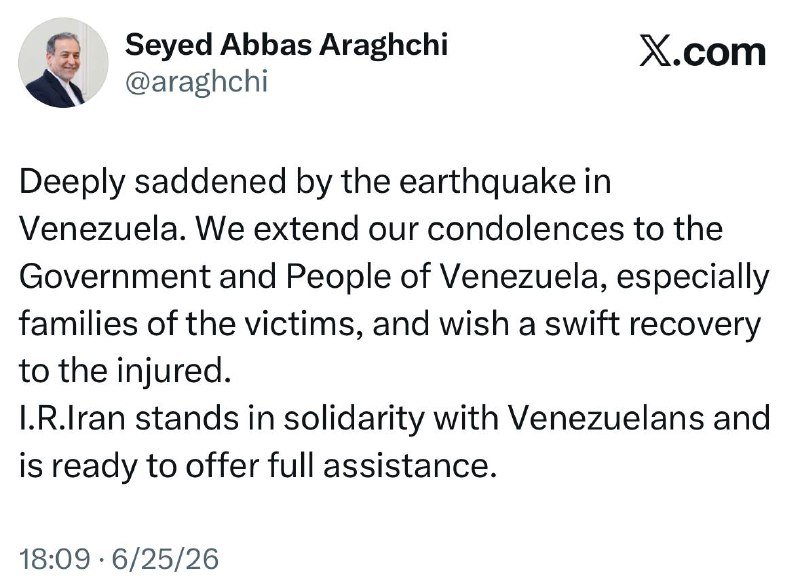
Two powerful earthquakes struck Venezuela on Wednesday evening, sending residents into the streets and bringing down buildings across several states, according to early reporting from regional outlets. Acting President Delcy Rodríguez declared a state of emergency within hours, with teleSUR English publishing photos of damage in Caracas and the Iranian state network PressTV airing video that it described as showing extensive structural collapse following the back-to-back tremors.
The episode places a country already contending with deep political polarisation, contested authority at the top, and a humanitarian crisis shaped by years of sanctions and economic contraction at the centre of a fresh test of state capacity. The reporting from Caracas on Wednesday evening suggests a coordination problem that goes well beyond the seismology: who is in charge, who is communicating, and on what authority relief operations are being ordered.
What the early reports say
The first indications came from teleSUR English, which at 04:12 UTC on 25 June 2026 published photographs from Caracas following a 7.5-magnitude earthquake that, the outlet wrote, "shook the country." teleSUR said Acting President Delcy Rodríguez would soon issue a statement on the extent of the damage and the deployment of security forces. Hindustan Times, summarising wire reporting, said two powerful earthquakes had struck Venezuela on Wednesday evening, triggering panic as residents rushed into the streets and buildings collapsed across several states. PressTV, the Iranian state broadcaster, reported at 04:26 UTC that Rodríguez had declared a state of emergency after what it called a "catastrophic earthquake," and published video footage it said showed extensive building damage.
Magnitude figures, the count of casualties, and the geographic spread of the damage have not yet been specified in the publicly visible dispatches reviewed here. The teleSUR footage and the PressTV video are the most concrete visual evidence to have surfaced in the first hours after the event.
Who is in charge, and on what authority
Rodríguez's title — Acting President — is itself part of the story. She has held the position since January 2026, when Nicolás Maduro was sworn in by Venezuela's Supreme Tribunal of Justice in a contested ceremony that was not recognised by much of the opposition, by the United States, or by a number of regional governments. The Caracas-based opposition maintains that Juan Guaidó's 2019 claim to the interim presidency was never formally relinquished, and a parallel claim was made in late 2024 and 2025 by María Corina Machado's Plataforma Unitaria Democrática. The result is a fractured recognition landscape that, until Wednesday evening, was largely a constitutional and diplomatic problem. A natural disaster of the scale telegraphed by the early footage turns it into an operational one.
In practical terms, the chain of command for civil defence runs through the executive. A declaration of a state of emergency by Rodríguez, transmitted through PressTV and teleSUR, would direct the mobilisation of the FANB (the Bolivarian National Armed Forces), the FANB's own civil-protection apparatus, and the government's regional coordinators. The opposition, by contrast, has no parallel institutional capacity to mount a coordinated response and has historically appealed to international NGOs and to the diaspora for relief coordination. The first hours after a major tremor are typically the moment when the de facto authorities consolidate control of the relief effort, and on Wednesday that consolidation appears to have proceeded quickly.
Counter-narratives and contested framing
Two of the three reporting threads Monexus reviewed on Wednesday — PressTV and teleSUR English — are state-aligned or sympathetic to the Maduro-aligned government. PressTV is an English-language outlet operated by the Islamic Republic of Iran Broadcasting. teleSUR is a Caracas-headquartered, Latin American multi-state platform created in 2005 under the Chávez-era push for a regional counter-hegemonic media infrastructure; it receives significant funding from the Venezuelan state and has historically been a sympathetic outlet for the Bolivarian government. Hindustan Times, a major Indian daily, is editorially independent of Caracas.
The reliance on those two channels is not, in itself, a reason to discount the underlying event: independent seismological monitoring (the US Geological Survey and the Venezuelan Fundación Venezolana de Investigaciones Sismológicas) typically publishes verified magnitude and depth data within minutes to hours of any tremor of this scale, and the photographs from teleSUR are consistent with significant structural damage. But the official framing of "catastrophic earthquake" and the immediate presentation of Rodríguez as the national authority on screen is exactly the optic the Bolivarian government would prefer, and exactly the optic that opposition-aligned media inside Venezuela have been contesting for the better part of a decade.
Structural context: disaster response under sanctions
The disaster arrives at a moment when Venezuela's capacity to absorb a major shock is constrained by structural factors that pre-date the earthquake. US sanctions — imposed under the Obama administration, expanded under Trump in 2017 and 2019, partially eased under Biden with a series of OFAC licences tied to the 2023 Barbados electoral agreement, and partially re-tightened over 2024 and 2025 as that agreement unravelled — continue to limit the access of the Venezuelan state to dollarised financial infrastructure and to certain categories of imported equipment. The Chevron OFAC licence, repeatedly extended, is the largest single exception.
Two practical consequences follow. First, humanitarian agencies operating inside Venezuela — UNHCR, IOM, UNICEF, the ICRC, and a dense field of Venezuelan NGOs — are likely to be the most important external response channels, since they are typically carved out from sanctions regimes or operate under specific OFAC and EU Council general licences. Second, any reconstruction effort that touches dollar-clearing, fuel imports, or specialised equipment will, by default, become entangled in the sanctions architecture. The 2010 Haiti earthquake response, the 2016 Ecuador earthquake response, and the 2017 Mexico earthquake response all illustrate how quickly reconstruction financing becomes a question of which counterparties can transact in hard currency.
A further structural point: Venezuela's electrical grid has been intermittently unstable since the 2019 blackout events, and any major seismic disruption to substations and transmission lines can interact with that baseline fragility. Wednesday's reporting does not specify the status of grid infrastructure in Caracas or in the affected states; that will be a question for the next 24 to 48 hours.
Stakes over the next week
The short-term stakes are operational: the number of casualties, the count of collapsed structures, the condition of hospitals, and the speed with which FANB civil-protection units and regional fire services can reach affected municipalities. Caracas is one of the most densely populated urban areas in Latin America, and vertical evacuation from high-rise buildings in the immediate aftermath of a major tremor typically produces a separate casualty toll from the tremor itself. The medium-term stakes are political: a successful relief operation under Rodríguez's direction would consolidate her authority at exactly the moment when the question of legitimate executive power is most contested. An unsuccessful one, or one perceived as such, would amplify calls for a transitional arrangement and reopen the diplomatic trench warfare over recognition.
The reporting available at 04:12–05:34 UTC on 25 June 2026 is the first hour of what will be a multi-day story. The source mix is heavily weighted toward outlets that take a sympathetic view of the Venezuelan government, and independent verification of magnitude, depth, and casualty figures is not yet in the public record reviewed here. Monexus will update this article as USGS, FUNVISIS, the Venezuelan opposition, and the major humanitarian agencies publish verified data.
Desk note: Monexus led with teleSUR and PressTV wire material because they were the first to publish on Wednesday evening and provided the only available visual documentation at the time of filing; we have flagged their state-alignment explicitly rather than laundering the framing into a neutral voice. Independent seismological confirmation and casualty data from UN agencies, ICRC, or Reuters/AP wires are not yet in the record we reviewed.
Wire provenance
This editorial synthesis draws on the following public wire/social posts:
- https://t.me/telesurenglish
- https://t.me/presstv
- https://t.me/hindustantimes