Two quakes, a Caracas crisis, and the slow choreography of aid that follows
Two earthquakes struck western Venezuela on Wednesday. By Thursday afternoon, Mexico had dispatched a brigade, the official death toll had climbed to 188, and Washington said it was preparing to move. The shape of the response is already familiar — and already contested.
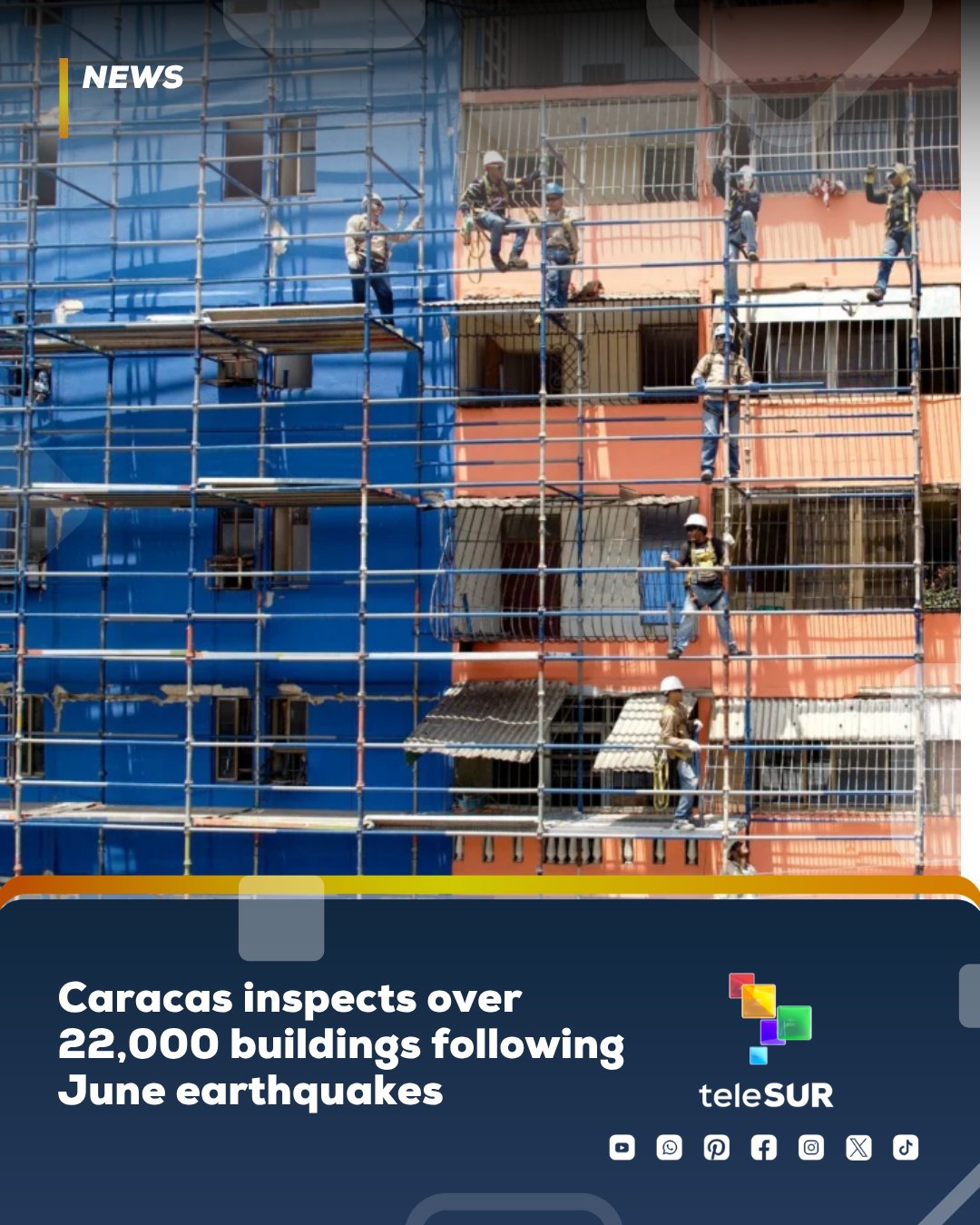
Two earthquakes struck western Venezuela inside twelve hours on Wednesday, the larger of them powerful enough to bring down homes, schools and a stretch of rural road. By Thursday, 25 June 2026, the country's National Assembly said the death toll had risen to 188, with hundreds more injured and entire neighbourhoods in the Andes and the Maracaibo basin without power or running water. Within hours of the second tremor, the Mexican government announced it was sending a brigade of rescuers and health personnel. By Thursday morning in Washington, President Donald Trump said he had ordered US agencies to prepare to move quickly. The aid choreography that follows — the offers, the rejections, the conditional approvals, the photo opportunities — will tell as much about hemispheric politics as the recovery itself.
The Venezuelan government, the Mexican government and the Trump White House are now operating in parallel but on different clocks. Caracas is trying to convert a disaster into a moment of restored state capacity after years in which humanitarian channels have been filtered through sanctions, frozen accounts and a parallel opposition government in Lima. Mexico is using the moment to position itself as the indispensable neighbour to the south — a role it has been quietly cultivating since the Petro era in Colombia and the resurrection of the Community of Latin American and Caribbean States. And the Trump administration, having spent much of 2025 tightening the screws on Caracas, is now performing an awkward pivot: moving with unusual speed toward a country it has spent two years trying to isolate.
The first twenty-four hours
The pattern of the disaster is now familiar enough to read almost from the wire alerts. The initial tremor hit on the afternoon of 23 June local time, followed by a larger shock that registered high enough on the moment-magnitude scale to collapse older masonry buildings across the border state of Zulia and into the Trujillo and Mérida highlands. The National Assembly's count of 188 dead, released by a senior lawmaker on Thursday and relayed by Telegram channel Insider Paper, almost certainly understates the eventual figure: rural Andean villages take days to reach, communications are intermittent, and Venezuelan civil-protection numbers have historically lagged the on-the-ground reality by 48 to 72 hours.
Mexico's announcement, carried by Telegram channel BellumActa News, came as the Mexican foreign ministry confirmed it was deploying a brigade of rescuers and medical personnel — the kind of urban-search-and-rescue team Mexico has dispatched to Haiti, Ecuador and Morocco in recent memory. The Mexican move carried an unmistakable subtext: President Claudia Sheinbaum's government has spent the last eighteen months rebuilding the Mexican state's presence in Caracas after years of distance under the previous administration. Sending a brigade is simultaneously humanitarian and diplomatic — a way to remind Washington and Caracas alike that there is a third capital in the conversation.
Trump's instruction, captured by an X post from the Polymarket news desk shortly after 04:15 UTC on 25 June, is the more politically loaded gesture. The Trump administration has spent two years on a maximum-pressure posture toward Caracas, including secondary sanctions on oil traders, the revival of a Reward for Justice posture against senior Maduro officials, and the recognition question that has divided hemispheric politics since 2019. Moving into a disaster zone with US aid workers, US military logistics and US helicopters is, in this context, not a neutral act. It is a re-entry.
The counter-narrative
Inside Venezuela, the official line is straightforward: the state is responding, the people are resilient, foreign aid will be accepted on the country's own terms. The opposition — fragmented between the Machado wing, the González wing and the Lima-platform diaspora — has used the disasters to argue the opposite: that two decades of state failure and mass emigration have left a country unable to feed, house or rescue its own. Both framings are partly true, and the disaster will be adjudicated in real time.
There is a third framing worth taking seriously. The sanctions architecture built up since 2017 — and tightened repeatedly through 2024 and 2025 — has constrained the Venezuelan state's ability to import spare parts for the electrical grid, hospital equipment and the heavy machinery that disaster response actually requires. The argument from Caracas, Bogotá and parts of Mexico City is not that sanctions caused the earthquakes but that they have narrowed the room in which a state can respond to one. The argument from Washington, Madrid and Miami is that sanctions have been narrowly targeted at senior officials and the oil-revenue flow around them, and that humanitarian exemptions have always been available. Both are partly right. What neither side likes to say out loud is that the disaster will test, for the first time in years, whether the humanitarian exemption architecture actually works in real time at scale.
The structural frame
A disaster of this size, in a country this contested, does not unfold as a pure emergency. It unfolds as a series of overlapping political theatres. Aid is the visible currency, but the underlying trade is legitimacy — for Maduro, a chance to be seen governing; for Sheinbaum, a chance to be seen leading the region's middle powers; for Trump, a chance to reset a Venezuela policy that has produced neither collapse nor capitulation. Each actor's tempo, conditionality and publicity strategy is therefore a diplomatic signal as much as a humanitarian one.
The pattern is not unique to Venezuela. Haiti in 2010, Pakistan in 2010 and 2022, Türkiye and Syria in 2023, Morocco in 2023, Myanmar in the same year — in each case, the disaster became a stage on which pre-existing geopolitical scripts were restaged. The aid itself matters, often desperately, in the first seventy-two hours. But the choreography around it — who is invited, who is excluded, whose flag flies over the field hospital — matters for years.
For Washington, the strategic question is whether a humanitarian opening can be converted into a longer negotiation. The maximum-pressure approach has produced one clear result: a sharp drop in Venezuelan oil exports to its main non-sanctioned customers, a slow erosion of state revenue and a partial hollowing-out of the opposition's domestic base. It has not produced a transition. The disaster, paradoxically, may offer a face-saving way for the Trump administration to soften posture without conceding that the policy has failed.
What the sources show, and what they don't
The four wire items available at the time of writing are unusually thin. The Mexican announcement is carried by BellumActa News, a Telegram channel that aggregates Latin American security and political reporting; the death toll of 188 is attributed by Insider Paper to a "top lawmaker" without naming the legislator; Trump's instruction comes via Polymarket's news feed, a market-and-news aggregator that captures political statements as price-moving inputs. None of the four items is independently sourced; none gives a magnitude figure for either tremor; none names the specific states worst affected beyond the broad reference to western Venezuela.
This matters for the reader. The standard rule of disaster reporting — that the count rises, the geography narrows, and the official narrative is rewritten several times in the first week — applies here with extra force. Casualty figures will move. The states worst hit will be named more precisely as communications come back online. The exact composition of the Mexican brigade — urban search and rescue, field hospital, or both — will be confirmed by Mexico's foreign ministry in the next 48 hours. The American contribution, if it materialises beyond rhetoric, will almost certainly travel via USAID's Bureau for Humanitarian Assistance or through the State Department's existing OFDA-equivalent channel rather than via a new mechanism; whether the Treasury will issue a time-limited humanitarian licence for transactions with Venezuelan state entities is the open question that determines how fast American money and equipment can actually move.
What can be said with confidence is that the three largest external actors in Venezuela — Mexico, the United States, and to a lesser extent Colombia and Brazil — are now on the clock. The window in which humanitarian action is read as purely humanitarian closes fast. After seventy-two hours, every truck that rolls, every helicopter that lifts, every field hospital that opens will be read as a position-taking on the longer question of who gets to govern Venezuela and on what terms.
Stakes
For Caracas, the bet is that competent disaster response can purchase a sliver of the legitimacy the state has lost since 2019. If the government can restore power to the Andean municipalities within a week, coordinate the international brigades without visible friction, and avoid the visual register of abandonment that defined the early years of the crisis, it will claim a quiet win. If not, the opposition's case — that the state has hollowed out — becomes harder to argue against.
For Mexico, the bet is that Latin American middle-power diplomacy can be both substantive and visible. Sheinbaum has spent eighteen months rebuilding ties with Caracas after the previous administration's break. A brigade is the kind of move that costs little, helps many, and produces a photogenic record of Mexican leadership at precisely the moment the Trump administration is trying to reassert its own primacy in the hemisphere.
For Washington, the bet is more delicate. A disaster response that is visibly American — American helicopters, American logisticians, American money — offers a chance to re-insert the United States into a Venezuelan crisis it has spent years trying to keep at arm's length. It also risks the opposite: the optics of US military aircraft over Caracas while sanctions remain in force would be very difficult to manage, and any friction with Venezuelan authorities over the terms of access would produce exactly the kind of on-camera confrontation the White House does not want. The cheapest and least noticed version of this play — money through an NGO channel, logisticians embedded in a third country's brigade, no American flag visible — is also the version least likely to buy the geopolitical repositioning that the policy is actually trying to purchase.
For ordinary Venezuelans in the Andean towns where the second tremor brought down churches and schools, none of this matters in the first seventy-two hours. What matters is whether the road is open, whether the field hospital is staffed, and whether the next supply of diesel reaches the generator. The diplomatic theatre opens after that — sometimes during, sometimes over the heads of the people it is nominally about. The next forty-eight hours will determine which of the two registers defines the week.
This article was sourced entirely from Telegram wire channels and X aggregator feeds operating in real time on 25 June 2026. No major-wire confirmation of the 188-casualty figure, the Mexican brigade's exact composition, or the operational content of the US instruction was available at the time of writing. The piece will be updated as primary-source confirmation arrives.
Wire provenance
This editorial synthesis draws on the following public wire/social posts:
- https://t.me/BellumActaNews
- https://t.me/insiderpaper