Venezuela's Twin Earthquakes and the Politics of an Emergency Without Numbers
A state of emergency declared hours after a twin quake, with no disclosed death toll, exposes the fault lines between Caracas and Washington — and the information vacuum that aid workers dread.
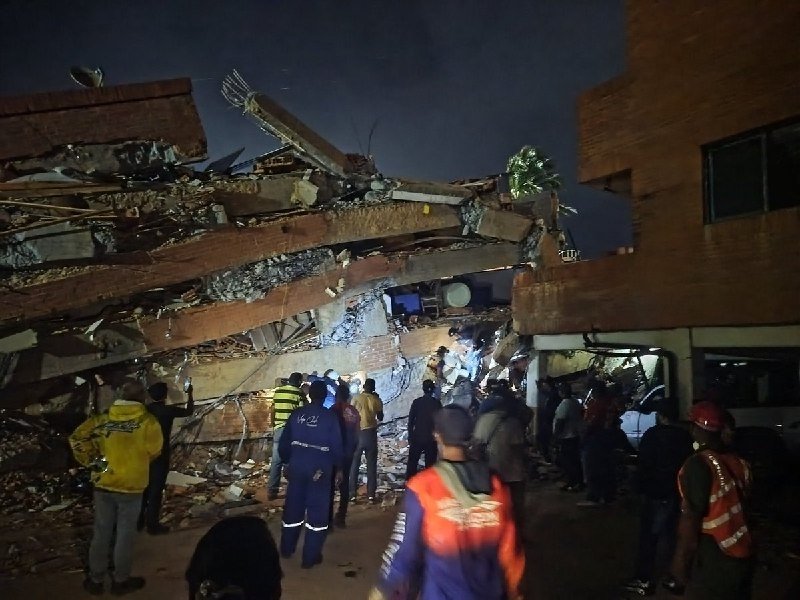
At 04:20 UTC on 25 June 2026, Venezuelan president Delcy Rodríguez declared a national state of emergency in the hours after a pair of earthquakes struck the country's western coast. Reuters, citing the announcement, reported that Rodríguez did not disclose a figure for the dead. The declaration came less than three hours after a US State Department announcement, relayed by Reuters at 04:01 UTC, that Washington was "mobilizing assistance" to Caracas — an unusually direct line of contact between the two governments, which have spent the better part of a decade without formal diplomatic recognition of each other's ambassadors.
The information vacuum is itself the story. A state of emergency announced without a casualty count is not an administrative formality; it is a signal that the official communications apparatus has not yet processed what its own emergency services are seeing on the ground. Internet-monitoring group NetBlocks, cited by the Telegram channel @wfwitness in the same window, recorded a "significant decline in internet activity" across Venezuela after the second tremor — a pattern consistent with cell-tower overload, rolling blackouts, or both. Until that connectivity returns, the death toll will remain a matter of partial reporting and competing claims.
What we know, and what we don't
The geography is clear even if the human cost is not. Western Venezuela — the states of Zulia, Mérida, Trujillo and Barinas, running down to the border with Colombia — sits on a complex of faults where the Caribbean plate grinds against the South American plate. Twin events of the magnitude implied by a state of emergency declaration would almost certainly produce structural damage in older urban centres and in hillside settlements that expanded informally during the economic crisis of the late 2010s.
Rodríguez's declaration activates emergency procurement powers, suspends certain labour protections for rescue workers, and unlocks federal coordination with regional governors. It does not, by itself, tell us how many buildings are down or how many people are buried. Reuters' framing — that the government "did not give figure of dead" — is the wire's way of saying the number is the number that matters, and that it is not yet available.
The Washington line
The US State Department's offer of assistance, published via Reuters at 04:01 UTC on 25 June, is the first substantive humanitarian engagement Washington has signalled toward Caracas in several years. It also lands inside a much longer story: the sanctions architecture built up under both the Trump and Biden administrations, the contested 2024 presidential election, the ongoing ICC investigation, and the steady migration of Venezuelans through the Darién Gap. None of that disappears because of an earthquake. But a natural disaster is the one context in which bilateral machinery that has been frozen for political reasons tends to thaw, briefly, around logistics.
The structural point worth naming: emergency relief between governments that do not formally recognise each other tends to travel through third parties — militaries, NGOs, the Red Cross movement. The US announcement does not name a delivery channel. That is the tell. If the channel turns out to be the US military's Southern Command working through a Colombian staging post, the political signal is different than if it travels through USAID's Bureau for Humanitarian Assistance to a UN-coordinated cluster.
The Caracas line
The Venezuelan government has, in past disasters, treated early-period information as a sovereignty asset. The official position — articulated repeatedly by the chavista apparatus since the 2017 floods and the 2019 blackouts — is that premature casualty figures invite foreign political exploitation and that verified numbers will be released when the institutions are satisfied. The argument has a kernel of structural sense: in a country under heavy external sanctions, any large death toll becomes a lobbying input for further measures. The argument is also, plainly, a way of controlling the political temperature inside Venezuela while the relief effort is still being organised.
This publication's read: both can be true. The same government that has spent fifteen years cultivating an information-management reflex is also the government best positioned to know, within hours, how many of its own citizens have died. If Rodríguez did not give a number at 04:20 UTC, the most likely reason is that the number, when it comes, will be contested no matter what it is.
What this is, structurally
A disaster that opens a humanitarian channel between adversaries is a recurring feature of the regional system. The 2010 Haiti quake drew US military logistics into Port-au-Prince within 72 hours despite decades of bilateral hostility. The 2023 Türkiye-Syria earthquake saw sanctions-easing discussions inside the G7 within a day. The pattern is not that natural disasters erase political conflict; it is that they force a temporary layering of relief logistics over the conflict, with the relief layer usually evaporating once the cameras leave.
For Venezuela, the open question is whether this earthquake opens a longer window — whether the US offer of assistance gets converted into a mechanism (sanctions carve-out for humanitarian goods, asset-release authorisations for oil revenue escrowed abroad) that survives the news cycle. Past precedent suggests not, unless a third-party broker — Colombia's Petro government, Brazil's Lula, possibly Mexico — pushes the conversation past the initial window.
Stakes
If the death toll is small and the infrastructure damage modest, the emergency becomes a diplomatic episode: a 72-hour thaw followed by a return to status quo. If the toll is large — and the twin-event profile, plus the internet blackout, suggests it could be — the emergency becomes a forcing function. The Maduro-aligned government will need foreign logistical capacity it does not currently have. The US will want to project relief without granting recognition. The Caribbean and Andean neighbours will want to avoid a second wave of migration on top of the seven million Venezuelans already displaced.
For ordinary Venezuelans in the affected states, none of that geopolitics registers until the bulldozers arrive.
What remains uncertain
The sources do not yet agree on magnitude, depth, or epicentre of either tremor. They do not specify which states are most affected, whether tsunamis warnings were issued for the Caribbean coast, or whether the Caracas-Comunicado infrastructure — the official state TV channel through which casualty counts have historically been released — is itself operating. The NetBlocks report of a "significant decline in internet activity" is a connectivity claim, not a death-toll proxy. Until at least one of those unknowns is resolved, the situation should be read as developing, not declared.
Monexus frames this as a humanitarian story with a diplomatic subplot, not a diplomatic story with humanitarian backdrop — the order matters for how readers weight the next 48 hours.
Wire provenance
This editorial synthesis draws on the following public wire/social posts:
- http://reut.rs/4vv2dpN
- http://reut.rs/4ajm6Yr