Twin Quakes Rattle Venezuela as Acting President Declares State of Emergency
Two strong earthquakes struck Venezuela within hours of each other on 25 June 2026, prompting acting President Delcy Rodríguez to declare a national state of emergency and mobilise security forces across affected regions.
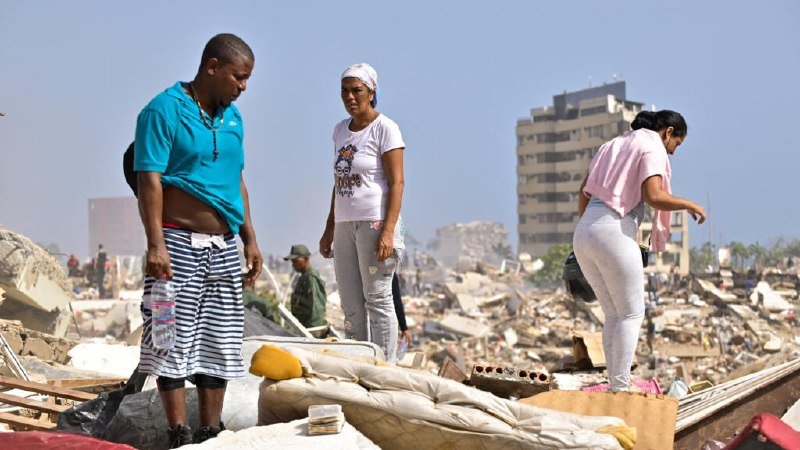
Venezuela was struck by two powerful earthquakes within hours of each other on the morning of 25 June 2026, sending passengers at Caracas's main international airport scrambling for cover and forcing the acting government in Caracas to declare a national state of emergency. The acting president, Delcy Rodríguez, ordered the full mobilisation of the country's security forces, an unusually broad response that points to the scale of disruption across multiple regions.
The twin shocks — reported at magnitudes of 7.1 and 7.5 by monitoring channels tracking the event — hit in quick succession, with the second tremor arriving while the country was still absorbing the first. Several flights to and from Simón Bolívar International Airport, the country's principal hub, were diverted or cancelled as the ground shook the terminal and surrounding neighbourhoods. Footage circulating on social media shows passengers and staff inside the terminal during the tremor, and one widely shared clip shows a Caracas apartment rocking as the second wave of shaking hit. The full extent of damage, casualties and infrastructure disruption is not yet known; the information available at publication is limited largely to eyewitness footage and official statements issued in the first hours after the event.
A country already under strain
The disaster lands on a country that has been politically and economically strained for the better part of a decade. Venezuela's formal head of state, Nicolás Maduro, faces ongoing legal pressure from the United States, including a US$25 million reward offered by the Federal Bureau of Investigation for information leading to his arrest, a posture that has deepened Caracas's international isolation. Delcy Rodríguez, the former vice-president and long-time civilian leader of the ruling United Socialist Party (PSUV), has been the de facto head of government in practice, particularly in periods when Maduro has been preoccupied by external legal proceedings. Her decision to declare a state of emergency and mobilise the armed forces is, in that sense, a constitutionally available instrument rather than a rupture — but it is also a political signal about who is in operational charge.
The choice of Rodríguez to lead the public response, rather than a more senior military figure, reflects a civilian-led posture for the moment. Whether that remains the case as rescue and recovery operations scale up is one of the open questions in the hours ahead. Reports from the OSINT-defender monitoring channel, which has been closely tracking the event, indicate that Rodríguez has publicly assumed the crisis-coordination role and directed the security forces into a disaster-response posture. The channel's framing, drawing on initial statements from the Venezuelan government, is the most specific public account of the official response currently available.
A region that knows this hazard
Venezuela sits on the boundary between the Caribbean and South American tectonic plates, a zone that has produced major earthquakes in the past, including the 1997 Cariaco tremor that killed dozens in Sucre state. The country has not experienced a quake of this reported magnitude in decades. The Caribbean basin, however, has been notably active in the broader geological record — the 2010 Haiti earthquake, centred further west along the same plate system, killed an estimated 220,000 to 300,000 people and remains the regional benchmark for catastrophic shaking.
Two structural points are worth underlining. First, the depth and exact epicentre of the two tremors will determine how much energy was transmitted to surface infrastructure; reports at this stage describe the events as major but do not yet specify depth. Second, the fact that two strong shocks arrived within hours of each other is itself a warning sign, since large aftershocks in the 6-to-7 range routinely follow a major event and can collapse already-weakened structures. Emergency planners in Caracas and other affected cities will be operating on the assumption that more shaking is coming.
What the early reporting shows, and what it does not
The early reporting is dominated by a small set of sources: eyewitness footage at the airport, footage of a Caracas apartment during the tremor, and government statements relayed through the OSINT-defender channel, which aggregates official Venezuelan and regional reporting. There is no verified independent casualty count at publication, and no confirmed damage assessment for infrastructure beyond the airport. The number of regions affected, the state of the electrical grid, and the status of hospitals and emergency services in the areas closest to the epicentres have not been publicly substantiated.
This matters because the gap between the speed of official statements and the arrival of independently verified information is precisely the window in which rumours travel fastest. Foreign governments, regional bodies, and humanitarian organisations will be reluctant to commit significant resources until the basic facts — epicentres, magnitudes, depth, and a credible casualty range — are confirmed by international monitoring agencies such as the United States Geological Survey and the Venezuelan Foundation for Seismological Research. The Caracas government's decision to declare a state of emergency should be read as a domestic mobilising signal rather than a request for international assistance; the latter typically follows a formal damage assessment that has not yet been issued.
A leadership test, and a question of capacity
The next 72 hours will define the political consequences of the disaster as much as the humanitarian ones. Rodríguez has positioned herself as the public face of the response, a role that concentrates credit and accountability in one office. The state of emergency grants the executive broad powers to redirect resources, commandeer private logistics, and deploy security forces in support of civil protection operations. Those instruments are useful only if the underlying state capacity — fuel supplies for rescue vehicles, functioning hospitals, intact communications — is available to back them up.
On that point, the early evidence is mixed. The airport footage shows a functioning terminal, albeit one whose flight operations have been disrupted, and the official statements suggest a government moving at tempo rather than in shock. Whether the country has the operational depth to maintain that posture across multiple affected regions will become clear as the day progresses. For now, the most that can be said with confidence is that a major geological event has occurred, that the acting government has moved quickly to declare a state of emergency, and that the full picture — of damage, of casualties, of regional impact — is still emerging.
This publication covered the initial event as reported by OSINT-defender and corroborated by eyewitness footage from WF Witness and PressTV, with specific reference to the state of emergency declared by acting President Delcy Rodríguez. The reporting will be updated as independently verified figures become available from international monitoring agencies.
Wire provenance
This editorial synthesis draws on the following public wire/social posts:
- https://t.me/wfwitness
- https://t.me/osintlive
- https://t.me/presstv