The Ashura tableau in Baalbek: what a mourning rite reveals about a region under strain
Crowds in Baalbek marked Ashura this week under the watchful eye of Iranian-aligned media. The ceremony is old; the optics are freshly contested.
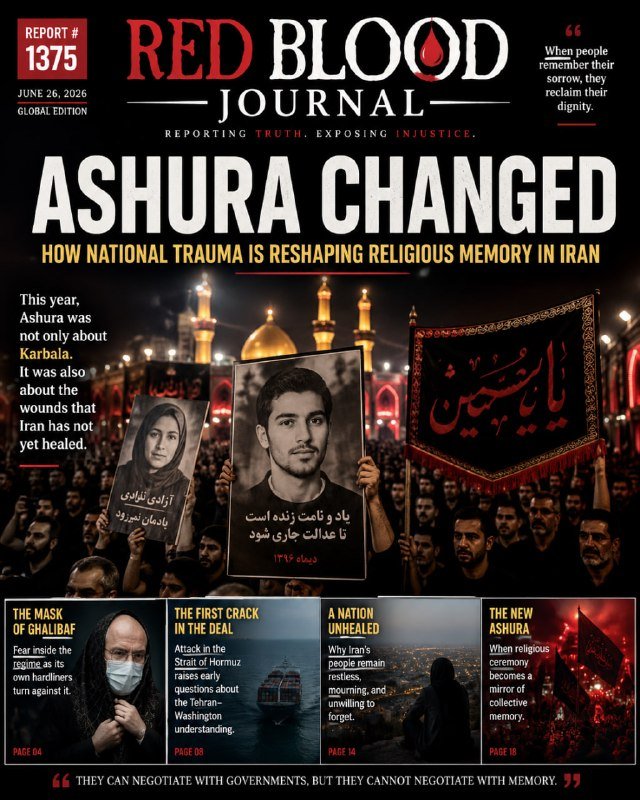
The mourning procession wound through the city of Baalbek in eastern Lebanon on 26 June 2026, the day of Ashura, and was documented by Iran's Tasnim News Agency in both its English and Persian Telegram channels within minutes of each other. The ceremonial substance is centuries old: Shia commemorations of the killing of Husayn ibn Ali at Karbala in 680 AD, marked with dirges, chest-beating rituals, and processions that pour through the Bekaa Valley's most symbolically loaded town. What is newer is who is on hand to film it, who is on hand to redistribute it, and what a single image now has to carry.
The contest over the photograph is the contest over the story. Baalbek is not a neutral backdrop: it sits in a region where Iranian-aligned political and military infrastructure has been visible for decades, where armed non-state actors operate with varying degrees of state cover, and where external media presence is itself a political fact. Tasnim is not an outside observer. It is the English-facing news arm of the Islamic Revolutionary Guard Corps, and its dispatch of the Baalbek ceremony is best read as a piece of soft-power choreography aimed at audiences well beyond the Bekaa.
What the camera is for
Ashura mourning in Lebanon has long served two masters. It is a genuine expression of religious grief and a community ritual; it is also, in towns like Baalbek where the Shia political project is deeply embedded, a public accounting of who belongs to which axis. Iranian state media's investment in the imagery is consistent with that dual purpose. Tasnim's English channel posted the footage at 12:06 UTC; its Persian-facing counterpart, branded Jahan Tasnim, posted the same scene a minute earlier, at 12:05 UTC. The near-simultaneous posting is not editorial carelessness. It is a synchronised push.
For a Western reader, the more useful question is not whether the mourners are sincere (they plainly are) but what work the footage is being asked to do. Iranian state media has spent two decades cultivating an image of Shia communities across the Arab world as part of a coherent political family anchored in Tehran. Baalbek is one of the camera-friendliest venues for that image: large crowds, distinctive architecture, and an unbroken association with Hezbollah and its allies. The Ashura photograph is rarely just an Ashura photograph.
The Bekaa as contested stage
Baalbek has been at the centre of Lebanon's wider crises, including periods of armed conflict that displaced residents and reshaped the country's confessional map. Coverage of the town in Western outlets has historically treated it as a place where Iranian influence is concentrated, sometimes reducing a complex social reality to that single fact. The Tasnim frame goes the other way, presenting Baalbek as a devotional community in clean continuity with a centuries-old rite, with the political scaffolding implicit rather than named.
Neither framing is sufficient on its own. The Bekaa Valley is a place where religious observance, partisan affiliation, and economic dependence on the Iran-aligned axis are genuinely entangled, not as a conspiracy but as a lived political economy. A serious read of the image requires holding both at once: the mourner is grieving, and the mourner is also a unit of measure in a regional information contest.
What the sources do not tell us
A note on what the available record actually contains. The two Telegram items from 26 June are captions and imagery; they do not include crowd estimates, casualty figures, names of clerics who addressed the gathering, security incidents, or any official Lebanese state comment on the event. Tasnim and Jahan Tasnim are Iranian state-aligned outlets; their reporting on Shia commemorations is consistent with their institutional mission and should be treated as primary-source advocacy, not as neutral documentation. The Western wire record on this specific Ashura gathering in Baalbek is not represented in the inputs to this piece, and this publication will not synthesise what it has not read.
The stakes, plainly
The image is small, but the pattern it sits inside is not. Across the region, the infrastructure for telling Shia communities' stories to Shia audiences, and to global ones, has matured into a sophisticated operation anchored in Tehran and extending through allied media in Beirut, Baghdad, and Sanaa. The Baalbek photograph is one tile in that mosaic. For Western policymakers and analysts who treat the Bekaa as a security file and not a social one, the temptation is to read the image as threat documentation. For Iranian-aligned communicators, the temptation is to read it as devotional photography and nothing more. The harder, more honest read is that it is both at once, and that the regional contest over who gets to define Lebanon's Shia heartland is being fought one procession at a time.
Desk note: Monexus sources this piece to Iranian state-affiliated channels only, with the caveat that they are advocacy outlets; the Western wire record on this specific event was not in the inputs and is not invented here.
Wire provenance
This editorial synthesis draws on the following public wire/social posts:
- https://t.me/tasnimnews_en
- https://t.me/JahanTasnim