Beirut's streets reject Washington's deal before the ink is dry
Hours after Lebanon and Israel signed a US-brokered framework agreement, protesters marched on the prime minister's office and the army moved to contain them. The street has delivered its verdict before the mediators have finished explaining themselves.
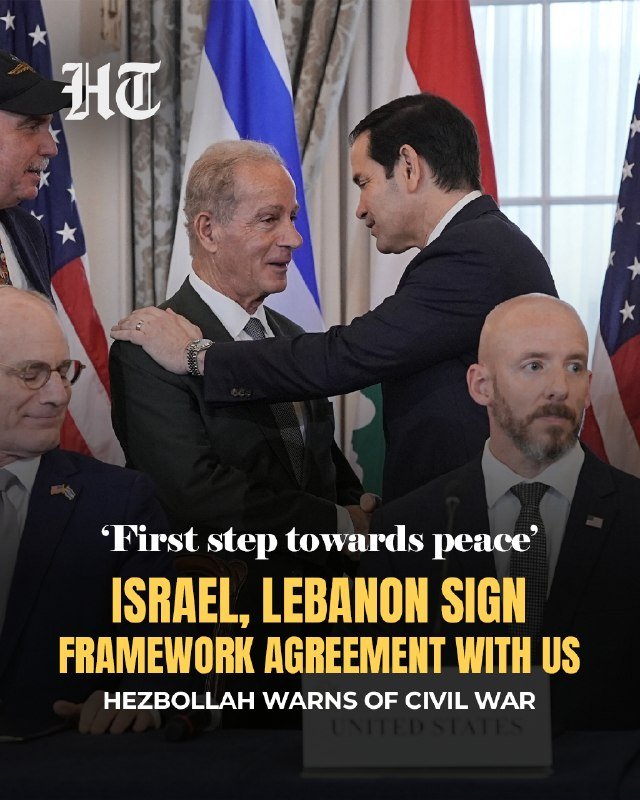
Beirut's downtown filled with protesters on the evening of 26 June 2026, hours after Lebanon and Israel initialled a US-brokered framework agreement. Demonstrators moved towards the office of Prime Minister Nawaf Salam, and units of the Lebanese army deployed to contain the crowd, according to Iranian-aligned outlets Farsna and Press TV, which carried video from the scene between 21:06 and 21:57 UTC. The deal itself was still being digested when the street issued its reply.
The agreement is the first direct Lebanese-Israeli accord in decades and the product of months of shuttle diplomacy led by Washington. Its terms, as reported in regional coverage, cover border demarcation, a phased reduction of armed presence south of the Litani, and a US security-coordination mechanism that gives American mediators a standing role in disputes. To Beirut's Shia political class, including Hezbollah and its allies, that last element is the most incendiary: it formalises an external arbiter inside Lebanon's security architecture at the moment the country is still arguing over its post-2018 defence doctrine. To Washington's negotiators it is precisely the point — a guarantor against unilateral revision. Both readings are present in the initial reporting, and both are politically live.
What the street is saying
The protests are not a single movement. Reporting from Farsna and Press TV describes a coalition that includes Lebanese youth groups, activists aligned with the Shia opposition, and nationalist figures who frame the deal as a capitulation signed under economic duress. Lebanon's currency has stabilised only partially since 2024, and the government has openly courted Gulf and Western financing tied to security normalisation. The demonstrators' charge is structural: that economic recovery is being traded for political sovereignty, and that Beirut is signing a document whose guarantor — the United States — is also the principal arms supplier to one of the two parties. The chants captured on Telegram footage target the prime minister's office rather than the Israeli embassy, which has not operated in Lebanon since 1994. The direction of the anger tells you where the protesters locate the decision.
What the deal actually does
Two parallel tracks are running. On the border, the framework commits both states to a defined land and maritime line, a mutual recognition of the Blue Line adjustments, and an Israeli withdrawal from positions held since the 2024–25 hostilities contingent on Lebanese army deployment to the same areas. On the political track, Beirut commits to suppressing armed non-state actors operating across the frontier, while Israel commits to refrain from unilateral strikes on Lebanese infrastructure outside active combat zones. Neither side has yet published the full text; what is public is a joint communique and a US State Department summary circulated to allied embassies. Until the annexes are released, every claim about specifics is provisional — including the protesters' claim, and the mediators'.
The counter-narrative
Hezbollah's leadership has not publicly endorsed the text. Iranian and pro-Iranian outlets have framed the deal as an American-imposed diktat designed to dismantle the resistance axis, language that mirrors but does not match the more pragmatic objections coming from Lebanon's Sunni business community, which is split between those who see the agreement as a path to reconstruction financing and those who see it as a strategic concession. The Lebanese army's public posture is neutrality; its deployment in central Beirut on the night of 26 June was framed as crowd control, not political alignment. That ambiguity is itself a signal: an institution that has historically claimed the role of national arbiter is choosing, for now, to enforce order rather than adjudicate the agreement's legitimacy.
Why this matters beyond Beirut
The framework is the template, not the exception. Washington has signalled that similar arrangements are being discussed with Damascus and with the Palestinian Authority, and that the Lebanon track is meant to function as a proof of concept for a regional security architecture in which the United States underwrites bilateral deals between states that do not maintain diplomatic relations. For the Israeli right, the deal delivers a quiet southern border and a precedent for direct deals with Arab capitals. For the Gulf monarchies, it offers a managed pathway to normalisation without the political cost of a separate Palestinian track. For Iran, it is an attempt to demonstrate that the resistance project can be rolled back deal by deal without a regional war. The street in Beirut is reacting not only to its own government but to a model being exported.
What remains uncertain
Three things are unresolved at the time of writing. First, the full text and its annexes, which both Lebanese critics and Israeli commentators have demanded be published; the substance on security guarantees and dispute resolution will determine whether the deal holds under stress. Second, the position of Hezbollah's parliamentary bloc, whose abstention or opposition would prevent the government from presenting the agreement to the chamber for ratification. Third, the durability of the protest movement itself, which on the available video is dense but not yet nationwide. The army's restraint on 26 June suggests the state has chosen to absorb rather than suppress the anger; whether that posture survives a second or third night of demonstrations is the open question.
The Monexus desk files this as the street's preliminary verdict on a regional architecture being negotiated over Lebanese heads. Wire reporting on the deal's text and on the government's ratification strategy will be tracked as it arrives; the domestic political cost is being priced in real time on the streets of Beirut.
Wire provenance
This editorial synthesis draws on the following public wire/social posts:
- https://t.me/presstv/122514
- https://t.me/presstv/122517
- https://t.me/presstv/122518
- https://t.me/farsna/345027