Brobbey double steers Netherlands past Tunisia and into Morocco tie
Brian Brobbey scored his second goal in two matches as the Netherlands beat Tunisia 3-1 in Group F, sealing top spot and a round-of-32 meeting with Morocco.
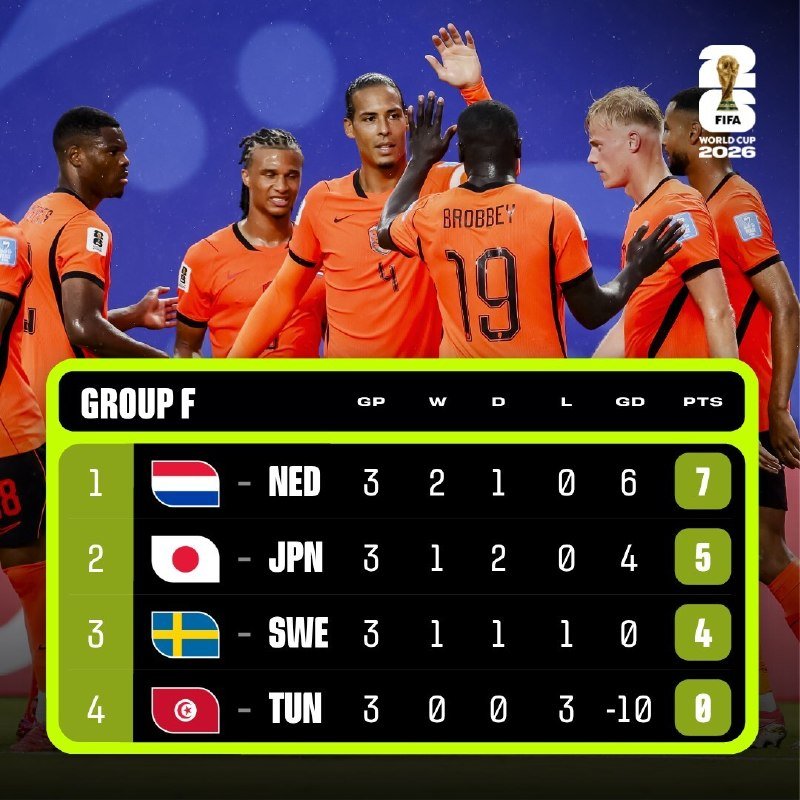
Brian Brobbey struck for the second consecutive game as the Netherlands beat Tunisia 3-1 on 25 June 2026 to claim top spot in Group F and set up a round-of-32 tie with Morocco at the FIFA World Cup. The Ajax forward, who opened his tournament account in the previous outing, finished a move he did not start when Virgil van Dijk delivered an early cross that Brobbey converted inside the opening ten minutes, according to a FIFA live update relayed via Telegram at 23:07 UTC. The result confirmed the Dutch as group winners and ended Tunisia's path to the knockout rounds.
The win matters less for the scoreline than for what it reveals about the Netherlands' shape heading into the knockout bracket. Ronald Koeman's side have now scored five goals in two group matches, and the emergence of a secondary scorer alongside the established attacking order is the kind of small-sample signal coaches spend tournaments trying to manufacture.
A set-piece side, by design
The opening goal was not a counter-attack, not a transition moment, not a moment of individual improvisation. It was a centre-back assisting a centre-forward from a wide delivery, the kind of goal that tends to come off the training ground rather than the back foot. Van Dijk's cross, Brobbey's run, the finish: the choreography belongs to a team that has decided to weaponise set-pieces and wide service rather than possession build-up.
That is a deliberate identity choice. The Dutch have historically been cast as the patron saints of 4-3-3 orthodoxy — Cruyff's inheritance, total football, the obligation to play through the middle. The current squad does not quite match that template. With a 31-year-old van Dijk supplying from deep and a striker in Brobbey who has spent his career running channels rather than combining in tight spaces, the team's clearest route to goal is aerial and vertical. Tunisia, for their part, defended deep and conceded exactly the kind of cross the Dutch wanted to hit.
Tunisia's exit, and what it tells us
Tunisia's elimination is not a surprise on the numbers: they finished the group without a win and with a single point from their opening fixture, per the group-stage summary reported by Sky Sports. The North African side had arrived with a generation of Europe-based players and the perennial hope that continental organisation could disrupt European technical superiority. In practice, the gap showed in both boxes.
There is a counter-narrative worth naming. Tunisia's defensive structure held for long spells, and the 3-1 scoreline flatters the Dutch more than the run of play did. But football's accounting does not credit spells held; it credits goals scored. Tunisia conceded early, conceded from a dead-ball zone, and never recovered the tempo. That is the pattern of a team that needed the first goal and did not get it.
The Morocco tie, and the brackets behind it
The round-of-32 meeting with Morocco is the more interesting story than the group-stage win itself. The Atlas Lions are the highest-ranked African side in the tournament, qualified from the other side of the bracket, and bring a defensive solidity and a counter-attacking threat that the Dutch have not yet faced in this competition. The meeting also sets up a politically loaded fixture — a North African side against a European one, in a tournament staged across North American venues.
The broader structural point is that the expanded 32-team format, by design, produces these cross-continental ties earlier in the bracket than the old 24-team structure did. That has consequences for who survives. European sides, traditionally deep in the tournament, now face African or Asian opposition a round earlier than they would have under the previous format. The Netherlands, having topped their group, have earned the right to face that reality first.
What remains uncertain
Two caveats are worth flagging. First, the available reporting — BBC Sport's match summary and the FIFA live feed via Telegram — does not detail the timing of all three Dutch goals or the identity of the scorers beyond Brobbey, so any minute-by-minute reconstruction should be treated as preliminary. Second, Tunisia's performance across the group, including the opening draw that gave them their point, is uneven: a side capable of frustrating opponents for sixty minutes and conceding three is a different proposition from a side that collapses. The sources do not resolve that ambiguity.
What can be said with confidence is that the Dutch leave the group with a striker in form, a centre-back contributing assists, and a knockout path that will test both. The tournament's structural pressure on European sides to convert group-stage dominance into knockout progression starts, for the Netherlands, against Morocco.
— Monexus reporting on the 2026 FIFA World Cup group stage; verified against BBC Sport, Sky Sports and FIFA live feeds.
Wire provenance
This editorial synthesis draws on the following public wire/social posts:
- https://t.me/FIFAcom/
- https://t.me/TheAthletic/