Hezbollah’s red line and Israel’s southern foothold: the standoff behind the US-brokered Lebanon talks
On 26 June 2026, Hezbollah’s Naim Qassem publicly rejected any normalisation with Israel, while Israeli strikes continued in southern Lebanon and prediction markets put the odds of an Israeli withdrawal this year below one in three.
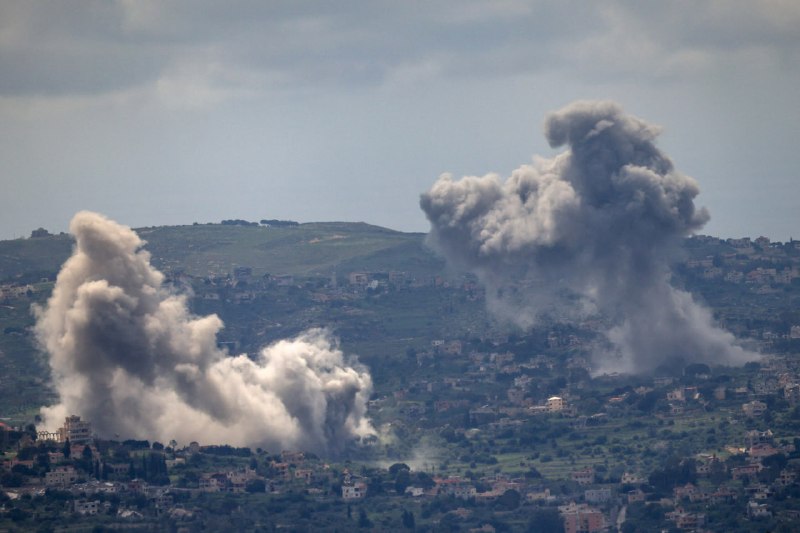
On 26 June 2026, the diplomatic choreography over Lebanon’s southern border produced two sharply incompatible statements in the same news cycle. Hezbollah secretary-general Naim Qassem, speaking as US-mediated talks with Israel dragged past their expected endpoint, declared that the movement accepted no normalisation with Israel and would tolerate no arrangement that yielded gains for the Israeli side. Hours earlier, the Israeli military said it had killed seven Hezbollah members in an airstrike near the so-called "security zone" along the frontier, in southern Lebanon. Prediction markets, picking through the wreckage of optimistic communiqués from Washington and Beirut, priced the chance of an Israeli withdrawal from Lebanon by year-end at roughly 29 percent — a steep slide from where odds had sat when talks began.
The gap between those three signals — the movement’s red line, the air force’s daily tempo, and the market’s cold arithmetic — is now the story of Lebanon. It is also the test case for whether the second year of the post-October 2023 regional track can produce a withdrawal on paper rather than a withdrawal in fact.
The line Hezbollah will not cross
Qassem’s framing, as relayed by Al Jazeera on 26 June, was unambiguous: any agreement must compel Israel to leave Lebanese territory unconditionally. The phrase carries weight because it forecloses the two concessions Beirut’s external backers have most often asked the movement to entertain. The first is a staged withdrawal tied to verifiably demilitarised zones south of the Litani. The second is a quiet bilateral channel that normalises Israel’s presence as a security actor inside Lebanese airspace or along the border — the kind of arrangement that, since 2023, has been the de facto condition of Israel’s southern Lebanon operations.
By inserting the word "unconditionally," Qassem is signalling to his own base, and to the Lebanese negotiating team, that Hezbollah will not be the party that signs an exit that leaves an Israeli security footprint behind. That position sits in tension with what an Israeli negotiating team has historically demanded: buffer zones, intelligence-sharing arrangements, and an explicit prohibition on reconstruction of Shia villages within firing range of the border.
What the public reporting on 26 June does not yet disclose is whether the Hezbollah position was transmitted through the official Lebanese negotiating channel or through parallel intermediaries. The Al Jazeera dispatch frames the statement as the movement’s headline answer; it does not detail which precise clauses on the draft under discussion triggered it. That distinction will shape whether the impasse is tactical — a public posture before a face-saving compromise — or structural — a refusal that the talks cannot bridge.
Strikes, ‘security zone’ and the question of facts on the ground
The Israeli military’s statement, picked up by Liveuamap’s Lebanon feed on 26 June at 13:04 UTC, is the operational counterweight. Seven Hezbollah members killed in a single strike near what the Israeli military terms a "security zone" in southern Lebanon is, in the context of June 2026, a heavy but not extraordinary daily figure. The "security zone" designation is itself a contested piece of vocabulary: in the post-2024 arrangement, Israel has maintained an operating presence along the frontier that extends beyond the 2000 UN-drawn Blue Line, justified as a buffer against cross-border fire.
Two facts are worth holding separately. First, Israel is still striking inside Lebanese territory on a daily basis; that tempo has not paused for talks, and the casualty figures — verifiable through Lebanese and international reporting, though not always through the Israeli military’s own statements — suggest that the air campaign has continued at roughly its prior pace. Second, the term "security zone" is being used by an Israeli military spokesperson for an area inside Lebanon, which is itself a statement about the limits of the current arrangement: Israel is operating as if a recognised zone exists, even where the diplomatic track has not formally acknowledged one.
Hezbollah-aligned outlets have, in previous reporting cycles, contested individual Israeli claims of "targeted" strikes, arguing that civilian infrastructure has been hit and that the term "security zone" is a euphemism for an occupation that no ceasefire has ever legalised. Those critiques do not appear in the 26 June wire material directly, but they form the inferential background against which Qassem’s "unconditionally" is being read.
What the prediction market is telling Washington
The Polymarket line — a 29 percent implied probability that Israel withdraws from Lebanon by the end of 2026 — is, in this telling, the most diagnostic number of the day. Prediction markets are blunt instruments, but they integrate two things that communiqués do not: the revealed beliefs of traders with money on the line, and the slow drift of those beliefs as new information lands.
A withdrawal under 30 percent by year-end means the market is pricing in one of two outcomes. Either the talks collapse and the current arrangement — strikes, border tension, low-level exchange — grinds on through 2026. Or a withdrawal happens, but late, after the calendar cutoff the market is being asked about. Either way, the implied message to the US negotiating team is that the diplomatic track is not on a glide path to a clean Israeli exit, and that additional pressure — on Hezbollah, on Israel, or on Lebanon’s caretaker government — would be required to move the line.
There is a third reading worth flagging. The 29 percent may also reflect market suspicion that a withdrawal, if it comes, will not look like a full return to the pre-October 2023 line. A partial drawdown, or a withdrawal paired with explicit Israeli monitoring rights, could satisfy a political headline while not registering as a true withdrawal in the contract Polymarket is pricing. That ambiguity is itself part of why the figure sits where it does.
The structural picture: a frontier held together by parallel non-agreements
What is unfolding on Lebanon’s southern border is best understood not as a negotiation approaching conclusion but as a frontier held together by parallel non-agreements. The diplomatic track exists; the air campaign continues; Hezbollah refuses to legitimise any Israeli position; Israel continues to assert one. Each side is acting rationally inside its own framework, and none of those frameworks is converging.
The deeper pattern is regional. The post-October 2023 architecture has produced, across multiple fronts, an arrangement in which de-escalation is achieved by managing intensity rather than resolving status. Gaza, the West Bank, Yemen, and now Lebanon all sit inside the same logic: ceasefires of convenience, ongoing operational reach, and political leaders who cannot afford to be seen conceding the principle while they concede the practice. That arrangement can persist for years. It can also fracture quickly when one of its load-bearing assumptions — that the other side will not push for a decisive outcome — fails.
For the United States, the dilemma is that the marginal cost of pushing harder is asymmetric. A genuine Israeli withdrawal, underwritten by Washington, would require Israel to accept that its southern Lebanon buffer is not a permanent feature of the regional map. A failure to deliver that would mean the talks produce a communiqué, not a change. For Hezbollah, the dilemma is mirror-image: a refusal to budge on normalisation forecloses the possibility of a diplomatic exit, but a softening forecloses the constituency that makes Hezbollah the political actor it is.
What the next weeks will test
Three near-term signals will say whether 26 June was a day of tactical positioning or a sign that the talks have reached their outer edge. The first is whether the Lebanese negotiating team, on the record, echoes Hezbollah’s unconditional framing or distances itself from it; that will reveal whether Beirut’s delegation speaks for the movement or alongside it. The second is whether the Israeli air campaign pauses, intensifies, or holds steady in the days that follow; a sustained tempo would suggest that Jerusalem has concluded that the talks are not producing a deliverable. The third is whether the Polymarket line moves meaningfully away from the 29 percent anchor; a sharp drop toward single digits would imply that traders are no longer pricing a withdrawal this year at all, while a rise above fifty would suggest new confidence in the track.
What the 26 June wire material does not resolve is the gap between the public statements and the text on the table. Hezbollah says unconditional. Israel says security zone. The market says one in three. Each of those can be true at the same time, and all of them are. The story of the next weeks is whether any of them has to give.
— Monexus framed this against the live wire rather than against the negotiating-room communiqués, on the view that the strikes tempo and the prediction-market line are the more honest read on whether the diplomatic track is delivering a real withdrawal.
Wire provenance
This editorial synthesis draws on the following public wire/social posts:
- https://t.me/Liveuamap/