Israel drops leaflets over southern Lebanon as ceasefire strain surfaces and US talks extend
Leaflets over Khiam and the hardening line from Hezbollah's Naim Qassem suggest a fragile truce under quiet duress, with withdrawal odds still pegged below one in three.
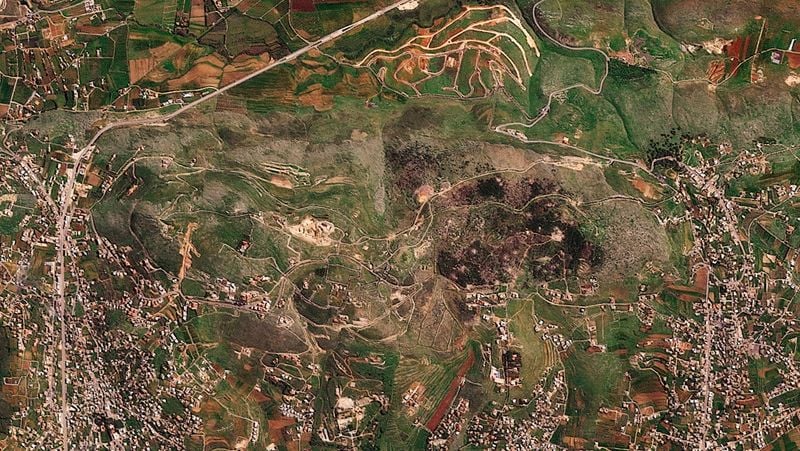
Lead
Israeli aircraft dropped leaflets on 26 June 2026 over a city in southern Lebanon, calling on residents to evacuate, in what local reporting identifies as the first such action since the ceasefire between Israel and Hezbollah came into force. The drop, captured in images circulated on X by the account sprinterpress on 2026-06-26T14:31, lands on a truce that US-mediated talks have so far failed to convert into a permanent settlement.
The leaflets — a familiar instrument of Israeli psychological operations against Lebanese border communities — appeared over Khiam, a town in southern Lebanon that has been at the centre of the fighting and the post-war monitoring arrangements. Their appearance coincides with a hardening of Hezbollah's public posture: the group's secretary-general, Naim Qassem, told Al Jazeera on 2026-06-26T13:28 that Israel must leave Lebanon "unconditionally," accepting "no normalisation" and "no gains for Israel." He spoke as US-brokered negotiations in the region extended beyond their expected window.
Nut graf
The leaflets, the speech and the market signals together describe a ceasefire that is holding but not normalising. Washington is buying time, Hezbollah is refusing to soften its demands, and Israel is reminding southern Lebanon — and by extension, the mediators — that it retains the means to escalate. The structural question is no longer whether the truce will collapse tomorrow, but whether it can survive long enough to be called a peace.
The leaflet drop and what it changes
Leaflet drops are a deliberate register. Israel used them extensively during the 2006 war, again in the 2019 exchanges, and through the 2023–25 escalation that culminated in the November 2024 ceasefire framework. Their return is not a tactical curiosity; it is a signal to a specific audience.
The audience is layered. The first, and most obvious, is the local population — civilians in towns and villages along the Litani river corridor who have been told to leave specific neighbourhoods or buildings. The second is Hezbollah itself, whose reconstruction and re-assertion in those very areas is the issue Israel has raised most consistently in post-ceasefire diplomacy. The third, less openly acknowledged, is the US negotiating team, whose pressure on Israel to hold fire during the talks is precisely the pressure this kind of action undermines.
In reporting on similar operations, Israeli outlets have framed leaflet campaigns as a calibrated precursor to kinetic action — a final warning before targeting. That history sits in the background of the current drop. Whether the leaflets are the prologue or the message itself will be determined in the days that follow.
Hezbollah's line: no normalisation, no gains
Qassem's intervention on Al Jazeera the same day is the rhetorical counterpart to the leaflets. He framed the Israeli demand set — which, as reported, includes the disarmament of Hezbollah forces north of the Litani, the withdrawal of reconstruction assets, and the depopulation of villages near the border — as a request for capitulation dressed as peace.
The Hezbollah position has three components that are now clearly articulated. First, that any Israeli withdrawal be unconditional, not staged against Lebanese concessions. Second, that the group will accept neither recognition nor normalisation with the Jewish state — a long-standing position now restated in the language of an emerging "no gains for Israel" framing. Third, implicit but unmistakable, that the timetable for reconstruction of south Lebanon and the suburbs of Beirut will not be dictated from Jerusalem.
This is not the maximalist language of the pre-ceasefire period. It is the language of a non-state armed actor that has survived a punishing campaign, retained its leadership, and is now bargaining from a position of diminished but non-zero strength.
What the US is actually mediating
The US-brokered track, extended on 26 June, has narrowed to a small number of contested files: the geographic definition of the Israeli withdrawal zone, the sequencing of Hezbollah's pullback from positions north of the Litani, the disarmament timetable for non-state fighters south of the river, and the conditions under which reconstruction aid enters the affected areas.
Two features of the track are worth noting. First, the Israeli demands as reported bear a family resemblance to those that produced the original ceasefire framework in late 2024 — demands that were honoured unevenly in the eighteen months since. Second, the Lebanese state's institutional capacity to enforce any agreement remains weak, a fact every participant at the table knows and no participant is willing to make the centre of the negotiations.
The extension of talks is itself a tell. Mediators extend when the gap is narrow enough that more time might close it. They pull the plug when the gap is too wide for any amount of additional diplomacy. The fact that Washington is still in the room suggests that the gap, on paper, is not yet insuperable. The fact that the Israeli side has resumed leaflet operations suggests that, on the ground, the patience is thinner than the diplomatic calendar implies.
The market signal and the time horizon
Prediction markets are imperfect instruments, but they are unusually useful at moments like this. Polymarket's running market on whether Israel will withdraw from Lebanon by the end of 2026, captured on 2026-06-26T13:37, sat at 29 percent. A bettor pricing withdrawal by year-end at roughly one-in-three is pricing a world in which the war does not formally end, the ceasefire frays, and the calendar runs out before the diplomats do.
That is not a forecast of renewed full-scale war. It is a forecast of drift — of a ceasefire that holds in form but not in substance, in which the relevant question at year-end is whether enough has changed on the ground to call the Israeli presence a withdrawal in name.
The structural frame here is not unfamiliar. A mediator purchases time; the weaker party refuses to grant the legitimacy the stronger party wants; the stronger party resumes low-cost coercive signalling; the mediator returns to the table with a slightly weaker hand. The pattern repeats until one side runs out of either energy or alternatives.
What is uncertain
Three things remain genuinely contested in the open reporting. The first is the exact content of the leaflets and the specific neighbourhoods named. The second is the operational intent behind the drop — whether Israel is signalling imminent kinetic action, conducting routine psychological operations, or testing the US mediator's reaction. The third is the actual content of the Qassem interview beyond the headline formulation: Al Jazeera's reporting captures the political line but not the conditions, if any, under which Hezbollah might accept sequencing of any kind.
These uncertainties matter. A leaflet drop framed as a final warning to a specific building or cell is operationally very different from a generalised evacuation order. The markets, the speech, and the negotiations are all interpretations layered on top of an action whose full meaning is still being negotiated.
Stakes
If the trajectory continues, Lebanon absorbs a slow-bleed ceasefire — enough quiet for reconstruction to begin, enough Israeli presence to keep Hezbollah from re-asserting in the border zone, and enough Hezbollah rhetoric to ensure the underlying conflict is not actually resolved. The cost of that middle state falls on civilians in the south, on Lebanese state institutions unable to govern their own territory, and on the credibility of the US as a regional broker.
If the trajectory breaks — whether upward, through a renewed Israeli campaign, or downward, through a sequenced agreement — the immediate beneficiaries will be visible on television within hours. The deeper beneficiary, in either case, is the side that ends up owning the diplomatic narrative at the end of 2026.
Desk note
Monexus treated this as a single integrated event: a kinetic signal, a political speech, and a market price, each corroborating the others, none sufficient on its own. The wire frame of "Israel drops leaflets / Hezbollah hardens line / talks extend" was preserved; the structural reading is our own.
Wire provenance
This editorial synthesis draws on the following public wire/social posts:
- https://x.com/sprinterpress/status/