A framework, not a finish: Israel and Lebanon cross the diplomatic line on US-brokered terms
A US-brokered framework between Israel and Lebanon is being framed as a diplomatic breakthrough. The street response in Dahieh suggests the harder politics starts after the signatures.
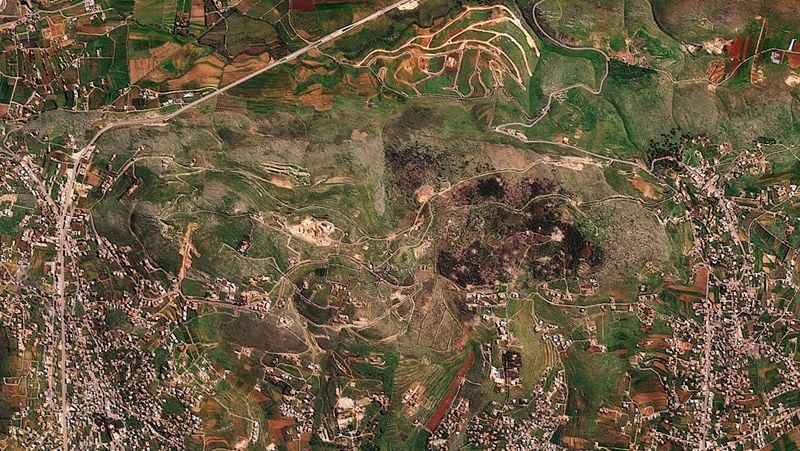
The text is described as a framework, not a peace treaty, and that qualifier matters. On 26 June 2026, Israel and Lebanon announced they had signed a framework agreement reached through US-brokered talks, according to BBC News reporting published at 21:33 UTC. The same announcement was carried by Al Jazeera English's global channel at roughly 21:15 UTC. Within hours, supporters of Hezbollah had begun gathering in Dahieh, the Shia-majority southern suburb of Beirut that has served as the movement's political and organisational centre of gravity for decades, to protest the deal, according to a correspondent for War on Facism / Witness channel posting at 20:11 UTC.
The three signals are out of phase in a way that tells you most of what you need to know. A diplomatic text exists. The governments of two states have attached their names to it. And the non-state actor whose military weight forced the original war, and whose disarmament is the unspoken centre of the document, is treating the announcement as an affront rather than an outcome. Reading those three signals together is the only honest way to read what was signed in Washington and announced in Jerusalem and Beirut.
What the wire says happened
The BBC News bulletin of 21:33 UTC describes the document as a framework agreement and not a final settlement. The BBC's framing is deliberately cautious, noting that previous ceasefires between Israel and Hezbollah have still seen near-daily cross-border strikes even after the formal language of de-escalation was in place. That lineage — 1996, 2006, the post-2024 arrangement — is the load-bearing context. None of those episodes converted a ceasefire into a political settlement. Each one held for a period measured in months, and each one broke for reasons that the parties had agreed to ignore while signing.
Al Jazeera English's coverage frames the announcement as a US-brokered outcome, with the State Department's hand visible in the architecture of the deal. The Dahieh protest, reported at 20:11 UTC, predates both the BBC and the Al Jazeera English write-ups and indicates that the text was already known in Beirut hours before it was packaged for international wire consumption. The chronology is itself a story: in modern Middle Eastern diplomacy, the local audience hears the news first and reacts first, and the foreign wire audience receives the polished version afterwards.
What is actually on the table, on the available evidence, is a framework — meaning a set of principles, commitments, and sequencing arrangements — rather than a binding bilateral treaty. No casualty figures, financial numbers, or specific military arrangements appear in the wire reporting cited here. That silence is informative: when the specifics are absent, it usually means the specifics have not been agreed, only the meta-text has.
Why Dahieh is the political barometer
Hezbollah's institutional position has been weakened over the past two years by the Israeli campaign in southern Lebanon and the broader erosion of Iranian-aligned deterrence after the open confrontation with Israel in late 2024 and 2025. That weakening is the precondition that made any framework possible at all. A movement that could credibly threaten northern Israel does not accept frameworks brokered in Washington; a movement that cannot credibly threaten northern Israel is forced into them.
The protest in Dahieh is therefore not a rejection of the framework on its merits. It is a public assertion by Hezbollah's political base that the framework's terms have not been sold to them. The unanswered question, which none of the wire reporting cited here resolves, is whether the Lebanese state and Hezbollah's leadership have an internal understanding about how to manage a deal their constituents are demonstrating against. That has been the recurring failure mode of Lebanese-Israeli diplomacy for three decades: an agreement signed in a foreign capital, ratified in Beirut, and never translated into a domestic political equilibrium that survives contact with a population that did not feel represented at the table.
The Lebanese state's own position deserves more weight than it usually gets in Western coverage. Beirut is not a passive recipient of a Washington-engineered text. The Lebanese army, which has been slowly extending its presence in the south as part of the post-2024 ceasefire architecture, is the institution that would have to operationalise any new arrangement on the ground. Whether the framework strengthens the army's position relative to Hezbollah's residual armed presence, or instead leaves the disarmament question deferred, will determine whether the document is a genuine state-to-state compact or another ceasefire in different clothing.
The American hand, and what it costs the mediator
Washington's role as sole broker is the most consequential structural fact about the announcement, and it is the fact most likely to be underweighted in the immediate coverage. A bilateral framework between Israel and Lebanon that bears the United States' fingerprints turns the deal, in effect, into a US-backed security architecture on the Levant's northern border. That is a strategic asset for Washington in the narrow sense — it locks in a diplomatic deliverable, restocks depleted credibility in the region, and gives the administration a foreign-policy win to point to.
It is also a strategic liability in the longer sense. The United States now owns the implementation gap. When the framework strains, when a violation is alleged, when a strike draws retaliation, the political question in every Middle Eastern capital will not be "what did Beirut and Jerusalem agree" but "what is Washington going to do about it." That is the recurring American pattern in the region: broker the text, inherit the implementation, and then discover that the domestic politics of the parties the text was negotiated through are not under Washington's control.
A second structural feature deserves attention. The framework is being announced without, on the available reporting, a clear public answer to what happens to Hezbollah's residual military capability. Any agreement that does not address that question is, by construction, a confidence-building measure rather than a settlement. Previous ceasefires have lived or died on that single variable. The honest read of the BBC's framing — that "previous ceasefires between Israel and Hezbollah have still seen near-daily cross-border strikes" — is that the wire is signalling, without saying so directly, that this framework is best understood as another instrument in that lineage rather than a departure from it.
What the framework changes, and what it does not
On the optimistic reading, the framework changes three things. It elevates the diplomatic channel above the military one, giving the Lebanese army and the Lebanese state a recognised interlocutor role that Hezbollah has historically monopolised on the Lebanese side. It creates a procedural basis for handling incidents short of war — a category that has historically been the trigger for the next war. And it gives the United States a formal role in arbitrating disputes, which is the closest thing to a guarantee against rapid escalation that exists in this conflict system.
On the pessimistic reading, none of those things are new. The 1996 understanding had all three. The 2006 arrangement had all three. The post-2024 architecture had all three. Each one degraded. The mechanism of degradation was always the same: an incident on the ground, an unverifiable claim of violation, a retaliatory strike that the formal framework was meant to prevent, and a re-escalation cycle that ran until the diplomatic text became irrelevant again. The framework announced on 26 June 2026 enters a system that has repeatedly demonstrated it can absorb diplomatic instruments without converting them into durable order.
The counter-narrative to the pessimistic reading is that the regional balance has shifted enough to make this framework stick. Israel's demonstrated capacity to degrade Hezbollah's military infrastructure, Iran's reduced capacity to replenish it, and Lebanon's domestic pressure on its own state to assert sovereignty over the south — these are real changes that did not exist in 1996 or 2006. They are the structural reasons a framework is on the table in 2026 rather than 2024. Whether they are sufficient is the open question, and the next ninety days of incident reporting on the border will be the test.
The next thirty days
The Dahieh protest is the leading indicator. If it remains contained — a noisy but bounded expression of dissent — then the framework has bought itself the political space to be operationalised. If it expands into a sustained mobilisation, and if Hezbollah's leadership is forced to choose between defending the deal and defending its constituency, the framework's centre of gravity collapses before the ink is dry.
A second indicator is the Lebanese army's footprint in the south. Reports over the past eighteen months have described a slow, contested extension of state authority into areas previously under Hezbollah control. If the framework accelerates that extension, it has a chance. If the framework is used by Hezbollah's political wing to argue that armed presence is no longer necessary while the movement's armed wing preserves its capabilities, the text is a domestic Lebanese settlement between factions rather than a Lebanon-Israel settlement, and it will be tested by the first serious cross-border incident.
A third indicator is the United States' tolerance for friction. The history of US-brokered frameworks in this conflict system suggests that Washington's attention span is shorter than the conflict's memory. If the next administration, or the same administration under domestic political pressure, treats the framework as a settled achievement rather than a managed process, the architecture will be left to drift.
The wire reporting cited here does not resolve any of those indicators. It records that an agreement exists, that it was brokered in Washington, and that the most directly affected political constituency on the Lebanese side is treating the announcement as a problem rather than a solution. The honest reading is that a framework has been signed and that signing a framework is the easy part. What was announced on 26 June 2026 is the start of a process whose outcome will be determined by what happens in Dahieh, in the South Lebanon governorate, and in Washington in the weeks that follow — not by what was written in the framework itself.
Monexus framed this as a structural event — one in which the diplomatic text, the regional balance of forces, and the domestic Lebanese political equilibrium all have to hold for the announcement to mean what its signatories want it to mean. Western wires led with the diplomatic text; the Dahieh protest, reported earlier in the day, was the underweighted signal.
Wire provenance
This editorial synthesis draws on the following public wire/social posts:
- https://t.me/aljazeeraglobal
- https://t.me/wfwitness
- https://t.me/bbcnews
- https://en.wikipedia.org/wiki/Dahiyeh
- https://en.wikipedia.org/wiki/United_Nations_Security_Council_Resolution_1701