Beirut's streets say no to a deal Washington hasn't read
A reported 14-point framework agreement between Beirut and Jerusalem was meant to close a chapter. Instead it has put Lebanon's streets back on the front page.
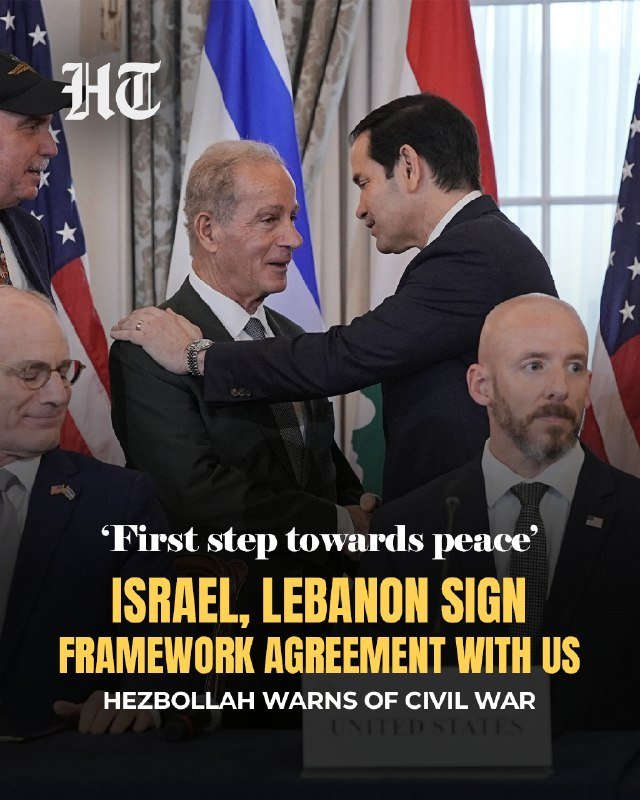
On the evening of 26 June 2026, security forces in Beirut moved against demonstrators who had poured into the streets to reject a framework agreement that Lebanon's government is reported to have reached with Israel. The intervention turned violent within hours. By late evening UTC, the picture from Lebanese outlets and Iranian state media was the same: a capital under tear gas, a government accused of selling out its south, and a foreign correspondent community working from a single Al-Arabiya leak that no Lebanese or Israeli official had, at the time of writing, confirmed on the record.
The thread running through Thursday's reporting is that the deal, as it has been described to two regional outlets, is less a peace than a managed pause, and one whose terms the Lebanese public is being asked to accept without seeing the text.
A 14-point framework nobody has signed
According to Al-Arabiya, whose reporting was carried by Iran's Tasnim News Agency shortly before 22:00 UTC on 26 June, the agreement in question contains 14 points and has been characterised as a "framework agreement" between the government of Lebanon and Israel. The details, as Tasnim relays them, sketch a phased Israeli withdrawal from southern Lebanon inside an "aura of uncertainty" — language that suggests the choreography of the pullback is still contested, even if the direction of travel is not. Tasnim also carried an Axios-sourced framing of the same document, indicating that Washington is at minimum a convening party to whatever has been initialed.
The substantive question — what Israel gives up, what Hezbollah concedes, what happens to the disputed points along the Blue Line — is precisely the question the document has so far been used to avoid answering in public. Lebanese viewers are being asked to react to bullet points whose own drafters will not put their names to in the local press.
The street is not the cabinet
The protests on 26 June are the politically inconvenient fact for Beirut's negotiators. Tasnim's Lebanese stringers reported that the demonstrations began against the initial agreement and escalated once security forces intervened. By 23:08 UTC, the agency's English feed carried accounts of violence in central Beirut, with protesters framing the deal as a capitulation on southern Lebanon's security architecture and on the residual armed posture of Hezbollah north of the Litani.
This is the part of the story Western wires will compress. Lebanon's sectarian political class has spent two decades negotiating in private precisely because it knows what an audible, public Lebanese debate does to its leverage: it strips the cabinet of the room to trade. The government's room to trade has now narrowed considerably. A framework that looked workable in a Beiruti conference room is now a framework that has to survive a televised street.
What the framework actually changes
Stripped of the diplomacy, the structural claim is straightforward. Israel would withdraw from positions it currently holds inside southern Lebanon — a withdrawal whose pace, verification, and triggers are still unspecified. In exchange, the Lebanese state, rather than Hezbollah's military wing, would assume formal responsibility for the security of the border region. That is the long-standing Israeli and American ask since the November 2024 ceasefire understanding. It is also the long-standing demand of UN Security Council Resolution 1701, which successive Lebanese governments have signed but never fully implemented.
The reason the framework matters, even at 14 bullet points, is that it moves the architecture of deterrence in the south off the bilateral Hezbollah–Israel track and back onto the state-to-state track. That is a structural shift, not a tactical one. It is the shift Iran's regional position is calibrated to resist, and it is the shift Washington's Middle East team has been pushing for since the spring.
The reason it is fragile is that the same architecture depends on a Lebanese army the cabinet does not fully command, on a southern population that does not trust the cabinet, and on a government that has not yet had to defend the deal's text in parliament.
Stakes, and what is still unverified
If the framework holds, the next phase is technical: the mechanics of withdrawal, the dispute-settlement annex, the language on prisoners' remains and on the villages just inside the border where the landmines have not yet been cleared. If it collapses, the alternative is not a return to the status quo ante. It is a second round of fighting in the south whose political centre of gravity, this time, sits inside Lebanon rather than on the Israel–Lebanon frontier.
What the public record still does not show is the document itself. Al-Arabiya is the single named source for the 14-point architecture, carried via Tasnim and not independently confirmed by Reuters, AFP, or the wire services that would normally triangulate such a claim. The Axios framing referenced by the same feeds points to a US convening role, but not to a US signature. The Israeli prime minister's office has not, on the late-UTC record of 26 June, confirmed or denied the framework in those terms. The Lebanese government's official communication channel has been silent on substance.
Until those three gaps are closed — the text, the Israeli readout, the Lebanese cabinet's own account — the protests in Beirut are not a sideshow to the diplomacy. They are the only public audit the framework has so far been subjected to, and the auditors have not been persuaded.
This piece was written by Monexus's news desk on the late-UTC cycle of 26 June 2026. We have led with Tasnim and Al-Arabiya because they are the named sources for the 14-point claim and for the on-the-ground protest reporting, and we have flagged both as the limits of what can currently be verified independently.
Wire provenance
This editorial synthesis draws on the following public wire/social posts:
- https://t.me/JahanTasnim
- https://t.me/JahanTasnim
- https://t.me/tasnimnews_en
- https://t.me/JahanTasnim