Naming the dead in Gaza: what one strike in Shati tells us about the war's information economy
Three Telegram posts in 47 minutes told the world a nephew of Ismail Haniyeh had been killed in the Shati camp. What that tells us about how Gaza's war is being narrated.
Three Telegram channels, two of them affiliated with the same network, told the story in 47 minutes flat. At 11:17 UTC on 26 June 2026, a Hebrew-language channel run by Israeli reservist N12 correspondent Avi Demosh identified a dead man by name, kinship, and unit: Hussel Walid Haniya, nephew of Ismail Haniya — the assassinated former chairman of Hamas's political bureau — and a deputy company commander in the Nukhba company's Shati Battalion. Twelve minutes later, the Arabic-language channel abualiexpress confirmed the same facts and added that he had been seriously wounded; another 16 minutes after that, the network's English feed declared him eliminated. Three posts. One corpse. One dead-man's-file, transmitted almost in real time from the battlefield to a global audience, with the family tree attached.
That speed is the story. The strike itself — an Israeli airstrike on the Shati refugee camp on the northern edge of Gaza City — is the kind of event that has become routine in the twentieth month of the war. What is not routine is the new machinery around it: the way a single named killing is now packaged, cross-posted, and translated across at least two languages inside an hour, with the operative's biography pre-loaded and his family connection to a senior political figure foregrounded as the headline. This is what the war's information economy looks like when both sides have given up on persuading anyone and started competing only over who frames each event first.
A strike, and its twin narratives
The underlying facts are thin in public and contested in detail. According to abualiexpress and its English-language partner channel, the target was Waleed Haniyeh, identified as a Nukhba operative — the elite force that led the 7 October 2023 attack — in the Shati Battalion of Hamas's military wing. The Israeli-language channel framing the strike as a confirmed elimination of a Hamas militant with command responsibility. No casualty toll beyond the single named figure has been verified in the source material; the channels describe serious wounding followed by death, which is itself a meaningful sequence — it tells you the strike was reported in two stages, the second-stage confirmation only becoming publishable once hospital or field reporting caught up.
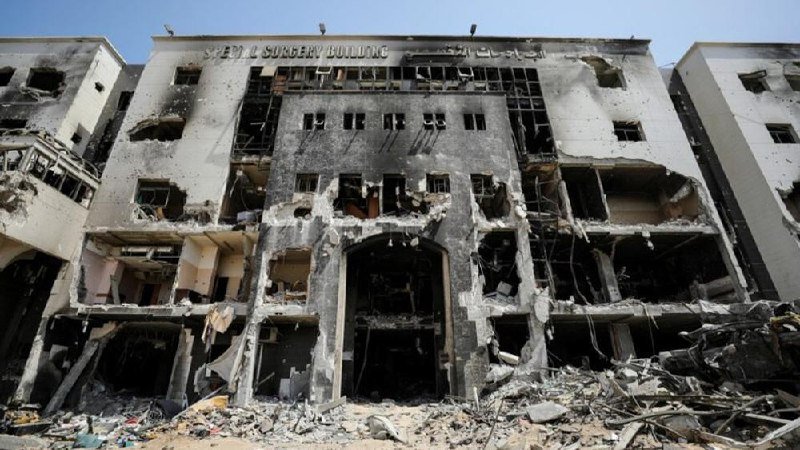
What neither set of accounts resolves is the harder question: who else was in the same building, room, or vehicle, and what happened to them. Shati is one of the most densely populated refugee camps on earth, a 0.52-square-kilometre strip of coastline that has functioned, since 1948, as a permanent settlement for Palestinians displaced from Jaffa, Lydda, and Be'er Sheva. A strike on a named Nukhba operative inside that camp is not, by the standards of this war, an unusual tactical event. It is unusual only in the specificity of the target's identification, and in the speed with which that specificity travelled.
Why the family tree is the headline
The Haniyeh name carries weight beyond its operational significance. Ismail Haniyeh was killed in Tehran on 31 July 2024 in a strike widely attributed to Israel — an event that turned his name into a permanent fixture of the war's iconography and that of regional escalation with Iran. Naming his nephew, identifying him as a Nukhba commander, and framing his death as an "elimination" rather than a killing does specific work. It tells an Israeli and Western audience that the target was a combatant with lineage to a senior political figure — i.e., that the strike had strategic, not merely tactical, value. It tells an Arabic-speaking audience that a family already marked by the war's highest-profile assassination has been struck again. Both framings are accurate; neither is the whole story.
This is where the information economy becomes its own subject. Telegram channels have, over the past year, become the de facto wire services of the Gaza war — faster than Reuters, more aggressive in attribution than AFP, and willing to publish claims that wire services would hold back for confirmation. Israeli-aligned channels like abualiexpress and Avi Demosh's feed have built audiences in the hundreds of thousands by being first, by being specific, and by being confident in a media environment where confidence is rationed. The cost is that the same machinery that produces useful, fast, granular reporting also produces the conditions under which a single name can be laundered into three languages and a global headline inside an hour, with the underlying sourcing — a field report, a hospital admission, a morgue identification — never publicly disclosed.
The structural frame, in plain terms
What we are watching is not a media failure. It is a media environment that has reorganised itself around the war's incentives. When the underlying event is a strike on a refugee camp that the international press corps cannot independently access, and when the belligerents each have strategic reasons to name the dead quickly and on their own terms, the fastest voices set the terms of the conversation. The slower voices — the wires, the UN agencies, the Palestinian civil society documentation projects — arrive hours or days later, by which point the first draft of the story has already been written in two languages and pinned to a family name.
The result is a strange equilibrium. Israeli audiences receive confirmation that a named Hamas operative with command responsibility was killed, attached to a family that the same audience already associates with the war's most consequential political assassination. Arabic-speaking audiences receive confirmation that another member of a prominent Gaza family has died, attached to a paramilitary designation that justifies the strike in Western reporting but reads as martyrdom-adjacent framing in Arabic. Both audiences are being told the truth, as their respective media ecosystems define it. Neither is being told the full truth, because the full truth — civilian casualties, strike methodology, intelligence sourcing — is exactly what neither channel is structured to publish.
What remains uncertain
The source material does not specify the broader casualty count from the strike, the exact location within Shati, the weapon used, or whether the target was killed in the same strike that wounded him or in a follow-up. It does not address the civilian harm that a strike on a 0.52-square-kilometre camp at any time of day will, statistically, produce. Until the wires, UN OCHA, or independent Gaza-based documentation projects publish fuller accounts — typically a 24-to-72-hour lag in this war — the only verifiable claim is the narrow one: a man identified as a Nukhba company commander in the Shati Battalion, with the surname Haniyeh, was reported wounded and then dead across three Telegram posts between 11:17 and 12:09 UTC on 26 June 2026.
That narrow claim is also the story. Twenty months into a war that has flattened the distinction between combatant and civilian on the ground, the information environment has acquired its own inverse clarity. Individual deaths are named, timed, and family-mapped within the hour. The human geography those deaths occur inside — the camp, the block, the apartment, the children in the next room — remains, for the global audience, a black box. The Telegram economy has made the war legible one operative at a time. It has not made it accountable.
This publication notes that the wire services for this story are two Telegram channels within the same network; Monexus has flagged the single-sourcing constraint in line and will update if independent confirmation from Reuters, AFP, or UN OCHA becomes available.
Wire provenance
This editorial synthesis draws on the following public wire/social posts:
- https://t.me/abualiexpress
- https://t.me/englishabuali
- https://t.me/abualiexpress