Venezuela's 'doublet' earthquake kills nearly 600 as Caracas confronts a rare seismic pattern
A rare back-to-back quake sequence has killed at least 589 people and injured thousands in Venezuela. FRANCE 24 explains the 'doublet' phenomenon — and what comes next for a country already stretched thin.
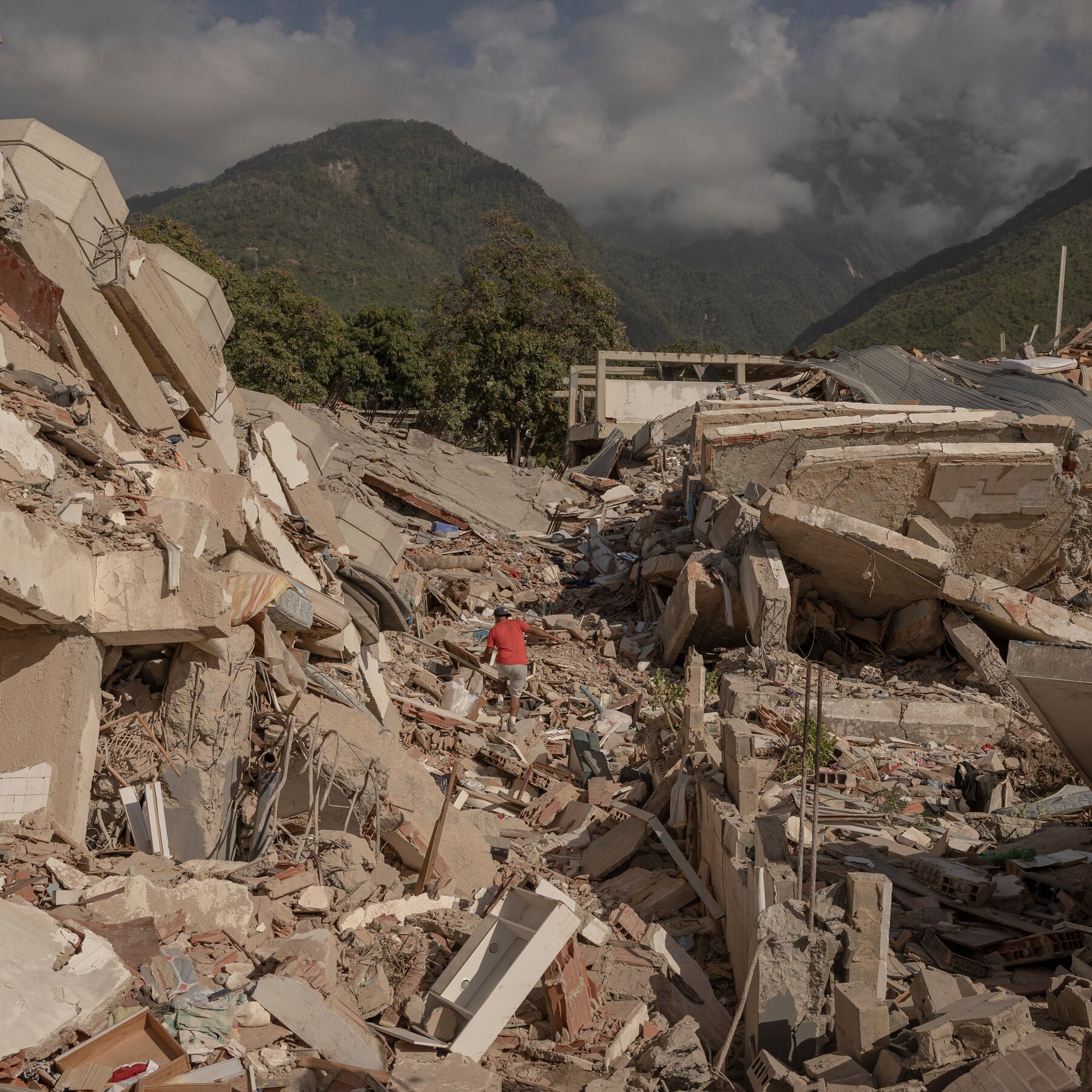
The death toll from the earthquake that struck western Venezuela on the evening of 25 June 2026 has climbed to at least 589, with roughly 3,000 people injured, according to FRANCE 24 and Telegram-channel reporting from Abu Ali Express citing on-the-ground counts published within hours of the disaster. The tremor hit with unusual force — and, more unusually, came as a pair, a seismic pattern scientists call a "doublet," in which two sizeable shocks arrive in close succession on adjacent fault segments and effectively double the destructive footprint of a single event.
The episode exposes a familiar vulnerability dressed in an unfamiliar scientific package. Venezuela sits at the boundary of the Caribbean and South American plates and has long carried seismic risk in its western states. A doublet, however, is rarer and more punishing than a single mainshock: buildings weakened by the first jolt collapse under the second, and rescue operations that arrive during the pause between tremors are caught exposed when the second wave hits.
What the 'doublet' pattern actually means
In conventional earthquake sequences, one mainshock dominates and the aftershocks that follow are progressively smaller. A doublet inverts that script. Two shocks of comparable magnitude occur within minutes to hours of each other on adjacent — but distinct — fault strands, according to FRANCE 24's reporting on the Venezuela event. The first shock loads stress onto the neighbouring fault; that fault then fails, producing a second shock roughly equal in size. The result, for anyone standing on the surface, is the feel of two major earthquakes arriving without the breathing room that conventional aftershock cadence would offer.
This dynamic helps explain why casualty tallies from western Venezuela have climbed so quickly even though the initial magnitude reading, by historical standards, was not extreme. Buildings that survived the first wave were structurally compromised; the second wave finished them. Rescue crews working in the minutes after the first shock were exposed when the second arrived. The pattern is documented enough in the seismological literature that the term has a precise technical meaning, but rare enough in practice that most countries have never lived through one.
The toll, and the strain on a country already stretched
The 589 deaths and roughly 3,000 injuries reported by FRANCE 24 and Telegram-channel aggregator Abu Ali Express are early figures and will almost certainly rise. The pattern of doublet earthquakes — with collapsed structures, blocked roads, and damaged hospitals — historically produces a tail of fatalities that surfaces over days as secondary collapses, fires, and untreated injuries accumulate. The initial count, by itself, almost never tells the full story.
The humanitarian strain lands on a country already operating with limited fiscal headroom. Venezuela's public infrastructure has been degraded by a years-long economic contraction, hyperinflation, and the emigration of medical and engineering talent. International sanctions, primarily US measures reimposed and tightened across multiple administrations, have constrained Caracas's access to dollar-denominated reconstruction financing and to imported medical supplies. The same sanctions architecture that Washington's policy community defends as a non-violent pressure tool becomes, in the hours after a doublet, a constraint on the speed at which a sovereign government can import field hospitals, electrical generators, and heavy extraction equipment.
The framing contest: disaster coverage and selective empathy
There is also a quieter pattern worth naming. Major wire coverage of natural disasters in Latin America has historically lagged coverage of equivalent events in Europe or North America, both in speed and in editorial weight. The reasons are partly structural — fewer permanently staffed bureaus, weaker translation pipelines from Spanish into English — and partly a function of how international media outlets triage which catastrophes merit sustained attention. The Venezuela event is large enough that the lag, this time, may be shorter than usual. The early FRANCE 24 explainer and the rapid Telegram circulation of casualty figures suggest the information environment is faster than it was a decade ago. Whether that speed translates into material aid is a separate question.
The standard counter-frame from Caracas and from sympathetic regional analysts is that the disaster response is being throttled not by Venezuelan state capacity alone but by external financial isolation — that the same machinery designed to pressure the Maduro government on political grounds is, in practice, slowing the arrival of relief finance from multilateral lenders and from foreign banks reluctant to run afoul of US secondary-sanctions enforcement. The standard counter-counter from Western capitals is that any Venezuelan government, of any ideological orientation, would struggle to absorb a doublet event, and that the international humanitarian system is operating as designed. Both framings have evidentiary support. Neither, on its own, is sufficient.
What comes next: a window for relief architecture
The next 72 hours will determine whether the Venezuela event becomes a contained tragedy or a compounding one. Field-hospital deployment, generator delivery, and the clearance of collapsed structures all decay rapidly with time: a patient whose crushed limb goes unstabilised in the first day is a death on day three. The international humanitarian financing instruments that matter most here — the UN Central Emergency Response Fund, the Inter-American Development Bank's emergency facility, and bilateral relief from neighbouring states — operate on timelines measured in days, not weeks.
Two policy questions sit underneath the humanitarian one. The first is whether existing sanctions regimes contain sufficient carve-outs for sovereign disaster response, with explicit licensing pathways for medical and reconstruction imports. The second is whether the regional architecture — CARICOM, CELAC, the Andean Community — is structured to deliver relief faster than the broader multilateral system. The Caracas government's diplomatic alignments complicate both questions: countries ideologically sympathetic to Venezuela are not always the ones with the deepest emergency-response stockpiles, and the countries with the deepest stockpiles are not always the ones willing to navigate the sanctions environment quickly.
Stakes and the limits of what's known
What is established, on the available sourcing, is straightforward: a rare doublet earthquake sequence hit western Venezuela on the evening of 25 June 2026; the early death toll is at least 589 with roughly 3,000 injured, per FRANCE 24 and Telegram-channel reporting from Abu Ali Express; the doublet pattern, in which two comparable-magnitude shocks arrive in close succession on adjacent fault segments, helps explain both the immediate casualty count and the likely trajectory upward. What remains uncertain is the final toll, the precise extent of infrastructure damage, and the speed of the international relief pipeline — three variables that depend on factors not yet visible in the reporting. The humanitarian window is open now. It will not stay open long.
Desk note: Monexus is leading with FRANCE 24's scientific explainer because the doublet phenomenon is the under-reported structural element of this story; wire coverage of the casualty count alone will age quickly. We have flagged the sanctions-finance dimension without endorsing either the Caracas framing or the Washington counter-framing — the evidence base for either is, at this 48-hour mark, thin.
Wire provenance
This editorial synthesis draws on the following public wire/social posts:
- https://t.me/france24_en
- https://t.me/abualiexpress
- https://t.me/TSN_ua
- https://t.me/TSN_ua