Bandages, Buckets, and a State That Stopped Supplying Its Hospitals
Two earthquakes struck Venezuela's coast on 25 June 2026. The hospitals were already empty of basics, and the volunteers were already doing the work of the state.
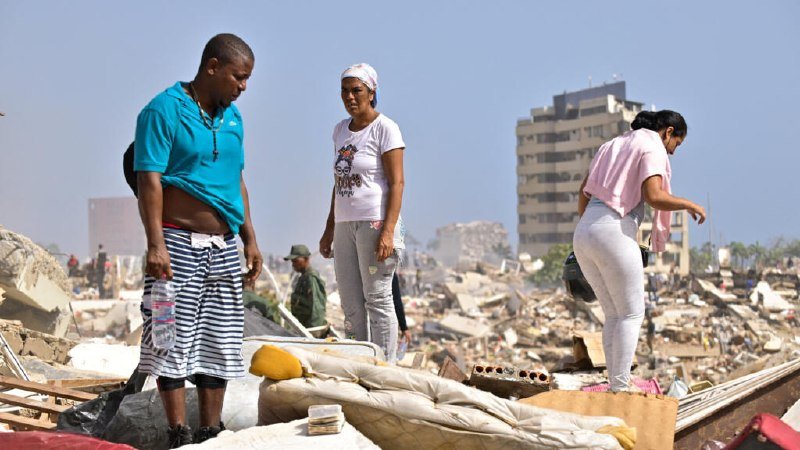
Two earthquakes struck Venezuela's northern coast within hours of each other on the evening of 25 June 2026, and the scene that has emerged in the aftermath is less a disaster story than a stress test of a state that stopped doing one of the jobs it is supposed to do. In La Guaira, pancaked buildings sit beside streets where neighbours, not engineers, are moving the concrete with buckets, shovels, and bare hands. In Caracas, the hospitals that should be receiving the injured are asking families to bring their own bandages, needles, and breathing tubes, because the shelves are empty.
The point worth stating plainly: a natural disaster has not collided with a functioning welfare state. It has collided with the opposite. Reporting from the ground describes amateurs and neighbours shifting rubble, and patients' relatives walking into emergency rooms with plastic bags of medical supplies. Both facts point to the same diagnosis — a state that has lost, or ceded, the routine capacity to supply its own citizens with the basics, leaving civil society to absorb the shock on its own.
A coast built on unstable ground
La Guaira sits on the Caribbean coast of Venezuela, the country's principal port region and the closest stretch of populated land to the capital. The Reuters correspondent on the ground described the town in the immediate aftermath as "pancaked buildings" with "people digging through the rubble with their hands." That phrasing matters because La Guaira is not a remote frontier town. It is the gateway. If the capital's port corridor cannot mount a professional search-and-rescue operation, the country's logistics spine has effectively broken.
The second strand of reporting — about hospitals in Caracas requiring patients to supply their own consumables — is the more damning in the longer term. Earthquakes, mercifully brief, produce a burst of casualties that can be triaged and evacuated. A hospital system that has been hollowed out over years produces a chronic condition that no rescue team can fix in 72 hours. The combination of the two is what makes this moment a political event rather than a meteorological one.
Volunteers are doing the state's work — and saying so
The most striking line in the early reporting came from a volunteer in La Guaira: "That was all thanks to amateurs, volunteers, people from down the street using buckets, shovels, boards, just trying to shift whatever they could of the rubble." Read that again. The speaker is not praising the volunteers. They are explaining, plainly, that nobody else came.
There is a pattern here that extends well beyond this one event. Across Latin America and the Caribbean, when state capacity contracts — through fiscal collapse, sanctions, or simple administrative decay — the gap does not stay a gap. It is filled, unevenly, by neighbours, diaspora networks, religious congregations, and informal WhatsApp groups. In Caracas, the equivalent of a volunteer rescue crew has been operating in the hospital system for years: families who arrive with their own gloves, their own syringes, their own rolls of gauze, because the alternative is a family member who does not get treated at all.
This is not a story about individual heroism, however moving the volunteers are. It is a story about which institutions still function and which have been hollowed out, and about who pays the cost when the answer to the second question is the same as the answer to the first.
The structural frame: collapse as a slow event
Disasters of this scale are almost never just natural. The mortality and morbidity figures that follow in the coming days will be the product of two multipliers — the shaking itself, and the condition of the infrastructure and services that the shaking met. Buildings collapse more readily where construction codes are unenforced or unaffordable. Casualties rise where ambulances are scarce, where hospitals are empty, where the electricity to keep an ICU running is rationed. The earthquake is the trigger; the long erosion of public capacity is the loaded chamber.
This is also where the counter-narrative deserves a hearing. Western coverage of Venezuela has, for the better part of a decade, framed the country's collapse primarily through the lens of sanctions and political dispute — a story about external pressure meeting authoritarian misrule. That framing is not wrong, but it is incomplete. The volunteer quoted above is not talking about sanctions. They are talking about a neighbour with a shovel who showed up because the state did not. The reader is entitled to hold both truths at once: that external measures have compounded internal decay, and that the immediate cause of an empty hospital shelf in Caracas in 2026 is a Venezuelan administrative and fiscal reality that predates any external pressure.
Stakes and what to watch
Three things are worth tracking over the next 72 hours. First, casualty figures. Initial reporting describes collapsed structures but has not yet settled on consolidated numbers; the figure will tell us how the building-code question resolves in practice. Second, whether the Caracas hospital system — already running on patient-supplied consumables — can absorb an earthquake-driven surge without triage decisions that are normally the preserve of wartime medicine. Third, whether the volunteer-led response is treated by the central government as a story to amplify, a story to manage, or a story to bury.
The honest uncertainty here is real. The early reporting is fragmentary and human, made up of voices from one coastal town and a handful of hospital hallways. It is enough to establish the shape of the event; it is not yet enough to count its full cost. What can be said with confidence is that a state capable of supplying bandages, needles, and breathing tubes to its own emergency rooms would not be asking its patients to bring their own. The volunteers will keep digging. The question is what happens on day three.
This piece treats the immediate aftermath of the 25 June 2026 Venezuelan earthquakes as a story about state capacity and civil-society substitution rather than as a stand-alone natural-disaster narrative, and pairs the wire reporting on volunteer rescue with the parallel reporting on Caracas hospital shortages rather than separating them into two unrelated stories.
Wire provenance
This editorial synthesis draws on the following public wire/social posts:
- https://t.me/reuters/171926
- https://t.me/reuters/171925
- https://t.me/reuters/171924