Ferrari draws first blood at the Red Bull Ring as Mercedes' Saturday turns sour
Charles Leclerc and Lewis Hamilton topped the timesheets in final practice at the Red Bull Ring, while a Turn 3 lock-up left George Russell the only driver yet to set a representative lap.
The Spielberg weekend has begun to take shape, and the early shape is unmistakably red. By the close of the final practice session at the Red Bull Ring on Saturday 27 June 2026, Charles Leclerc had vaulted to P1 with a lap that immediately defined the pace benchmark, with Lewis Hamilton slotting into P2 in the sister Ferrari. The two scarlet cars, separated by a few tenths rather than the half-second deficits that have punctuated their season so far, set the early benchmark the rest of the field had to chase.
Mercedes, by contrast, emerged from the session with a problem to solve rather than a time to defend. Kimi Antonelli produced the fastest lap of his weekend to that point — a 1:06.763 that, while encouraging, still left him adrift of the Ferrari pair. George Russell, his more senior team-mate, was the only driver on the twenty-car grid not to register a representative time, having locked up at Turn 3. The session, in other words, handed Ferrari the psychological advantage and Mercedes a question mark going into qualifying.
What the Ferrari pace actually tells us
A Friday-or-Saturday practice table is a notoriously poor predictor of Saturday-evening qualifying pace, particularly at a circuit as aero-sensitive and overtaking-friendly as the Red Bull Ring. What it does reveal, however, is the working window of each car: which balance the engineers have found, which tyre compounds the drivers trust, and which energy-deployment modes are paying dividends through the long uphill right-handers that dominate sectors one and three.
Leclerc's elevation to P1 is notable less for the absolute number than for its relationship to Hamilton. Throughout 2026, the two Ferrari drivers have traded quickest times within sessions, but rarely have they both been inside a tenth of the eventual benchmark. The Spielberg configuration, with its heavy braking zones into Turn 3 and Turn 4 and its long flat-out stretch between Turns 1 and 2, has historically rewarded a stable rear platform under braking — the precise characteristic that has defined Ferrari's 2026 chassis philosophy. That the car is fast here is therefore less a surprise than a confirmation. That Hamilton is within striking distance is the more interesting variable for the Scuderia's strategists.
Mercedes' Saturday morning headache
The Mercedes narrative is, for now, a tale of two cars in two very different states. Antonelli's 1:06.763 — the fastest lap of his weekend so far, as confirmed by Formula 1's official live-timing account — is the kind of incremental step the Brackley squad has been looking for. The Italian teenager has spent much of 2026 on the back foot relative to team-mate Russell, not because of any shortage of raw speed but because of the operational rhythm that comes with experience.
Russell's Turn 3 lock-up is the more awkward data point. Turn 3 at Spielberg is a heavy downhill right-hander approached in fourth gear; a flat-spot at that point of the lap typically ruins not only the corner exit but also the long uphill drag to Turn 4, costing measurable tenths across two sectors. A single lock-up on a single lap is recoverable, but it is the absence of any clean representative time that is harder to discount. Without a baseline, Mercedes' engineers are flying partially blind into the qualifying simulations, relying on Antonelli's data alone to set up Russell's car for a session where a tenth of a second is the difference between pole and the third row.
The wider field, and what qualifying tends to do to it
Red Bull's home race places peculiar pressure on the reigning constructors' champions, who have rarely enjoyed the smoothest weekends at the Red Bull Ring despite the partisan support in the Tyrolean grandstands. McLaren, meanwhile, have been the most consistent qualifying performers across the 2026 season to date, with a car that has historically excelled in the medium-speed corners that punctuate the Spielberg layout. Their pace in Saturday practice is, in this sense, more indicative than Ferrari's outright benchmark: the McLaren tends to improve between sessions as the track rubbers in and the rear-end balance tightens.
It is also worth remembering the structural rhythm of an Austrian Grand Prix weekend. Saturday practice is a set-up session, not a dress rehearsal; qualifying at the Red Bull Ring typically reshuffles the order by several positions relative to practice, because the single-lap margin between the top six cars is routinely inside two tenths and because slipstream effect on the pit straight can flip the running order on its head.
Stakes for the championship arc
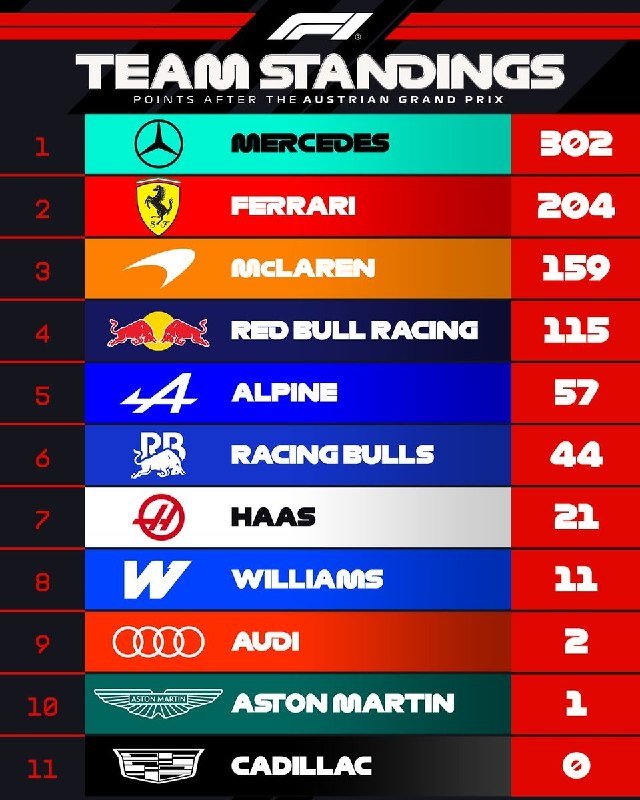
For Ferrari, a front-row lockout at a circuit where overtaking is feasible but not free would be a statement result — the kind of weekend that shifts the psychological balance of a championship campaign that has run hot and cold through the early summer. For Mercedes, the arithmetic is more pointed: a session in which only one car is on pace and the other is a Turn 3 lock-up away from anonymity is precisely the kind of Saturday that costs constructors'-championship points on Sunday evening.
The qualifying session that follows will, as ever, settle the question the practice timesheets only pose.
Desk note
This article was filed from the official Formula 1 practice-timing feed and reflects session-end running order at the Red Bull Ring on 27 June 2026. Where drivers' positions and lap times are cited, they come from the official channel; wider grid context is drawn from general season reporting and is offered as orientation rather than verified session data.
Wire provenance
This editorial synthesis draws on the following public wire/social posts:
- https://t.me/formula1/3
- https://t.me/formula1/2