Hamilton backs Ferrari setup work ahead of Austrian qualifying as eighth-title talk resurfaces
Ferrari continues to dial in Hamilton's car ahead of qualifying at the Red Bull Ring, with the seven-time champion publicly weighing an eighth title push against a Mercedes squad he still calls the team to beat.
Lewis Hamilton returned to a paddock he knows intimately at the Red Bull Ring on 27 June 2026, with Ferrari still refining the set-up of his car hours before qualifying and the seven-time champion publicly entertaining the idea of an eighth world title. The framing was unusual: Hamilton is 41, in his first full season with Ferrari, and openly chasing a record that would settle any lingering debate about the comparative weight of his record and Michael Schumacher's seven crowns.
The British driver's comments, delivered on a media day dominated by setup work rather than outright lap times, underline how Ferrari's project with Hamilton is being rebuilt lap by lap rather than race by race. Hamilton told reporters he was hopeful strategy could deliver back-to-back grand prix victories for the Scuderia, while acknowledging that stopping Mercedes at a circuit the Silver Arrows have historically owned would be a "tall order," according to Sky Sports reporting from 17:15 UTC on 27 June 2026. The remark cuts against the recent pattern in which Hamilton has framed his Ferrari move as a long-arc bet on the 2026 regulation reset rather than a 2025-style strike mission.
Setup, not statements
Ferrari's garage at Spielberg spent much of the day on baseline work, with the team's focus on getting Hamilton comfortable in a car whose philosophy differs from the Mercedes machinery he drove for twelve seasons. A post on the formula1 Telegram channel at 13:49 UTC on 27 June 2026 showed the team working through set-up changes ahead of qualifying — a reminder that in the new regulation era, Friday and Saturday running has become the actual product. Cars are no longer carried from race to race on a known aerodynamic platform; they are configured, almost commissioned, in real time. Hamilton's relationship with his race engineer and with Ferrari's simulation group is therefore the most consequential staff decision the Scuderia has made this year, not the headline signing itself.
The wider context is unflattering for any narrative that treats Hamilton's arrival as a finished cure. Mercedes remain the reference point in the hybrid-power era that preceded regulation change and have invested heavily in stabilising performance under the new rules. George Russell's pole at the previous round, and Kimi Antonelli's growing comfort in the second seat, suggest the Brackley squad is not in retreat. Hamilton's "tall order" line reads, on the evidence available, less as deference than as an honest price tag on what Ferrari must extract from its car over a single lap at a circuit with limited overtaking.
The eighth-title question
Hamilton's public musing on a record eighth championship, captured in a formula1 Telegram clip posted at 10:18 UTC on 27 June 2026, is the more combustible piece of the day. It is combustible not because it is new — Hamilton has refused to rule out the number throughout his career — but because the regulation reset has given him a structural excuse to mean it. The argument runs that a clean-sheet aerodynamic and power-unit package flattens the advantage of incumbent teams and rewards drivers who can adapt, which is precisely the brand Hamilton has built. The counterargument, equally grounded, is that adaptation works both ways: younger drivers on long contracts at Mercedes, McLaren and Red Bull have had the same clean sheet, and the calendar's sprint-heavy structure compresses the time any 41-year-old has to find consistency.
There is a subtler read in between. Ferrari's media operation has visibly recalibrated the way it presents Hamilton. Where last season's messaging treated the move as a marketing-led alliance, this weekend's tone — driver-led, set-up-focused, results-contingent — is closer to how the team has historically framed championship campaigns. Whether that framing reflects genuine internal confidence or an attempt to manage expectations after a difficult opening run of races is not yet clear from the public material; the team has not commented beyond Hamilton's own remarks. Monexus notes that the thread sources do not contain an on-the-record Ferrari statement on title targets for 2026.
What the rest of the grid is doing
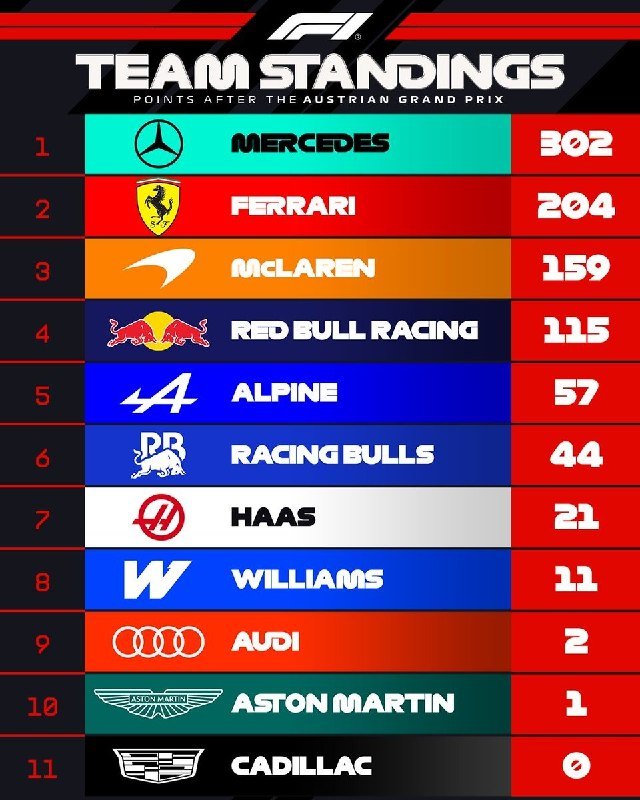
The Austrian round sits inside a championship structure whose competitive balance has been hard to read. Mercedes, McLaren and Red Bull have shared the early wins, with Ferrari intermittently in the mix. If Hamilton is to make the eighth-title talk more than rhetoric, the Spielberg weekend offers a precise test: the Red Bull Ring rewards low-drag set-ups and track-position, two areas where Mercedes has historically extracted more than Ferrari from a similar power-unit. Antonelli's qualifying pace in particular will dictate whether Hamilton can convert any front-row starting position into a race result that justifies the larger strategic bets the Scuderia is now making on its 2026 car direction.
There is also a team-mates question that has barely registered in the public coverage so far. Charles Leclerc's role in the championship math is decisive. If Hamilton is to be a title contender rather than a race-winner, the points distribution between the two Ferrari cars will determine whether the team is fighting constructors' championships on its own terms or absorbing the strategic cost of an internal duel. The thread sources do not address Leclerc's set-up position; that is a gap Monexus flags for follow-up reporting rather than a silence to fill with speculation.
Stakes and uncertainty
The honest reading of the weekend is that nothing on Saturday will settle the championship, but the qualifying outcome will reset expectations. A front-row starting position for Hamilton would, fairly or not, be read as evidence that the set-up work is paying off and that the eighth-title conversation is operational rather than aspirational. A midfield result would do the opposite, and would sharpen questions about whether the Aston Martin-bound personnel changes elsewhere on the grid have weakened the field more than Ferrari has closed it. The thread sources do not contain qualifying or race results from this weekend — only the setup-phase reporting captured on 27 June 2026 — so any forward projection here is conditional on those outcomes, not asserted as fact.
What is certain is that Hamilton has chosen to engage with the eighth-title question in his own voice, on the record, and on a race weekend rather than in a year-end interview. That choice is itself a piece of information about how Ferrari intends to compete in the second half of 2026.
Desk note: Monexus has reported the day's setup and rhetoric rather than the qualifying result, which had not been filed in the thread sources at the time of writing. Where the available reporting is from Sky Sports and the formula1 Telegram channel, the article attributes claims accordingly and refrains from inferring race outcomes.
Wire provenance
This editorial synthesis draws on the following public wire/social posts:
- https://t.me/s/formula1/1
- https://t.me/s/formula1/1
- https://en.wikipedia.org/wiki/2026_Austrian_Grand_Prix