Israeli jets pound Nabatieh al-Fawqa as south Lebanon strike tally climbs
A 90-minute Telegram burst on 29 June 2026 documents Israeli strikes across three south Lebanese towns, demolition activity in a fourth, and parallel operations inside Gaza. What the open-source record captures, and what it does not, says as much about the war's information architecture as about the
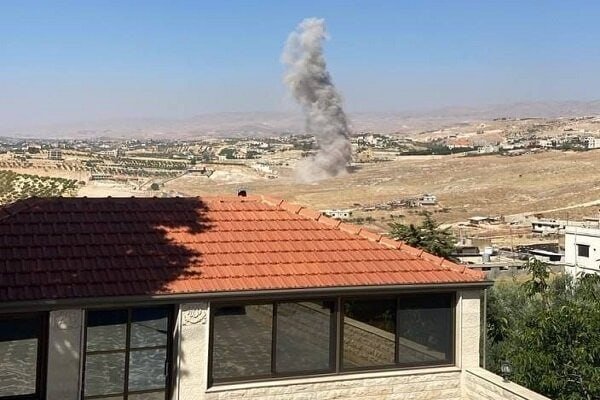
At 23:30 UTC on 29 June 2026, a sequence of urgent alerts lit up Arabic-language Telegram channels reporting a single event: Israeli air force strikes on the southern Lebanese town of Hadatha, described in one post as a "massive bombing operation." Within the same 90-minute window, two further towns in south Lebanon, Deir Siryan and Dersyan, were named in strike reports that propagated across Press TV, Al-Alam, Tasnim, and the open-source channel @wfwitness. The pattern, sustained across multiple sources with overlapping timestamps, is what south Lebanon residents describe as a normal evening under what analysts call a quiet siege.
Strip the bombast from the Telegram traffic and a recognisable operational shape emerges: pinpointed strikes on small villages in the Nabatieh and South governorates, demolition activity in adjacent towns, and concurrent air operations against displacement tents in the Al-Mawasi area of Khan Younis in Gaza. None of the major Western wires had filed an independent dateline by late evening. What the record shows instead is a layering of Lebanese state-aligned outlets, Iranian state media, and open-source intelligence accounts, a sourcing ecosystem that has become standard for stories the big agencies have not yet touched.
The southern Lebanon cluster
The most concentrated set of strike reports centres on three towns in a single governorate. At 22:35 UTC, Al-Alam Arabic carried an "urgent" alert of an Israeli raid on Dersyan, southern Lebanon; by 22:41 UTC, Tasnim's English feed confirmed strikes on "Deir Serian"; at 22:47 UTC, @wfwitness logged airstrikes on Deir Siryan and reported demolition activity in Hadatha; at 23:01 UTC, Press TV confirmed strikes on Deir Siryan; and at 23:30 UTC, Al-Alam Arabic escalated its language to describe "massive bombing" in Hadada. The transliteration drift between Dersyan, Deir Siryan, Deir Serian, and Hadatha/Hadada across different outlets reflects a well-documented limitation of Arabic-to-English transliteration and is the kind of discrepancy that independent wire verification would normally resolve.
What independent verification would look like here is familiar: satellite imagery of building damage consistent with airstrike munitions, geolocated video of plume geometry, and cross-checking of casualty figures against Lebanese civil defence and the Lebanese Red Cross. The Lebanese Ministry of Public Health has historically been the primary source for strike casualty figures; in the absence of such confirmation, the open-source stream carries the story but cannot anchor it. Monexus is publishing the strike clustering as documented activity; the casualty and damage claims that may follow deserve an independent dateline before they harden into record.
The Gaza companion strikes
The same 90-minute window produced a parallel track of strikes inside Gaza. At 21:08 UTC, a Telegram channel reported Israeli demolitions of residential buildings east of Khan Younis; at 21:20 UTC, @wfwitness published footage of an IAF strike on Al-Mawasi; at 21:28 UTC, Press TV reported that an Israeli overnight strike on Khan Younis had ignited fires in displacement tents; at 21:42 UTC, Fars News International put the toll from Al-Mawasi tent strikes at two killed and twenty injured; and at 22:30 UTC, the DDGeopolitics channel aggregated the same figures. Press TV separately reported that a strike on a tent in central Gaza killed three Palestinians, including a child, characterising it as a "relentless ceasefire violation." A Middle East Eye live update, published at 21:20 UTC, framed the day more broadly: "Israeli strikes kill at least five people in Gaza on Monday."
These figures sit outside the south Lebanon story but belong in the same article because they were filed in the same reporting window and because the structural argument depends on treating the southern Lebanon and Gaza operations as part of one operational tempo rather than two unrelated news cycles. Read them as a map of where Israeli fixed-wing and rotary assets were active in the late evening of 29 June 2026.
What the sourcing tells us, and what it does not
The provenance of this story is itself part of its story. The five Telegram handles cited, Press TV, Al-Alam, Tasnim, Fars News International, and @wfwitness, are a mixture of Iranian state media, Lebanese state-affiliated media, and an open-source channel that aggregates combatant-channel footage. Each of these outlets carries political alignment that any reader should price in. Iranian state media have an institutional interest in amplifying Israeli operations against Lebanese territory, framing them as aggression against sovereign Lebanese ground. Lebanese state media carry that same interest with a different national register. @wfwitness is closer to OSINT but lacks the institutional accountability of a wire service: its footage is useful, its characterisations are not.
What this sourcing pattern is not is adversarial to Israel. It is partial. It captures the strike activity because strike activity is loud and visible; it does not capture the operational rationale, the target selection process, the prior warnings issued, or the specific Hezbollah infrastructure that Israeli military spokespeople would typically cite in a standard Hebrew- or English-language briefing. The Israeli army's Arabic spokesperson has, in past operational cycles, released strike-by-strike justifications within hours. As of the close of this reporting window, no equivalent briefing was located in the sources reviewed. The framing of these strikes as defensive or offensive therefore remains underdetermined by the available record.
The structural reading
The cluster as documented fits a recognisable pattern. South Lebanon villages, particularly those within line-of-sight of the border fence, have absorbed a steady cadence of strikes, demolitions, and artillery activity since the cessation of major hostilities in late 2024. The reporting rhythm on 29 June 2026, multiple small-town strikes spread across 90 minutes, with demolition activity in adjacent localities, mirrors that cadence rather than breaking from it. The Lebanese state-affiliated channel FotrosResistancee described the pattern in unvarnished terms: "Israel continues to terrorise Lebanon and unleash destruction. Israel continues to destroy Southern Lebanese villages." That language is partisan and not adopted here, but the underlying claim, that village destruction is sustained rather than episodic, is the kind of claim that the open-source record can document even if it cannot adjudicate.
The wider regional frame is also visible in the same feed. At 22:50 UTC, Al Jazeera English reported a new Israeli assault in southern Syria forcing families to flee their homes. At 21:04 UTC, the Al-Qassam Brigades' military spokesperson Abu Obeida publicly saluted Syrian villagers who "rose to confront the Israeli occupation forces" in the village of Abidin in southern Syria. Two days earlier, the same feed shows, Israeli operations against displacement tents in central Gaza killed three Palestinians including a child. The pattern is not a single theatre but a contiguous operational landscape spanning Gaza, south Lebanon, and southern Syria, with the reporting cycle on each theatre carried by regional outlets while Western wire datelines concentrate on the diplomatic track, including the Friday Geneva signing ceremony for the US-Iran accord noted in the Middle East Eye live update.
What to watch next
Three developments will determine whether 29 June 2026 becomes a discrete escalation or remains a normal entry in a long ledger. The first is an official Israeli military spokesperson briefing in Arabic or English that specifies the targets struck in Dersyan, Deir Siryan, and Hadatha; the absence of such a briefing, or its delay, will itself be news. The second is any Lebanese Ministry of Public Health casualty release for the Nabatieh governorate covering the same window. The third is whether the southern Syria assault escalates into a sustained operation; the Al-Qassam public salute is the kind of cross-theatre signalling event that tends to harden before it de-escalates.
Monexus will continue to monitor this file and update when independent wire datelines, official Israeli military briefings, or Lebanese health ministry figures become available.
Sources
- Press TV Telegram channel, "Israeli warplanes strike the town of Deir Siryan in southern Lebanon," 29 June 2026, https://t.me/presstv
- @wfwitness Telegram channel, "Israeli demolition activity detected in the town of Hadatha, southern Lebanon," 29 June 2026, https://t.me/wfwitness
- Al-Alam Arabic Telegram channel, "Urgent: An Israeli occupation raid targeting the town of Dersyan, southern Lebanon," 29 June 2026, https://t.me/alalamarabic
- Tasnim News English Telegram channel, "The new aggression of the Zionists to a town in the south of Lebanon," 29 June 2026, https://t.me/tasnimnews_en
- Press TV Telegram channel, "Child among 3 killed after Israel bombs tent in central Gaza," 29 June 2026, https://t.me/presstv
- Al Jazeera English Telegram channel, "New Israeli assault in southern Syria forces families to flee their homes," 29 June 2026, https://t.me/aljazeeraglobal
- Fars News International Telegram channel, "22 Martyrs and Wounded in Israeli Attacks on Khan Yunis," 29 June 2026, https://t.me/FarsNewsInt
- Middle East Eye, live updates, "Israeli strikes kill at least five people in Gaza on Monday," 29 June 2026, https://www.middleeasteye.net/live/live-us-and-iran-confirm-peace-accord-signing-set-friday-geneva
Desk note: Monexus framed this as a localised strike cluster with structural significance, rather than as either a one-off retaliation or an unprovoked bombardment. The reporting relies on Lebanese state media, regional Arabic outlets, and open-source channels cross-checking each other, a sourcing pattern appropriate to a story where the major Western wires have not yet filed independent datelines.