A missing activist and a year of Gen Z mourning in Kenya
Five demonstrators detained after Thursday's anniversary march have been released; a sixth, Davis Lichuma, has not been seen since his arrest, and a civil-society coalition is pressing for answers.
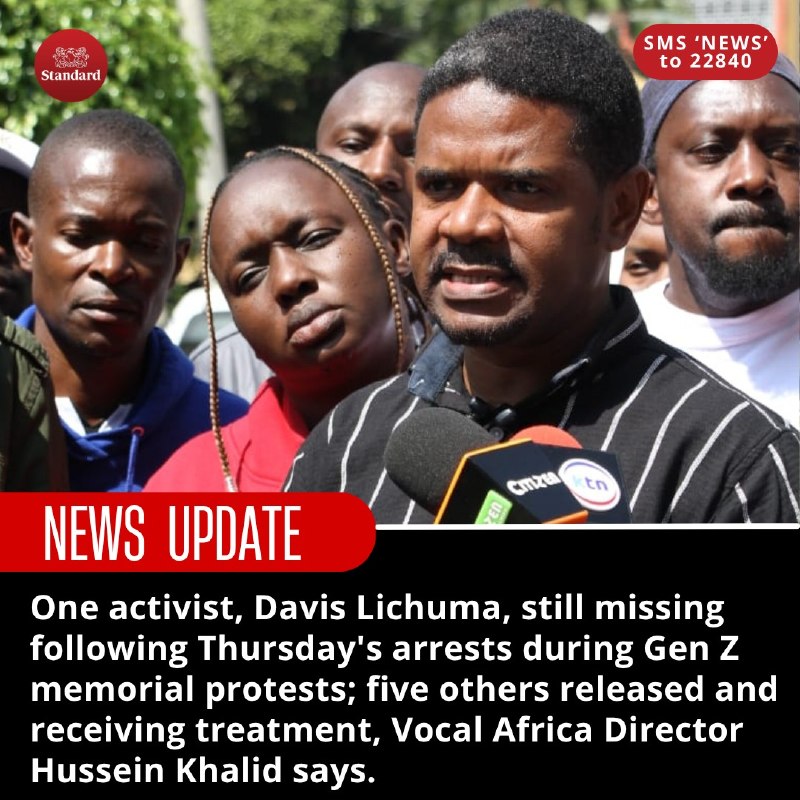
On the morning of 26 June 2026, six people walked into police custody in Nairobi after a memorial march marking one year since Kenya's 2024 Gen Z uprising. By the next day, five of them had been released and were receiving medical attention, according to Hussein Khalid, the director of the civil-society group Vocal Africa. The sixth — an activist identified as Davis Lichuma — had not been seen, his whereabouts unconfirmed, and his name was being carried from press conferences to social-media timelines as a single, unresolved question: where is he?
The disappearance, even if temporary, lands at a politically sensitive moment. The marches of June 2024 were the most serious street challenge to President William Ruto's government since he took office, and they left a toll — dozens killed in confrontations with police, an aborted finance bill, and a generation of young Kenyans newly organised and newly suspicious of the state. A year on, the question of how the security services treat the people who turn up to remember the dead has become, in its own way, a measure of how much has changed — and how little.
A memorial, then arrests
The 25 June 2026 demonstration was organised to commemorate the first anniversary of the protests that began in June 2024 against a controversial finance bill and metastasised into a broader cry against corruption, tax burdens and police violence. According to the Telegram channel StandardKenya, six activists were arrested during the memorial march on Thursday 25 June, an indication that, even in commemorative mode, the events drew a security response. By Friday 26 June, the civil-society coalition tracking the cases said five had been freed and were being treated; one remained missing.
Vocal Africa's Hussein Khalid, speaking to the press, framed the episode in plain terms: five released, one still unaccounted for. The channel's write-up, posted on Telegram at 09:26 UTC on 27 June, gave the activist's name as Davis Lichuma and named no other detail about him beyond his status as a participant in the memorial. The framing in the post — activist missing, others receiving treatment — tracks a pattern that Kenyan civil-society groups have flagged repeatedly over the past year: that those who challenge the state in public space risk vanishing, even briefly, into a system that does not always answer for them.
The pattern the anniversary confirms
It is worth stating what the memorial itself confirms. Twelve months after the 2024 protests, the underlying grievances — cost of living, police conduct, fiscal governance — have not been resolved to the satisfaction of the constituencies that took to the streets. Memorials only become necessary when the dead have not been fully accounted for, and the fact that a generation felt compelled to mark the date in the first place tells you the wound is still open.
The arrests also illustrate a continuity in state response. During the 2024 protests, civil-society coalitions documented abductions, prolonged detentions and what they described as coordinated intimidation of protest leaders. Independent press accounts at the time corroborated some of those patterns; the government denied systematic abuse and pointed to specific criminal cases against individuals. The dispute is unresolved, and the present episode is small enough that it could resolve in either direction — a clerical confusion, a longer and more troubling story.
What the missing-activist frame does
The single most politically charged claim emerging from the episode is not the arrest of five people but the disappearance of a sixth. "Disappearance" is a word with a history in East Africa. It carries the weight of the 1980s and 1990s, when state security services in Kenya and across the region were credibly accused of holding suspects in unofficial facilities for days or weeks before producing them in court — or not. The vocal-society framing of Lichuma's case leans on that history, intentionally or not, because it is the only framing that makes a single missing person a matter of national concern.
A counter-read is also available. Memorials that approach the line of an unsanctioned political demonstration can attract arrest on recognisable public-order grounds — obstructing traffic, gathering illegally, scuffling with police. In that reading, six arrests is unremarkable; the question is whether due process is observed and whether those arrested are produced before a magistrate within the time limits set by Kenyan law. The release of five within roughly 24 hours would, on that reading, suggest the system is working more or less as designed — which still leaves the sixth case unexplained.
Stakes and what to watch
If Lichuma is produced in court in the coming days, the episode becomes a footnote in the longer story of the 2024 protests — a brief detention, a worrying press conference, and a government that eventually complied with its own rules. If he is not produced, the episode becomes something else: an indication that the state's tolerance for public commemoration of its own failures is narrower than its public rhetoric suggests, and that the cost of showing up to remember the dead in Kenya has, in some cases, not yet been brought down to zero.
Three things are worth watching. First, whether the coalition around Vocal Africa can produce a confirmed sighting — a court appearance, a lawyer visit, a hospital admission — before the story moves on. Second, whether the Independent Policing Oversight Authority, Kenya's civilian police-review body, opens a file on the case or stays silent. Third, whether the episode changes the calculus of organisers planning the next round of memorial actions. In Kenya, as elsewhere, the answer to the third question is usually set by the answer to the first two.
The post from StandardKenya is brief, the names are few, and the timeline is short. But the combination — a memorial, an arrest, a missing person and a civil-society coalition speaking in public — is, by now, a recognisable sequence. It is the sequence that defined the original protests in 2024, repeated one year on at a smaller scale, and the question is whether the rest of the story repeats as well.
Desk note: Monexus treats the Kenyan Gen Z anniversary as a domestic civil-society story, led by Kenyan civic sources and Telegram-based wire reporting, with Western coverage reserved for cases where it adds corroboration rather than framing. Where the official line and the civil-society line diverge, both are given and the uncertainty is named rather than resolved.
Wire provenance
This editorial synthesis draws on the following public wire/social posts:
- https://t.me/s/StandardKenya
- https://en.wikipedia.org/wiki/2024_Kenyan_protests
- https://en.wikipedia.org/wiki/William_Ruto
- https://en.wikipedia.org/wiki/Independent_Policing_Oversight_Authority