A Summer Concert on Nevsky, and the Long Shadow of Cultural Isolation
A small recital of Russian opera and romances in central St. Petersburg lands on 28 June as the country's classical institutions find themselves increasingly cut off from Western stages.
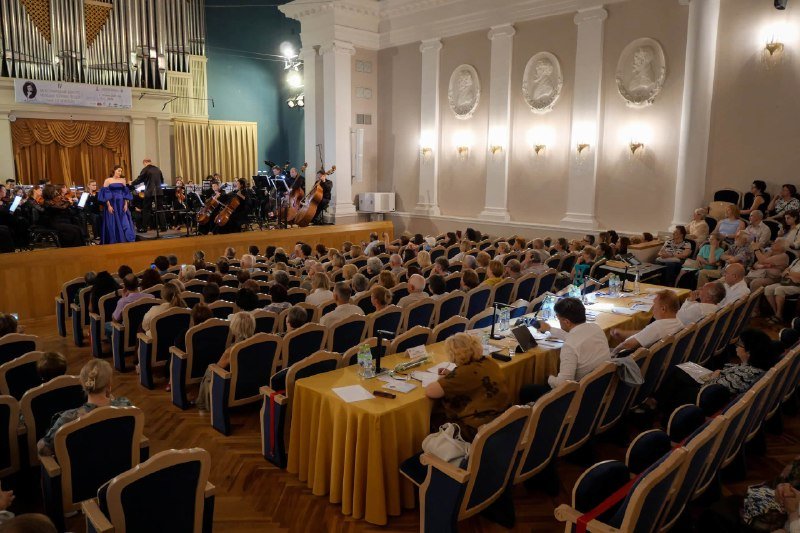
On Sunday evening, 28 June, at 19:00 local time, the House of Journalist on Nevsky Prospekt 70 in central St. Petersburg will host a chamber recital titled "Russian Opera and Romances" — a programme of home-grown repertoire performed, by all available evidence, for a Russian domestic audience rather than an international touring circuit. The listing, distributed via the Telegram channel Classical Music News on 27 June at 18:37 UTC, is small and routine: a Sunday concert, a known hall, a familiar repertoire. Read in isolation it is barely a story.
Read in context, it is a symptom. Since February 2022, the country's major opera houses, conservatoires and touring soloists have seen their access to Western venues, conductors, guest directors and festival programmers contract sharply. A modest house recital on Nevsky is what remains visible: a self-sufficient national repertoire, performed in Russian, marketed to Russian listeners, sold locally. The pipeline that once carried Russian singers onto the stages of Milan, Vienna and New York now runs in a much narrower band.
The concert itself
The Telegram announcement gives the practical details and almost nothing else. The venue is the House of Journalist, the central St. Petersburg press-hall on the city's main avenue. The date is Sunday 28 June, with a 19:00 start. The repertoire is signalled in the title: Russian opera arias and romances — the nineteenth-century drawing-room song tradition that runs from Glinka and Dargomyzhsky through Tchaikovsky and Rachmaninoff into the Soviet conservatoire repertoire. The performance is sold via ticket links attached to the original Telegram post.
No performer names, ensemble affiliations, conductor or programme details appear in the announcement. The single source item does not name the singers, the accompanist, the producing institution or the ticket price.
What is missing is the larger circuit
Two weeks after the full-scale invasion of Ukraine, the major Western opera houses moved to cancel or freeze engagements with Russian state institutions and artists seen as closely tied to the Kremlin. La Scala in Milan cut a planned appearance by the Mariinsky Theatre's conductor; the Bavarian State Opera removed Valery Gergiev, a long-time artistic figure in Russia and internationally, from its roster; the Vienna Philharmonic ended a long relationship with him as well; Carnegie Hall in New York cancelled planned appearances. Performers based outside Russia who had publicly endorsed the invasion lost engagements; others exited European posts voluntarily in solidarity with Ukraine.
For Russian institutions, the response was a turn inward. The Bolshoi and the Mariinsky leaned into domestic repertoire, internal promotions and tours to former-Soviet and Asian markets. New platforms emerged: a state-backed platform for Russian classical performance; partnerships with concert halls in Beijing and the Gulf. None of this replaces the European festival circuit that was, for decades, the global prestige layer of Russian classical life. What survives is the domestic base — and a chamber recital on Nevsky Prospekt fits that base cleanly.
Why a small event signals a structural shift
Cultural exchange is not a luxury line item. It is the connective tissue that lets a national repertoire stay calibrated against international standards and lets a national workforce of singers, conductors and designers earn the foreign-currency income that has historically underpinned Russian performing arts. When that tissue is cut, two things tend to happen, in sequence.
First, the repertoire turns inward. Russian houses lean on Russian opera in Russian, on Russian conductors, on programmes built around familiar nationalist composers. The audience gets more of what it already knows. Second, a generation of mid-career artists loses its runway. A singer who would once have built a career across fifteen European houses now has fewer international auditions, fewer guest contracts, fewer co-production credits. The Mariinsky Academy of Young Artists and similar training pipelines continue to produce world-class vocal talent; the international platform to absorb that talent has narrowed.
The longer that narrow band persists, the harder the rebuild becomes. Opera is built on continuity — on conductors who know singers, on casting directors who trust agencies, on audiences who have watched a soloist mature over a decade. Strip that out for four years, and the rebuild is not a resumption but a reconstruction.
Stakes and what to watch
For Russian listeners, the immediate loss is partly aesthetic — fewer international guest conductors, fewer foreign-language productions, fewer touring stars on the big Moscow and St. Petersburg stages. For Russia's classical-music workforce, the stakes are economic and professional: a smaller global market for Russian-trained talent means smaller fees and fewer opportunities. For European and American houses, the loss is reputational and curatorial — a century of Russian opera and Russian training cut out of the international repertoire at the very moment that repertoire is enjoying a global revival.
Three things to watch from here. First, whether the Mariinsky and Bolshoi can rebuild their Asian and Middle Eastern touring circuits to a scale that meaningfully substitutes for the European circuit. Second, whether any of the cancelled conductors and singers return to Western stages in the next two seasons, and on what terms. Third, whether the domestic repertoire shift — more Russian opera, performed in Russian, for Russian audiences — becomes permanent or reverses if and when conditions change.
The concert on Sunday is a minor event by any measure. It is also a working illustration of what cultural isolation looks like when it is allowed to settle in: a known hall, a familiar programme, a domestic audience, no foreign names on the bill.
This piece reads against the wire line, which tends to treat each individual Russian concert as a routine cultural item. Monexus finds the structural frame more useful: a localised Sunday recital is the visible tip of a four-year contraction in Russia's place in the international classical-music circuit, and the policy question is whether that contraction becomes permanent.
Wire provenance
This editorial synthesis draws on the following public wire/social posts:
- https://t.me/classicalmusicnews
- https://en.wikipedia.org/wiki/International_sanctions_during_the_Russo-Ukrainian_war
- https://en.wikipedia.org/wiki/Mariinsky_Theatre
- https://en.wikipedia.org/wiki/Valery_Gergiev