Strait of Hormuz: an Iranian parliamentary warning and a Trump accusation collide on 27 June 2026
A single shipping corridor sits at the centre of an exchange between Tehran's parliament and the White House, with both sides accusing the other of breaking a deal whose precise terms have never been published.
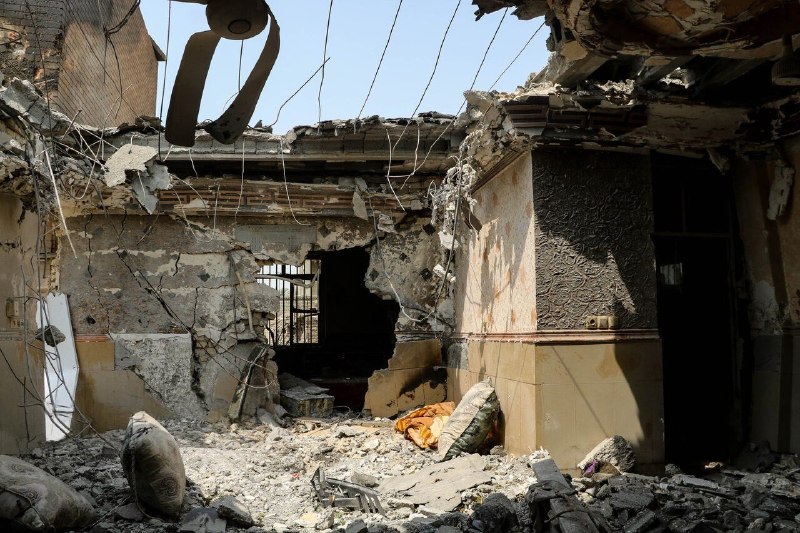
Two separate dispatches, separated by hours and by institutional register, converged on a single chokepoint on the morning of 27 June 2026. In the first, Ebrahim Azizi, chairman of the National Security Committee in Iran's parliament, addressed a message to Donald Trump asserting that "the Strait of Hormuz is under Iran's control" and demanding that Washington "respect the rules." In the second, posted on X roughly thirteen hours earlier under the handle @unusual_whales, the same president was reported to have declared that Iran had "violated the ceasefire agreement by attacking a ship in the Strait of Hormuz." A third wire, this one on the @Polymarket account, sharpened the accusation further: Trump alleged "foolish violations" of the ceasefire after, the post said, Iran attacked four ships. Three lines of communication, two narratives of breach, and one waterway through which roughly a fifth of the world's traded petroleum passes each day.
What is striking is not the temperature of the exchange — brinkmanship between Washington and Tehran has been a near-permanent condition of the past two decades — but its asymmetric foundation. A ceasefire exists, by the account of both sides, and was being violated by the other at almost the precise moment the accusations were being made public. The text of that ceasefire has not been published. The parties to it have not been enumerated in any joint communique visible in the source material. The corridor that the agreement purports to govern carries crude oil, liquefied natural gas, petrochemicals and the bulk of Gulf-state exports to Asia and Europe; disruption to it moves Brent and TWI benchmarks within minutes and alters insurance premia for shipowners traversing the Gulf of Oman.
The dispute is therefore best read not as a maritime incident but as a test of an unwritten contract whose precise obligations are known only to the two governments that claim to have negotiated it.
What Tehran actually said
Azizi is not a member of Iran's executive. He chairs a parliamentary committee whose remit covers defence and security legislation, and his statements therefore sit one rung below official foreign-ministry or military communiques. That matters: Azizi's language is the language of a legislature that is, in Iran's institutional design, answerable to a Supreme National Security Council and ultimately to the office of the Supreme Leader. When such a figure publishes a foreign-policy warning addressed to a sitting US president, the message is calibrated for both external and domestic audiences — a posture that is itself a form of communication.
The message's substantive content is short and bears quoting closely. The Strait of Hormuz, Azizi wrote, "is under Iran's control," and Washington must "respect the rules." He added a conditional: if the rules are not respected, the consequences will follow. The construction is notable for what it does not include. It does not describe the precise legal regime Iran claims to be defending — the 1982 UN Convention on the Law of the Sea treats the strait as one in which transit passage must not be impeded, a position Iran has formally accepted in the past while reserving operational discretion in practice. It does not name the ships, the owners, the cargoes, the flag states, or the insurers. It does not specify which "rules" are alleged to have been broken, by whom, or what evidence underwrites the accusation.
That silence is consistent with a wider pattern. Iranian state communications about maritime friction in the Gulf have, over several years, alternated between granular operational claims — seizures of tankers, the publication of drone footage, court proceedings against crews — and broader declarations of sovereignty over the waterway. Azizi's message belongs to the second category. It is a warning, not a report.
What Washington is alleged to have said
The two X posts, attributed by their accounts to the president himself, run on a different logic. The @unusual_whales post describes a single ship attacked in the strait and a ceasefire said to have been violated. The @Polymarket post raises the figure to four ships and uses the word "foolish" — a Trumpian register that has become familiar in coverage of his foreign-policy statements. Neither post links to a White House transcript, a Department of Defense readout, or a CENTCOM statement. Neither names the vessels, their flag states, the casualties if any, or the operational details that would normally accompany an accusation of this gravity.
This matters because the United States, unlike Iran, maintains a standing public infrastructure for announcing maritime incidents in the Gulf: the US Navy's Fifth Fleet, based in Bahrain, publishes incident reports; the UK Maritime Trade Operations office in Dubai issues advisories; and the regional insurers' bodies, including Lloyd's Joint War Committee, list named and unnamed vessels on their hull-war listings. The absence of those parallel signals in the source material does not mean they have not occurred — the sources available here are limited — but it does mean the public record, as it stands on the morning of 27 June, rests on assertions rather than corroborated incident reports.
A fair reading of the two X posts, then, is that they describe what the White House claims happened, not what has been independently verified to have happened. That distinction is the substance of the story.
The corridor in question
The Strait of Hormuz is approximately 33 nautical miles wide at its narrowest, with shipping lanes confined to two-mile-wide channels inbound and outbound separated by a two-mile buffer. On its northern shore sits Iran; on its southern shore, the Musandam exclave of Oman and the UAE. Through it pass the oil exports of Saudi Arabia, the UAE, Iraq, Kuwait, Qatar and Iran itself. Roughly 21 million barrels of oil a day transited the strait in 2024 by industry estimates, alongside a significant share of LNG cargoes. Any sustained disruption is read, almost instantly, by global markets as a supply shock.
The corridor's strategic history is longer than its oil history. British imperial planners identified it as a chokepoint in two world wars; successive US naval deployments have used the Gulf of Oman and the North Arabian Sea as forward operating areas since the late 1940s. Iran's asymmetric naval doctrine — fast-attack craft, mining capability, anti-ship missile batteries sited along its coastline — is, in significant part, a doctrine designed for the strait.
That history is relevant to the present dispute for a structural reason. The waterway is contested infrastructure. No state, including Iran, has claimed a unilateral right to close it without producing a crisis; no outside power has acknowledged a unilateral Iranian right of exclusion. Any "rules" that govern the corridor are therefore understood rather than codified, enforced rather than written, and revised by behaviour as much as by treaty. Azizi's invocation of "the rules" is therefore intelligible only against that unspoken framework.
Why the framing on both sides is under pressure
Two frames compete for the same incident. The first, articulated from Washington in the language of "violation" and "foolish violations," reads the events of 26 June as the breach of a binding bilateral undertaking and frames Iran as a recidivist actor within an agreement it had nominally accepted. This frame draws its force from a long history of US-Iranian standoff in which Tehran is cast as the disruptor and Washington as the enforcer of a rules-based maritime order that the United States itself helped build.
The second frame, articulated from Tehran through Azizi's message, recasts the same events as a test of whether the United States will accept that Iran has an operational say over the corridor. This frame is older than the current ceasefire, older than Trump's first term, and arguably older than the Islamic Republic itself — it draws on a continuity of Persian-Gulf strategic thinking that treats the strait as a national-security asset rather than as an international commons. Azizi's choice of the word "control" is therefore not anodyne. In English-language maritime-law usage, "control" is reserved for the coastal state's authority within its territorial sea; in this case, the strait's narrowest point falls largely inside Omani and Iranian territorial waters on either side, with a corridor of international transit passage running between. The word is doing work.
The two frames are not symmetric. The US framing depends for its force on the existence of an agreement with named terms; the Iranian framing depends for its force on the existence of an underlying strategic position with a long pedigree. A reader weighing them has to decide whether to privilege the documented text (which, in this case, is not public) or the documented behaviour (which, in this case, is very long indeed).
What remains uncertain
The honest summary of the public record on 27 June 2026, based on the source material available, is short. Three reports describe an Iranian parliamentary warning and an alleged US accusation of Iranian attacks on shipping in the Strait of Hormuz. None of the three names the vessels, the cargoes, the flag states, the casualties, the time of the alleged attacks in UTC, the location within the strait, or the source of the US government's intelligence. None cites a wire-service confirmation. None references a parallel statement from a Gulf state, an insurer, or a maritime authority. Two of the three are X posts attributed to the US president; the third is a Telegram channel posting what purports to be an Iranian parliamentary figure's message.
What the sources do not specify is therefore as important as what they do. They do not specify whether the alleged ceasefire under discussion is the same arrangement reported in earlier 2026 coverage; whether the four ships named in the @Polymarket post overlap with the one ship named in the @unusual_whales post; whether Iran has issued an official foreign-ministry response; or whether any third-party naval force — US, British, French, Indian — has corroborated the incident at sea. A serious news report on this exchange, on the morning of 27 June, cannot resolve those questions. It can name them.
Stakes
The structural stakes are easier to name than the operational ones. A single shipping corridor, a large share of globally traded hydrocarbons, and two governments that cannot agree on what was struck or whether it was struck at all. Insurance markets, which repriced Gulf transit premia sharply during periods of friction in 2019, 2021 and 2024, will watch for hull-war listings and additional premia. Brent and TWI will move on any operator confirmation. European and Asian importers, whose dependence on Gulf crude has declined but not disappeared, will recalibrate sourcing where they can.
The deeper stake is whether a tacit arrangement between Washington and Tehran, the kind of unwritten understanding that has governed Gulf transit for most of the past two decades, can survive a public exchange in which both sides accuse the other of breach. Such arrangements are typically load-bearing: they keep a corridor open because both parties find closure more costly than friction. When the dispute moves from the realm of unspoken mutual interest into the realm of public accusation, the cost of compliance rises for both sides. That is the period the Gulf is now entering.
Desk note: Monexus framed this as a contest of two unverified claims — one Iranian parliamentary, one attributed to a US social-media account — rather than as a confirmed maritime incident. Where wire outlets may yet publish incident reports naming vessels and operators, we have waited for those before asserting specifics the source material does not contain.
Wire provenance
This editorial synthesis draws on the following public wire/social posts:
- https://t.me/englishabuali
- https://t.me/englishabuali
- https://t.me/englishabuali