Verstappen's Q3 exit hands Antonelli Austrian GP pole — and a wider question about Red Bull's home form
Antonelli took pole at the Red Bull Ring after Max Verstappen's Q3 ended in the barriers. The result sharpens a trend: Red Bull's advantage on its home asphalt is no longer a given.
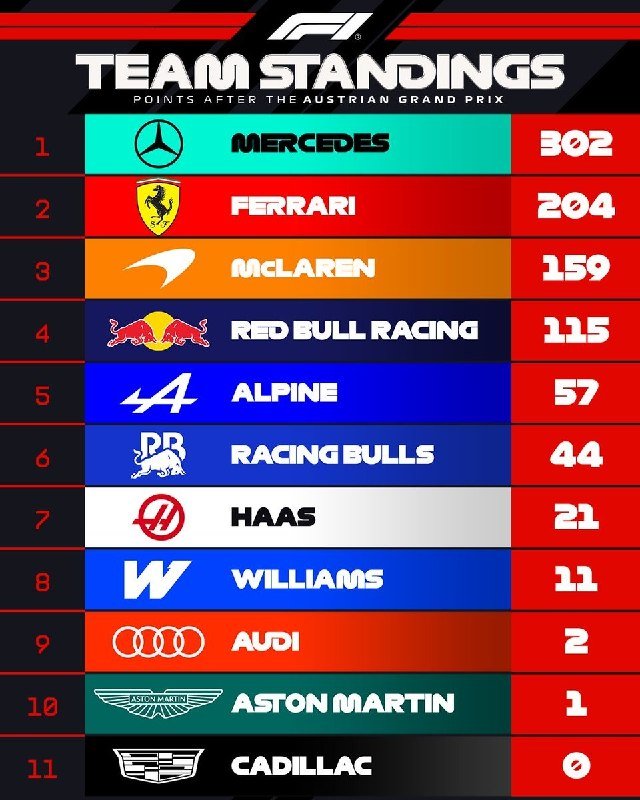
The Austrian Grand Prix grid will be set by a name that, two seasons into his top-flight career, is still being measured against the weight of expectation that comes with being fast-tracked into a Mercedes race seat. Andrea Kimi Antonelli took pole at the Red Bull Ring on Saturday 27 June 2026, ending Q3 with a lap of 1:07.083 — 0.176 seconds clear of Lando Norris and 0.207 seconds clear of Lewis Hamilton, according to timing data circulated by Formula 1's official channel. Max Verstappen, the home crowd's reference point and the driver whose name still anchors Red Bull's title ambitions, ended the session fourth at 0.324s and, more consequentially, did not set a representative final time after a late off that the same channel described as "the dramatic moment that ended Max Verstappen's Q3."
The result is a qualifying snapshot, not a championship verdict. But it lands on a circuit that has historically done Red Bull's heaviest lifting in the Verstappen era, and on a weekend where the grid order tells a slightly more interesting story than the headline times suggest. The question is no longer whether Antonelli is quick. The question is whether the structural advantage Red Bull has long enjoyed at Spielberg — high-altitude, low-degradation, power-sensitive layout — is being matched, lap by lap, by a Mercedes that no longer looks like a project in recovery.
What the timing screen actually showed
The Q3 order as released by Formula 1 put Antonelli on top, Norris alongside, Hamilton third, Verstappen fourth and Isack Hadjar fifth at 0.325s. The margins are tight in a way that is now characteristic of the 2026 regulatory package — three drivers within two-tenths, a fourth within three — and they reset the conventional reading of the Red Bull Ring. The circuit's combination of short lap, heavy braking zones and a long straight back through the final chicane has, in past seasons, rewarded Red Bull's chassis balance and Verstappen specifically. On this evidence, that reward is no longer automatic. Verstappen topped the first sector on the initial push in Q3 before Norris took to the track first at the head of the pack, but the sequence of mini-sectors does not change the column that matters: when the chequered flag fell on Q3, Antonelli's name was at the top.
The Verstappen problem, in two parts
There are two readings of Verstappen's session and they are not mutually exclusive. The first is the obvious one: he made a mistake on a lap that mattered, and the wall paid him a bill. Formula 1's channel carried the footage of the off with characteristic understatement. The second is the structural one. Verstappen has won three drivers' titles in this car generation and the assumption, held inside the paddock for most of the hybrid-era rules cycle, has been that the Red Bull Ring compresses that advantage into something close to certainty. Saturday suggests otherwise. Even if Verstappen had banked his opening banker, he would still have started behind Antonelli on the timing screen, and behind Norris and Hamilton as well. The qualifying deficit is small enough to be recoverable in race trim — Verstappen has made a career out of recovering from second-row starts at circuits where tyre management and clear air matter more than grid position — but the direction of travel is the part Red Bull's engineers will be reading more carefully than the result.
A wider pattern inside Mercedes' 2026
The Austrian pole is not an isolated data point. It follows a stretch of the season in which Mercedes has looked more coherent than at any point since the start of the new regulations, and it places Antonelli — not George Russell, not Hamilton — at the front of the timing sheet. The internal dynamic is worth noting. A team that begins a season with one designated senior and one designated protégé is, by mid-season, often asking itself harder questions about which of those labels still fits. Antonelli's lap on Saturday does not answer that question; it sharpens it. For Hamilton, the third-place finish is the kind of quietly professional Saturday that does not generate headlines but does, over a season, add up to a constructors' championship position worth defending.
What Sunday actually decides
Race day at the Red Bull Ring begins with a pole-sitter whose first job is to convert an advantage into a clean Turn 1 exit, and a chasing pack whose first job is to make sure he cannot. Verstappen's recovery drive, if it comes, will be the more heavily analysed outcome even if it finishes only second or third, because the alternative — a Verstappen win from fourth — would be the kind of result that flatters Red Bull's weekend while quietly confirming that Saturday was the anomaly rather than the pattern. The honest pre-race read is narrower: the margins in Q3 were tight enough that any of the top four could have taken pole on a different lap, and the tyre degradation picture across long runs — not visible in qualifying data — will do more to set Sunday's hierarchy than the column of sector times that ended Q3. What Saturday does establish, with reasonable clarity, is that the Red Bull Ring no longer offers Red Bull a free lap of margin. The rest is for the race to decide.
Desk note: The F1 channel's Saturday feed gave this publication the Q3 order and the Verstappen off; Monexus has read the timing screen rather than the narratives attached to it. Where this piece goes further than a wire recap is in treating Antonelli's pole as evidence about Red Bull's home advantage, not just as a sporting headline.
Wire provenance
This editorial synthesis draws on the following public wire/social posts:
- https://t.me/formula1
- https://t.me/formula1
- https://t.me/formula1
- https://t.me/formula1