Russell takes Austrian Grand Prix pole as McLaren threat looms in Spielberg
George Russell claimed pole at the Red Bull Ring while McLaren's pace in the long runs suggested the race itself is far from settled.
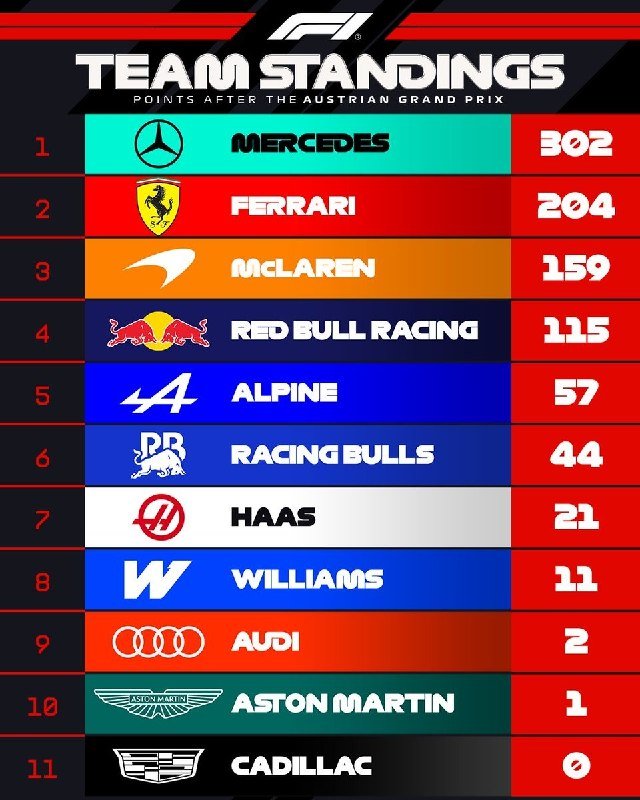
Saturday at the Red Bull Ring produced the result Mercedes needed and the storyline Formula One wanted: George Russell on pole for the 2026 Austrian Grand Prix, with the McLaren pair lurking close enough to turn Sunday's 71-lap race into a strategic rather than a speed contest. Russell's Saturday lap in Spielberg set the benchmark in a session in which margins were thin enough that one minor mistake in sector two reshuffled the top order.
The pole matters, but only up to a point. The Red Bull Ring is a circuit where qualifying position typically decays faster than the lap-time sheet suggests, because the long uphill run into Turn 4 and the heavy braking zones at Turns 3 and 9 reward cars that can manage rear-tyre temperature over a stint rather than those that merely light up the softest compound for a single lap. Sunday's race, scheduled to begin at 14:00 BST (13:00 UTC) on 28 June 2026, will reward tyre management and clean air at the first corner more than the raw Saturday pecking order.
A session decided in the second sector
Russell built his pole on a clean middle sector, the technical stretch between the two right-handers at the back of the circuit and the slow left of Turn 6. The lap that mattered most came on his second run in Q3, after a first effort had been aborted when he encountered yellow flags in the final chicane. Drivers who set their banker laps early in the session lost time to track evolution; drivers who waited too long found themselves in traffic. Russell timed neither error.
The McLaren drivers, second and third on the grid, ended within a few hundredths of a second of Russell's benchmark. The closeness of that margin is itself the story. McLaren arrived in Spielberg with a car that had been stronger in race trim than in single-lap trim at the previous two rounds, and the Saturday sheet suggests the team has narrowed that gap precisely at the circuit where single-lap pace and race pace diverge most sharply. If McLaren can stay within undercut range on lap one, the race is theirs to lose.
The session also offered an instructive footnote on the new-for-2026 aerodynamic rules. Cars at the Red Bull Ring are running lower-downforce packages than at Monaco or Barcelona, which has levelled the field in the slow corners and exposed small differences in traction out of the medium-speed right-handers. That shift is part of a wider pattern across the 2026 season: teams whose strength sat in high-downforce circuits have had to relearn tracks like Spielberg, where straight-line speed through the first sector and braking stability matter more than ultimate cornering grip.
What the long-run data suggests
Friday's long-run pace, run on the medium compound in race-simulation conditions, told a more complicated story than Saturday's qualifying column. McLaren's average race-pace delta to Mercedes over a ten-lap stint was within a tenth of a second per lap — close enough that undercut and overcut strategy will likely decide the outcome of any on-track fight. Red Bull, the home team, ran reliably in the long runs but lacked the outright one-lap pace to threaten the front row; the team's best qualifying result was in the second row of the grid, leaving Max Verstappen with work to do on Sunday if he is to convert home advantage into a meaningful result.
The strategic wrinkle is the tyre allocation. Pirelli has brought the C3, C4 and C5 compounds to Spielberg, the softest three in its range, which encourages a one-stop strategy on paper but leaves teams open to a two-stop if degradation surprises. Sunday's air temperature, forecast in the high twenties Celsius, will push the soft compound into a graining window after roughly twelve laps on the rear axle. That window is where races at the Red Bull Ring have been won and lost in past seasons, and it is the most likely source of strategic divergence between the front three teams.
The constructors' picture behind the headline
The Austrian Grand Prix sits at the midpoint of a European summer run that will define the constructors' championship. Mercedes' need for a strong result is structural rather than sentimental: the team's development tokens for the 2026 power-unit regulations are already spent, and the remainder of the season will reward operational excellence over in-season upgrades. McLaren, by contrast, brought a floor update to Spielberg that visibly improved rotation through the medium-speed corners, and there are indications the team has further aerodynamic work in the pipeline for the races immediately after the summer break.
For Red Bull, the home race is a chance to arrest a slide that has seen the team drop to third in the constructors' standings. Verstappen's record at the Red Bull Ring — multiple wins in previous seasons — sets a baseline that the car's current form may not reach. The team's strategic priority on Sunday will be to limit the damage, secure a podium if possible, and bank points that keep the constructors' fight alive into the second half of the season. Anything less than that would represent a difficult weekend for a team whose home grand prix is meant to be a showcase.
What remains uncertain going into Sunday
The biggest unknown is the weather window. Forecasts in the Alpine valleys around Spielberg are notoriously local; a convective shower mid-afternoon on Sunday would scramble the strategy calculus and elevate the driver who can read a damp track fastest. The second unknown is reliability. The 2026 power units have, across the first half of the season, proven broadly robust, but the Red Bull Ring's full-throttle commitment through the first and third sectors is the most punishing stretch on the calendar for the energy-store and MGU-K systems. Any retirement from the front row on Sunday would reshape the championship arithmetic overnight.
The third unknown is the start. Russell's pole is valuable only if he converts it off the line. McLaren's race starts have been a quiet strength all season, and the run to Turn 1 at the Red Bull Ring is short enough that a strong launch from second on the grid could neutralise the advantage of pole position before the first braking zone. Sunday's race will reward the driver who defends best on lap one, manages the rear tyres through the first stint, and reads the undercut window correctly. Qualifying gave Mercedes the headline. Race day will decide whether it deserves the trophy.
Desk note: Monexus framed this as a strategic preview rather than a qualifying recap, on the view that Saturday's grid at the Red Bull Ring is a less reliable predictor of Sunday's order than at any other circuit on the calendar.